


Voice of the Customer: From Listening to Impact
In every executive meeting about customer experience the same sentence comes up, with confidence: we listen to our customers. Then someone asks a simple question: what has actually changed this year because of what you heard? A short silence follows. Or an answer arrives about a score that went up in a survey, without a single decision a customer could feel.
This article follows one hypothetical case, Salma, a customer experience manager at a food-delivery app, from the day her satisfaction score dropped and nobody knew why, to the day something real changed in the app and customers were told about it. You will leave with the difference between listening, understanding and acting, with a way to define who your customers are and where to gather their voices, with tools to sort voices and set priorities, and with a test for any voice-of-customer program: did it change one decision this year?
Salma and the Score That Dropped
Salma runs customer experience at a hypothetical delivery app. In the last quarterly meeting she showed management the dashboard, including post-order customer satisfaction. The score had dropped from the previous quarter. The room went quiet. Then one manager said what everyone says at such moments: “Food quality must have got worse. We will review the partner restaurants.”
It sounded like a reasonable decision. But Salma was not reassured. She had one number, and that number does not say why it dropped. Did the food really get worse? Or did something else in the journey annoy people and find no place on the dashboard? If the company spent its effort reviewing restaurants and the cause lay elsewhere, it would have fixed the wrong thing and left the real problem bleeding.
This is the starting moment of every voice-of-customer program: a number that says something happened, and does not say what.
“Most organizations do not suffer from a lack of data, but from a surplus of measurement and a shortage of understanding.”
Where the case stands now: Salma faces a decision about to be taken on a guess. She knows she must open the door to what customers actually say, not to what the number says.
Try it now: write down the last decision your organization took because of a number on a customer dashboard. Then ask yourself: did we know the cause, or were we guessing?
Listening Is One Thing, Understanding Another
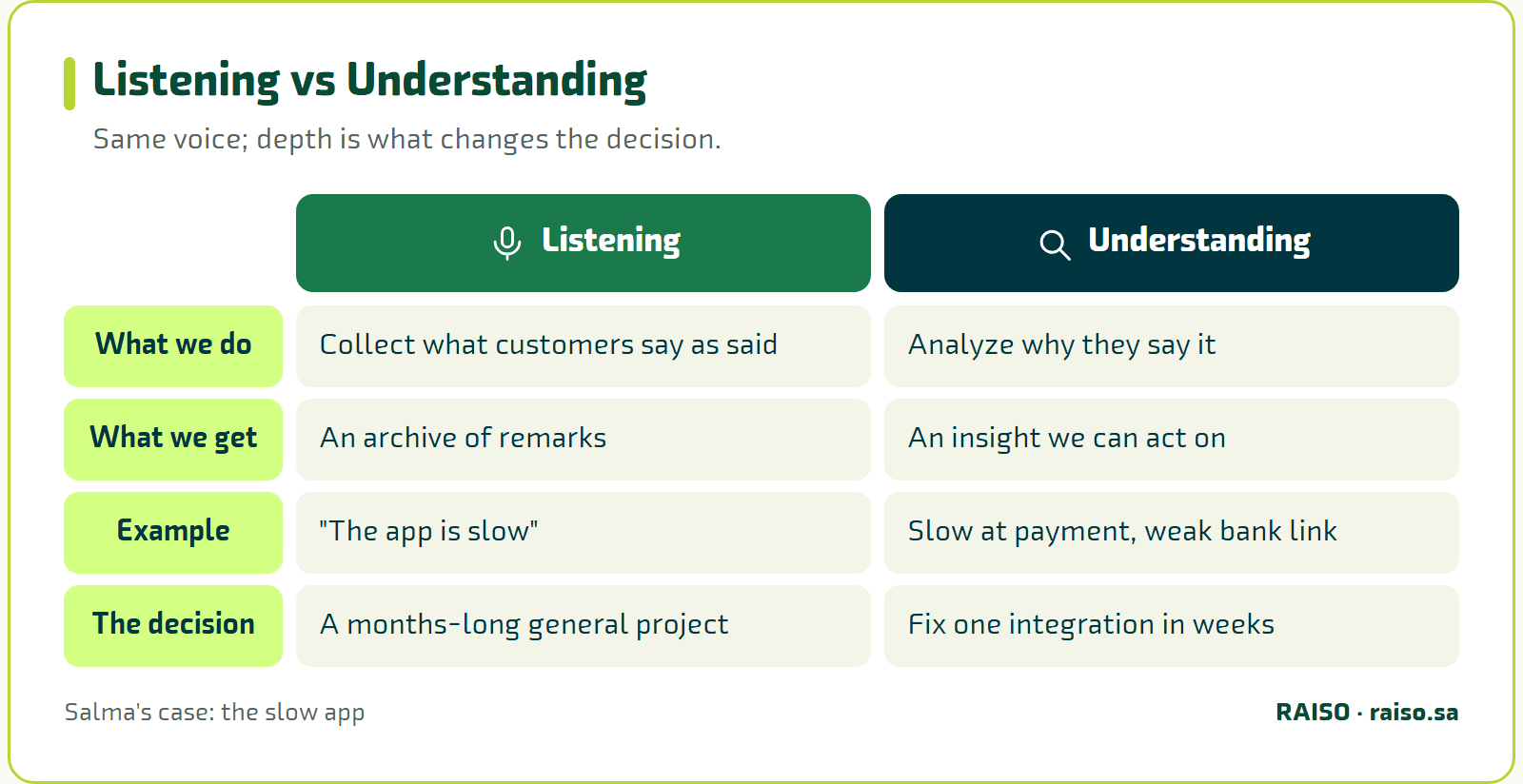
Many organizations blur two stages. The first is listening: collecting data and recording what the customer says as they said it. The second is understanding: analyzing why they say it and generating an insight you can act on. Whoever stops at listening owns an archive, not insight.
The difference is not theoretical. It changes the decision. When customers say the app is slow, that is listening. When you discover the slowness happens specifically at payment, because of a weak link with the bank gateway, not across the whole app, that is understanding. The first decision is a general improvement project lasting months. The second is fixing one integration point within weeks. The voice is the same; depth makes the difference.
Look at the wider picture. Measurement tells you the patient’s temperature has risen. The real voice of the customer is the diagnosis that says where the illness is and why. The first records the symptom; the second reveals the cause. Whoever settles for symptoms spends energy chasing numbers instead of treating roots.
This idea is not ours alone. The Customer Experience Professionals Association, CXPA Global, treats the voice of the customer as an independent competency among six for practitioners, alongside experience strategy, culture, measurement, design and practice within the organization. It describes the competency as the ability to design systematic voice collection, analyze the gaps between expectation and experience, communicate insights in a way that persuades and moves people, and prove impact: explicitly linking what was heard to what changed.
Where the case stands now: Salma asks management to postpone the restaurant review for two weeks. She says: “We have a number and no explanation for it. Give me time to listen to customers.” The manager agrees, reluctantly.
Try it now: take one customer comment from your organization, such as “the service is slow”, and write three different causes that could lie behind it. Each cause leads to a different decision, and that is the difference between listening and understanding.
The Whole Experience or Nothing
Before Salma starts asking questions, she must decide what she is asking about. Customer experience, as defined by Meyer and Schwager in Harvard Business Review in 2007, is the internal and subjective response customers have to any direct or indirect contact with an organization. Notice how wide this is: it covers thoughts, feelings, triggers, service channels and the tasks the customer performs, all together.
This leads to a simple causal frame: Y = f(x). The whole experience (Y) is the outcome of many entangled causes (X1, X2, X3 and more): process time, service cost, the competence of the provider, the technology used, the places of waiting, and dozens of other factors interacting at every moment of the customer’s journey.
The conclusion is unsettling for anyone used to the comfort of one number. If experience is a function of all these variables, then measuring satisfaction at a single touchpoint cannot tell us enough about the whole journey. A number isolated from its structure misleads more than it guides.
A second truth follows: experience is measured by its weakest link, not by its average. Imagine a journey of four consecutive touchpoints with customer satisfaction of 90%, 85%, 85% and 90%. Satisfaction with the whole journey is not the average of these figures but their product, about 60%. One weak link drags the whole journey down and wastes what the strong links built.
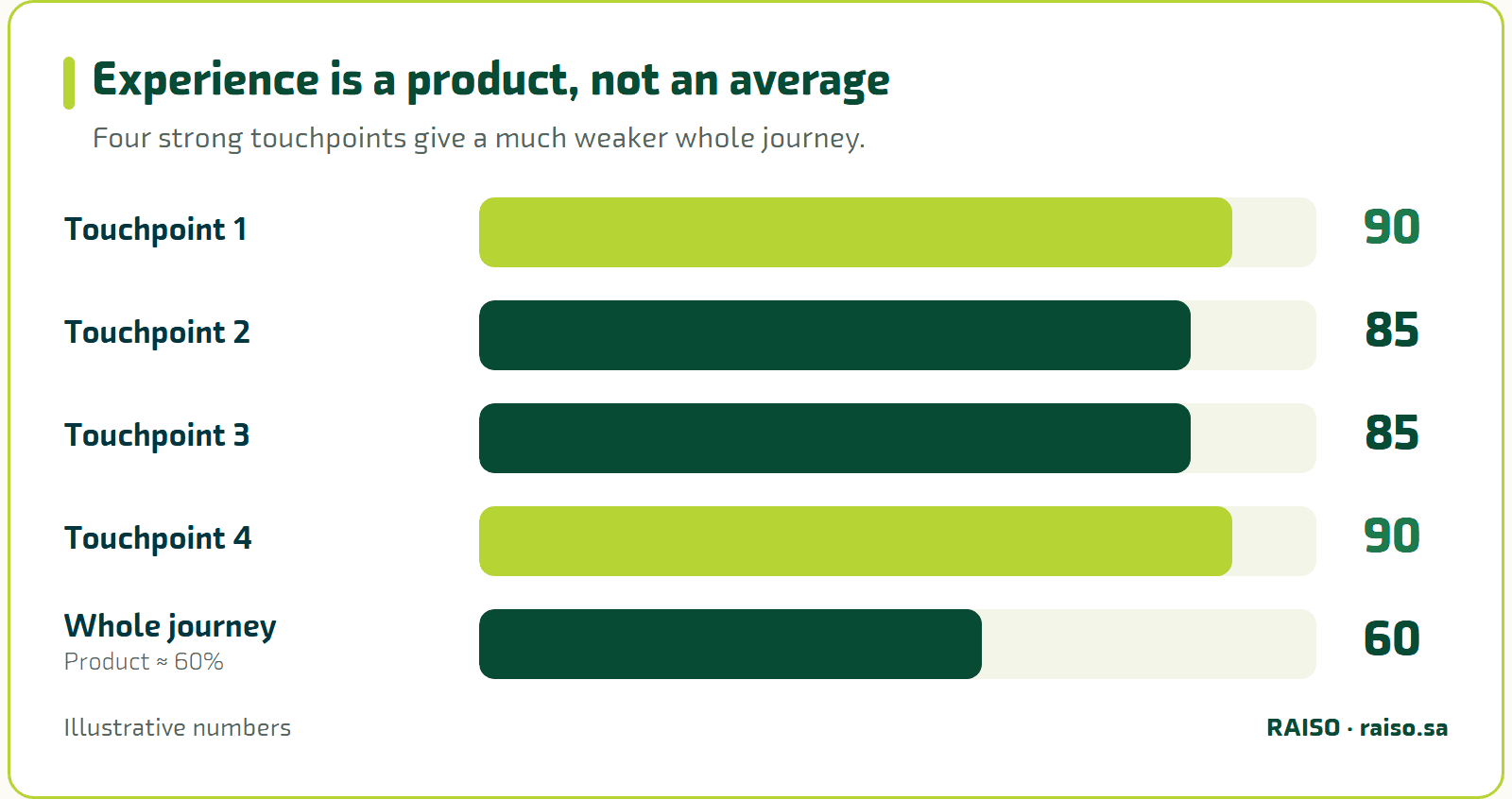
This redefines the purpose of a voice-of-customer program. We are not looking for an overall satisfaction score to boast about in a report, but for the weak link that quietly destroys value. Whoever does not understand the structure of the experience keeps improving the strong links and neglecting the one that bleeds.
Where the case stands now: Salma sketches the customer journey on paper: opening the app, choosing a restaurant, paying, waiting for the order, receiving it, contacting support. She understands that the drop in overall satisfaction may come from one link, and that reviewing restaurants treats only one link of six.
Try it now: write a customer journey in your service with five or six touchpoints. Beside each, ask: do we know satisfaction at this exact point, or only with the service in general?
Who Is Speaking? The Customer’s Identity First
Many teams make a common mistake when they start a voice-of-customer program: they design the survey before answering a simple question. Who is our customer, anyway? A survey designed before that answer asks everyone the same questions and hears an average voice that resembles nobody.
The customer is not one person. In Salma’s app there is someone ordering lunch for herself in a rush, a family ordering on Friday evening, and someone ordering for guests who worries about the arrival time more than anything. Each segment expects something different and tolerates failure differently. When we blend their voices into one average, we lose the differences that tell us what to do.
So the first step is identifying segments: who they are, what they need, how they use the service, and how large and valuable each segment is. Then comes the second practical question: whom do we hear first?
Where the case stands now: Salma divides her customers into three segments: individuals at lunch, families in the evening, and people ordering for an occasion. She decides to hear all three, since the drop may be in only one of them.
Try it now: name three segments of your organization’s customers with descriptive names, and write one sentence for each: what do they expect from us?
Collection Tools: Not All Are Equal
After identifying the customer and the segments comes the practical question: how do we collect their voices? Mature organizations know the tools are not interchangeable at random. Each has its suitable context and its limits, and choosing the wrong tool for a segment yields a distorted voice that leads to a wrong decision.
Let us review the main tools and what each is good for:
- Personal interviews
The deepest. Good when we want to understand a customer’s need and how they benefit from the service, and they uncover reasons and feelings left unsaid. Their cost in time and effort is high, so they do not suit wide-scale measurement.
- Direct observation
Shows what the customer actually does during the experience, not what they say about it. The strongest at exposing the gap between saying and doing, and good for verifying interview results.
- Focus groups
Better than interviews at revealing collective opinion and how expectations form socially. But they are draining, so they are used when needed, not periodically.
- Surveys
Faster and wider, good for measuring quantitative specifications across a large population. But they answer what, not why.
- Complaints and suggestions
A rich mine of unsolicited voices, often the most honest and sharpest, because the customer volunteered them.
A mature program does not cling to one tool. It designs a mix that covers each segment with the most suitable tool, and assigns each tool an owner, a time frame and an adequate sample size. Without that, collecting voices becomes random activity that produces noise instead of signal.
| Tool | Good for | Limit |
|---|---|---|
| Personal interviews | Needs, reasons and feelings | High cost, not for wide measurement |
| Direct observation | Exposing the say-do gap | Needs time and field presence |
| Focus groups | Collective opinion, social expectations | Draining, use only when needed |
| Surveys | Quantitative view of a large group | Answers what, not why |
| Complaints and suggestions | Honest, unsolicited voices | Only from those who spoke |
Tools are not interchangeable. A mature mix covers each segment with the right one.
Where the case stands now: Salma runs eight short interviews across the three segments, sits with the support team to hear calls, reviews written complaints from the last two months, and adds a two-question survey: what annoyed you most? What would you change? In the interviews she hears a phrase repeated in different forms: “I didn’t know where my order was.”
Try it now: for each segment you named, pick one collection tool that suits it, and write why it is the best fit and what its limits are.
From Listening to Understanding: The Journey of the Data
Now Salma holds a pile of voices, and the danger is that it stays a pile. Moving from listening to understanding needs an analytical method, and its strongest tools are three: root cause analysis, sentiment analysis of text, and linking voices to the customer journey map to discover moments of truth. A moment of truth is a decisive point that determines whether the customer stays loyal or leaves quietly.
All of it begins with the right question. Do not ask customers only about their satisfaction. Ask: why did you not complete the order? Why did you call support although the app exists? The question why is the true gateway to understanding. A survey that does not ask it collects mute numbers that lead to no decision.
Take an example close to what Salma saw. A drop in the satisfaction score of a delivery app does not necessarily mean the food got worse. The customer’s voice may reveal the cause is a lack of clarity about order status. The customer does not know where the order is or when it will arrive, and this worry turns into a negative rating of the whole experience. Had the company fixed food quality in response to the number alone, it would have fixed the wrong thing.
That is what Salma found. She linked the voices of the three segments to her journey and placed each complaint at its point. Complaints clustered at two points: after payment, when the customer cannot clearly see the order’s status, and at payment itself, when confirmation is delayed for some orders. Food quality sat at the bottom of the list.
Where the case stands now: She now has an explanation instead of a guess: unclear order status after payment, and delayed confirmation at payment. And she has a sentence for the manager: “Do not review the restaurants now. They are not the reason for the drop.”
Try it now: take five real complaints from your organization. For each one ask “why?” five times, until you reach a cause that can be fixed. What changed in your understanding of the complaint?
The Kano Model: Sorting Voices and Setting Priorities
Salma now faces a long list: status clarity, payment speed, clearer messages, more options, map tracking, small surprises. Where to start? Here the Kano model helps. The Japanese professor Noriaki Kano developed it in 1984 to classify customer wants by their relation to two axes: the level of performance and the level of customer satisfaction. It reminds us of an important truth: not every piece of feedback is equal in value.
The model divides what customers want into three kinds:
- Basic needs
Things the customer expects automatically without mentioning them. Their absence causes strong dissatisfaction and may drive the customer away, but their presence brings no delight, because they were taken for granted.
- Performance requirements
Linked directly to satisfaction: the better the performance, the higher the satisfaction, and the lower it falls, the lower the satisfaction. Like internet speed in a hotel, or waiting time in a hospital.
- Delighters
What the customer did not expect at all. Their presence creates delight and doubled loyalty, and their absence causes no dissatisfaction, because they were never expected.
The real value of the model is in setting priorities. An organization that neglects a basic need while investing in a delighter offers a flawed experience that the sparkle of surprises cannot rescue. And one that masters only the basics will not create the unforgettable experience that builds loyalty. Remember too that the classification is not fixed: what delights today may become a basic need tomorrow, once the market gets used to it.
| Type | If present | If absent | Example |
|---|---|---|---|
| Basic needs | No delight, it is expected | Strong dissatisfaction, may leave | Order arrives intact |
| Performance requirements | Satisfaction rises with performance | Satisfaction falls with it | Hotel internet speed |
| Delighters | Delight and doubled loyalty | No dissatisfaction, not expected | An unexpected small surprise |
Priority goes to basics first, then performance, then delighters.
Where the case stands now: Salma classifies her list. Order-status clarity is a basic need: the customer expects it without asking. Payment speed is a performance requirement: the faster it is, the higher the satisfaction. Map tracking is a lovely delighter, but it will not repair a basic gap. So she orders the priorities: basic first, then performance, and only then thinks about delight.
Try it now: write ten remarks you have heard from customers and put a letter beside each: B for basic, P for performance, D for delighter. Which should come before the others?
From Understanding to Action: Kaizen, Six Sigma or Design Thinking?
Having insight is one thing; turning it into action is another. Here lies the real test of a voice-of-customer program: what matters is not the voices you collected, but the decisions you took because of them. Institutional intelligence shows in choosing the right method for the nature of the voice and the depth of the problem, not in applying a single method to everything.
Kaizen suits quick, simple improvements. When the voice reveals that an automatic message is unclear, or that a button in the app confuses users, no large project is needed. The thing is improved at once and its effect observed.
Six Sigma suits repeated, complex problems that need quality control and statistical analysis. When errors in customer invoices keep rising, or complaints from a particular channel recur, we use the DMAIC path: define the problem, measure it, analyze its roots, improve it, and control it.
Design thinking is what we turn to when the insights show the problem is deeper than a faulty procedure and the whole experience needs redesign. When customers say that requesting a government service end to end is confusing and exhausting, the answer is not improving a form but designing a new journey that starts from real empathy with the customer.
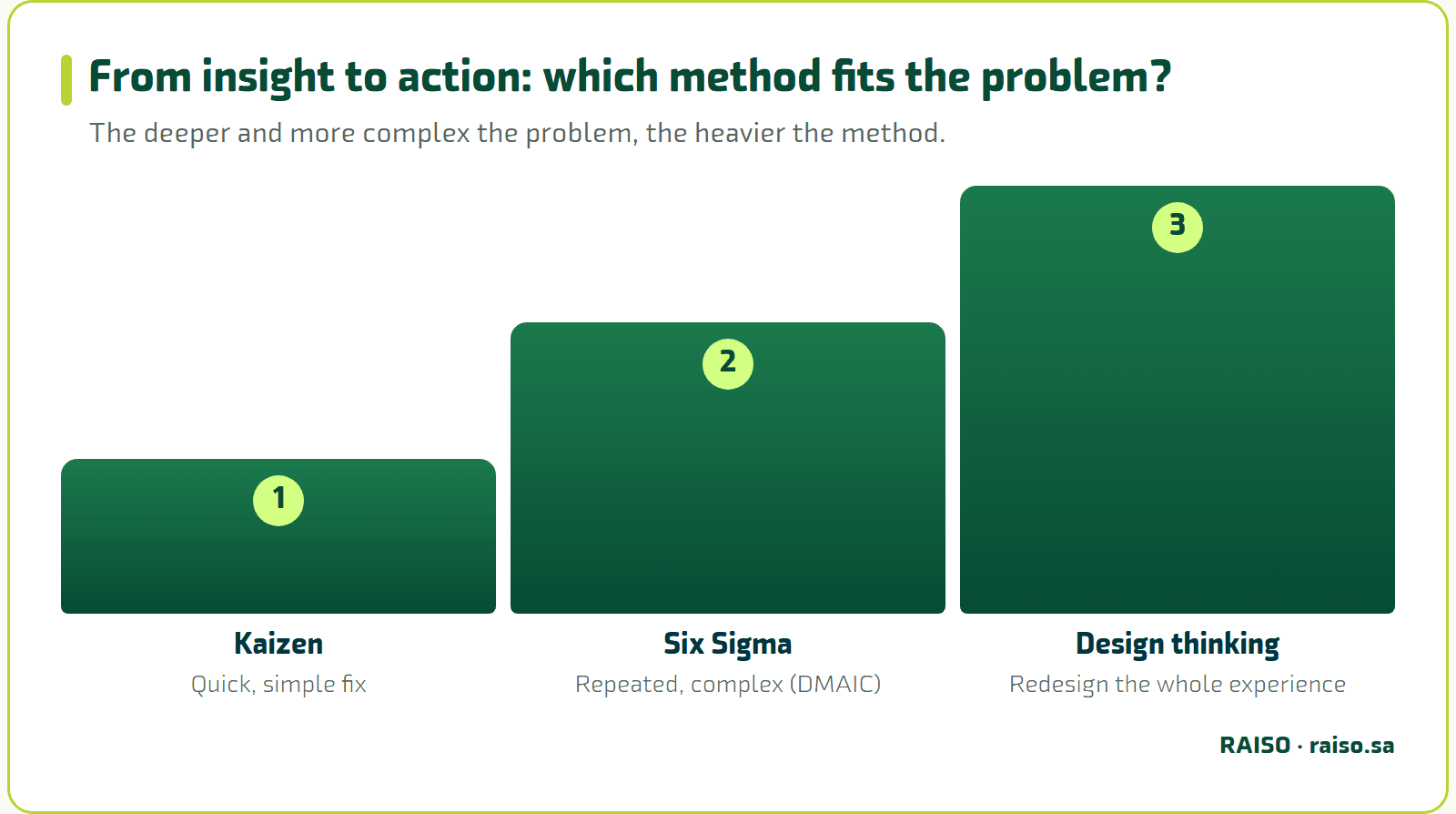
Where the case stands now: Salma spreads the list over three tracks. The order-confirmation message is vague, so that is Kaizen: reworded within days. Payment confirmation delays recur for some orders, so that is Six Sigma: a short DMAIC project with the technology team to find the cause of the delay in the link. And the customers’ feeling of being “lost” between payment and delivery is deeper, so she opens a design-thinking workshop with the product team to redesign that stage of the journey.
Try it now: take three customer voices from your organization and decide the best method for each: Kaizen, Six Sigma or design thinking. Write one reason for each choice.
The Successful Program: Methodology, Analysis and Response
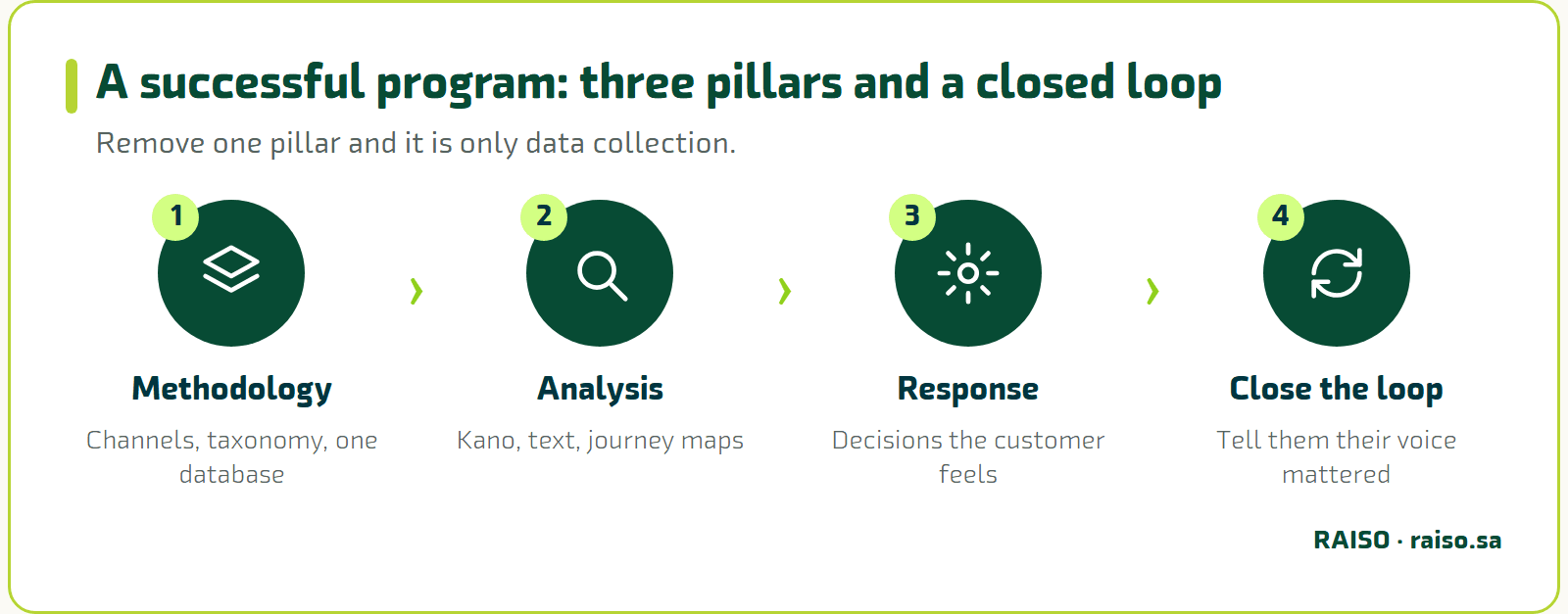
What distinguishes a successful voice-of-customer program from a periodic data-collection activity? Three pillars, without any of which it does not stand, and the absence of one turns the whole program into effort without harvest.
The first pillar is methodology. It is the institutional framework that decides how the organization receives its customers’ voices regularly across several channels, then classifies and documents them by clear criteria. It includes a map of receiving channels in which no source is lost, a unified policy for classifying remarks in one language across the organization, and a central database that gathers all voices in one place.
The second pillar is analysis. It turns raw data into insights that can be applied, through quantitative and qualitative analysis together. It covers direct and indirect voices, the Kano model for ordering priorities, text and sentiment analysis to grasp what lies behind words, and journey maps that tie a voice to its place in the experience.
The third pillar is response. It is the decisive stage in which insights become decisions. Its success is measured by an actual change the customer feels, and then by communicating with them so they know their voice made a difference. It includes quick Kaizen improvements, Six Sigma projects for complex problems, and new solutions through design thinking.
What completes the program is closing the feedback loop: telling the customer their voice was heard and that a change happened because of it. This act alone strengthens loyalty and encourages the customer to keep taking part, and it turns the program from cold data collection into a real two-way conversation.
Where the case stands now: Six weeks later a clear order-status bar appears in the app after payment, and the integration point that delays confirmation is fixed. Salma sends a short message to the customers who complained: “You told us you did not know where your order was. We added a status bar. Thank you for telling us.” The score rises the following quarter, and this time the team knows why.
Try it now: write the text of a short message that closes the loop with a customer or a segment: what did they say? What did we do? What changed for them?
What You Take With You
Remember where we began: the sentence “we listen to our customers” and a question about what changed. Salma can now answer. The order-status bar changed, payment confirmation time changed, and the confirmation message changed. Every one of these changes can be tied to a specific voice, from a specific segment, at a specific point in the journey.
If five ideas stay with you from this article, let them be these:
- Listening is collecting, understanding is analyzing causes, and impact is a decision the customer feels. Do not stop at the first.
- Experience is measured by its weakest link, so look for the link that bleeds, not for an average that comforts you.
- Define who your customer is and the segments before designing any tool, and give each segment its most suitable tool.
- Order voices with the Kano model, and start with the basic before the delightful.
- Choose the method by the voice: Kaizen for the quick, Six Sigma for the recurring, design thinking for the whole experience. Then close the loop with the customer.
The question we leave with you is the question of the whole article: what is the evidence that the customer’s voice influenced one decision in your organization this year? If you find an answer, build on it. If not, start with Salma: take one recurring voice, understand its cause, change one thing, then tell the customers. And if you want to go deeper into building a complete voice-of-customer program, we invite you to explore RAISO’s customer experience course and apply it to a real case in your organization.