



Policy Governs, Procedure Moves: Why We Keep Them Apart
In every workshop that brings compliance officers and systems developers together, the same question surfaces, and it sounds simple: do we merge policy and procedure into one document, or keep them apart? One camp says merging simplifies, cuts the number of files and puts the whole picture in front of the reader. The other says separating tightens governance and gives each document its identity. Between the two camps, many organizations swing back and forth, merging here and separating there, with no philosophy behind their choices.
This article takes a clear position: separating policy from procedure is not a cosmetic arrangement of files but a decision in document engineering that affects operating flexibility, audit integrity and the ability to grow. We follow one case from start to finish to see what happens when the two are merged, and what changes when they are separated. You will leave with three gaps that merging creates, one question that settles every case, and steps to separate a merged document without losing any of its controls.
Lama and a thirty-eight-page document
“You will follow Lama and the merged “Procurement Policy and Procedures” document. In each section a new problem appears, we see how separation solves it, and what changes in Lama’s situation. At the end she places the two situations side by side.”
Lama is compliance manager at a hypothetical company with branches in Riyadh, Jeddah and Dubai. Two years ago the company issued one document titled “Procurement Policy and Procedures,” thirty-eight pages. At the front are the principles: best value for cost, transparency in awards, and prevention of conflicts of interest. In the rest are the steps: how bids are received, how evaluation committees are formed, which forms are filled, and how minutes are recorded.
Merging was a comfortable decision when it was made. One document meant one file, one reference, one review. Lama felt that day she had done tidy work. Then months passed, and with them things began to move in the company. Three events took place in a single year, and from each Lama learned something she did not expect.
The first: the procurement manager wanted to replace paper bid receipt with an electronic platform. The second: an external auditor visited the company. The third: the Dubai branch asked to apply the document in a way that fit its local systems. These three events are the subject of the sections that follow.
“Lama, the company and the numbers here are written for illustration only and do not refer to any real entity.”
“Five minutes, now: open a document in your organization titled “policy and procedures” or “policy and controls.” Mark in red every sentence that changes when tools or people change, and in blue every sentence expressing a principle that will not change. What is the proportion of each color?”
Untangling the concepts: fixed and changing
Before we judge Lama’s document, we need to know what we are merging or separating. Much of the debate over merging and separating comes from blurred concepts, not from a genuine difference of opinion. When the boundaries of policy and procedure tangle in the minds of those who write them, the debate has no common ground.
Policy: the compass of intentions
A policy is a governing document that represents the will of the board or senior leadership. It answers only two questions: what does the organization want, and why? It draws red lines, defines authorities, and fixes principles that are not up for negotiation, such as integrity, safety and protection of assets. It changes only when strategic direction or external regulation changes. Its essential trait is stability.
Procedure: the guide for movement
A procedure is the field translation of policy. It answers operational questions: how, when, by whom, and in what sequence? It is not limited to steps inside an electronic system but includes complex human steps such as negotiation methods, field inspection practices and decision criteria in committees. Its essential trait is dynamism, meaning movement and change.
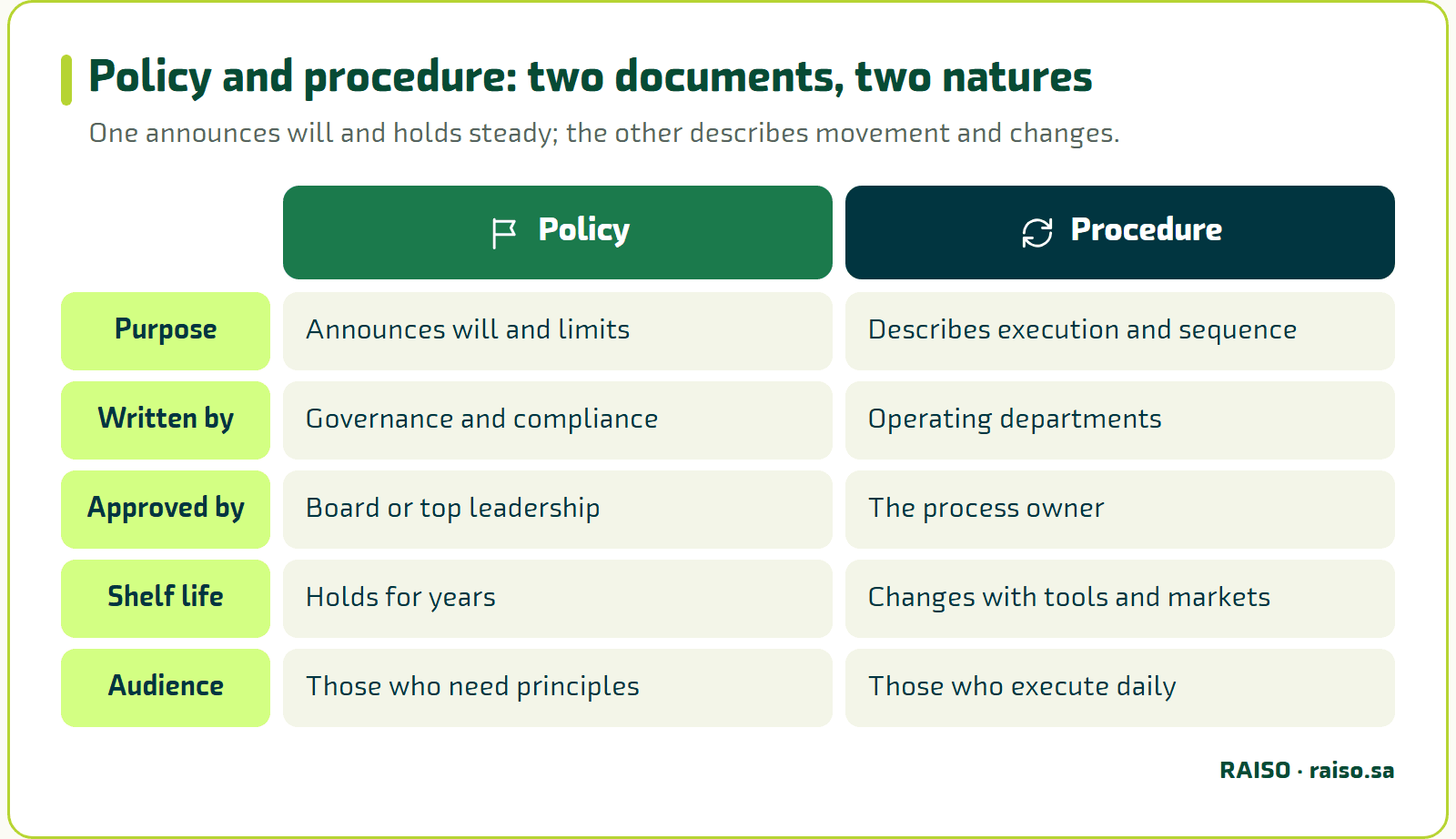
This distinction between stability and dynamism is the starting point for everything that follows. When we put two documents of opposite natures into one template, we do not simplify, we create a chronic structural tension that surfaces whenever one side needs to change. The difference extends to every practical detail:
- Purpose: policy announces will and limits; procedure describes execution and sequence.
- Who writes it: policy is written by governance and compliance units; procedure by operating departments.
- Who approves it: policy is approved by the board or top leadership; procedure by the process owner or executive manager.
- Shelf life: policy holds for years; procedure changes with tools, markets and structure.
- Audience: policy is for whoever needs the principles and limits; procedure is for whoever needs daily execution.
“In the case now: Lama reread her document with two pens. She found that only three pages carried principles that would never change, and that thirty-five pages were steps, forms and tables that shift. She realized she had been carrying, in one file, two documents living at two different rhythms.”
“Split a document you know into two columns: what changes twice a year or more, and what changes only when direction changes. How big is each column?”
The first gap: mismatched lifecycles
Back to the first event. Six months after the merged document was issued, the procurement manager decided to replace paper bid receipt with an electronic platform. This change requires updating the steps for receiving bids, the ways requirements are verified, and the supplier evaluation forms. All of them are purely executional details touching no principle and no control.
What happened under the merge? The manager discovered that this simple procedural amendment required amending the parent document, which meant reactivating the policy’s entire lifecycle: the review committee, then the executive manager’s approval, then the board. What could have been done in days took eleven weeks, because an operational step had been placed where it does not naturally belong.
This is what we call lifecycle mismatch: tying two documents with radically different lifecycles into one entity. Policy is long-lived, designed to settle. Procedure is short-lived, changing with work tools, the market and structure. When you merge them you shackle the moving document with the chains of the fixed one, and impose the rhythm of the fixed on the changing.
The effect goes beyond administrative annoyance. When employees and managers find that every small improvement hits the wall of higher approvals, initiative dies slowly. Everyone learns to wait rather than improve. Over time outdated documents pile up, no longer describing reality, and no one is keen to begin their long update path.
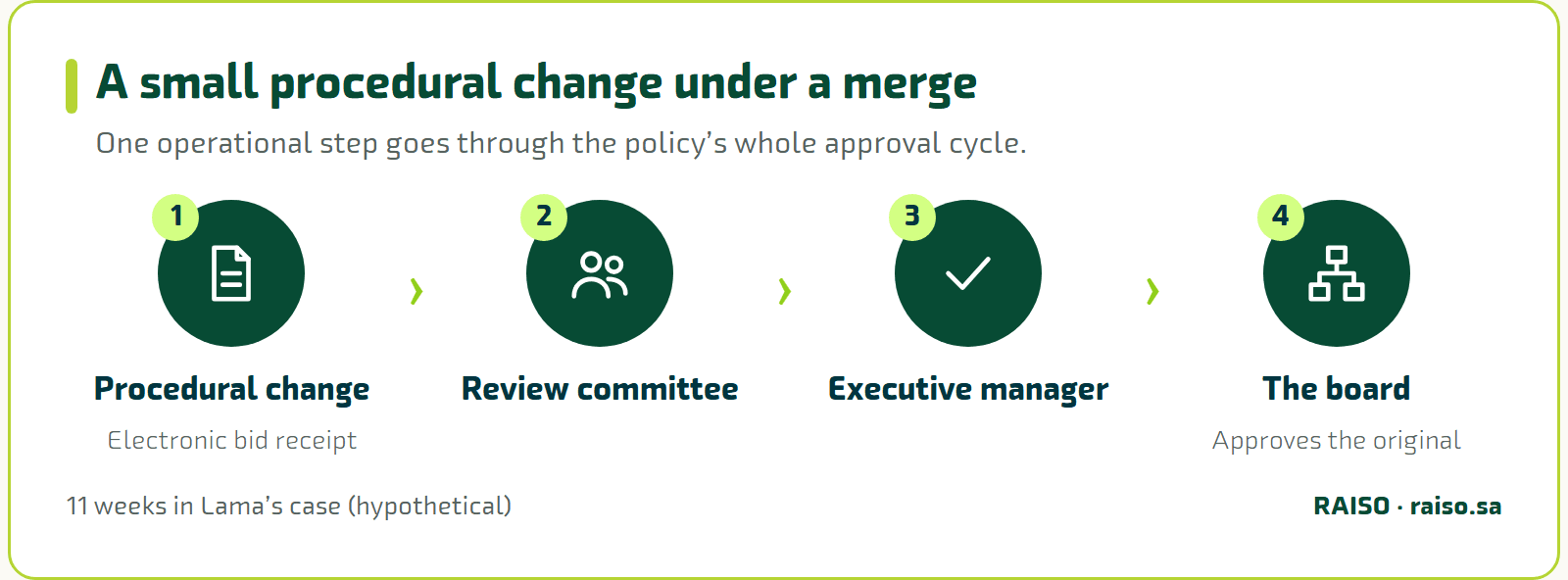
Separation solves the problem quietly: each document lives in its natural cycle. The procedure moves at the speed of operations, the policy at the speed of strategy. Each has its own rhythm, approvals and owner, so neither shackles the other.
“In the case now: Had Lama separated the two documents, the platform amendment would have ended with the procurement manager’s signature in four days, and the policy the board approved would have stayed as it was. As it is, eleven weeks passed, and the suppliers were waiting for the platform.”
“Name the last small procedural change in your organization. How long did its approval take? Who had to sign? Did any of them truly need to?”
The second gap: the audit scope trap
The first gap touches efficiency. The second touches something more sensitive: the organization’s audit and legal standing. It is, plainly, the most important argument for compliance officers and executives, because it concerns risks recorded in official reports that affect the organization’s standing.
When the auditor arrives, internal or external, he examines the approved documents to verify that controls exist and are effective. Under separation the answer is easy: yes, here is the policy. A focused document proving the controls exist without drawing the auditor into daily execution detail.
Under a merge what we call the audit scope trap occurs: when you fold procedural detail into the approved policy, you unintentionally give the auditor the right to hold the organization to account for a small step with the same severity as for a great principle.
This is what happened to Lama in the second event. Her merged document states that supplier bids are sent by registered mail. But the company moved to the electronic platform before the document was updated, because the update was still stuck in the approval cycle. The auditor came and noted it in his report: a violation of the approved policy.
Consider the difference. Under separation this would have been merely an internal procedure not yet updated, easily justified as an improvement in progress. Under the merge it became a documented policy violation in an official report. The act is the same, but the layer in which the text sat changed the judgment on it.
“When you fold procedural detail into the approved policy, you do not simplify the document, you raise every small step to the level of a principle that is held to account.”
Separation draws clear boundaries for the scope of accountability. The external auditor assesses the policy, and procedures remain an internal matter subject to internal audit and continuous improvement without formal consequences for each amendment. In this way the severity of accountability fits the importance of what is judged, which is the essence of sound audit.
“In the case now: Lama went into a meeting with the auditor to explain why the registered mail had not been updated. She spent an hour defending a step that was never a principle. She told herself: if this were in a separate procedure, our talk would have been ten minutes about improvement, not an hour about a violation.”
“Open a merged document in your organization and find a procedural step that has actually changed in the work. If an auditor visited today, how would he classify it?”
The third gap: central principle, local execution
When an organization grows and expands, with branches in different cities, sectors of different natures or operations under multiple legal systems, there arises the question every governance officer faces: how do I ensure the organization’s values and principles are one everywhere, without shackling each branch to a single way of executing that does not suit its environment?
The only possible answer: central principle, local execution. And this is achieved only through separation. The organization issues one unified policy (a global policy) that imposes principles, controls and red lines on all branches without exception. At the same time each branch or department is left to write its local procedures that translate these principles into steps fitting its environment, tools and legal requirements.
This is what Lama faced in the third event. The Dubai branch asked to apply the document, but its written steps are designed around the Saudi market’s systems and forms. Lama had only two options, both costly: keep the document as it is, so Dubai works outside it and becomes a violator, or issue a special version for Dubai, so versions multiply and principles drift apart.
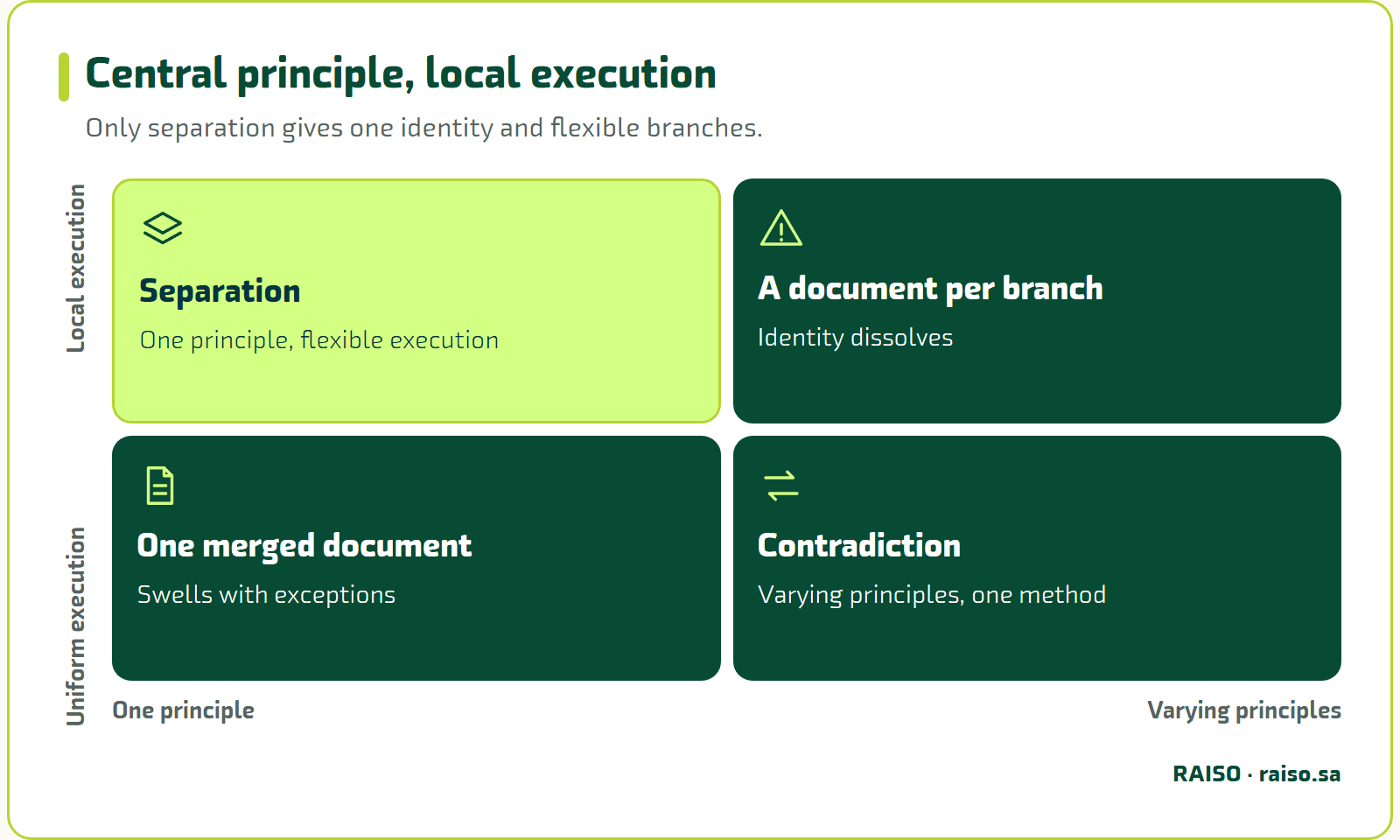
A company with branches in Riyadh, Jeddah and Dubai cannot bind everyone to the same supplier-handling steps word for word, because systems and markets differ. But it can fully bind them all to the principle of transparency and the avoidance of conflicts of interest. The first is a procedure that takes shape by environment, the second a policy that does not budge. This way unity of identity meets flexibility in application.
Under a merge this balance becomes impossible. Either one detailed unified document that tries to cover every environment, swells with exceptions and no one reads to the end, or different documents for each branch that dissolve the governing identity of the organization. Separation alone breaks this false choice.
“In the case now: Lama drew a triangle on the whiteboard: at the top one policy for all branches, beneath it three procedures, one per branch. She told her team: the same principle in Riyadh, Jeddah and Dubai, and the road differs. Everyone grasped the idea in a minute.”
“Write one principle in your organization that must be the same everywhere, and one step that can differ between branches.”
What international frameworks and psychology say
After these three events Lama asked a sharp question: is this just our view, or do the well-known frameworks say it too? What she found is that separation is not a matter of preference but an original structure in the standards themselves. Then she found another argument of equal weight, the nature of the people who read these documents.
ISO and the Annex SL structure
The structure on which recent editions of ISO standards are built, called Annex SL, clearly distinguishes the policy level, as a commitment from top leadership expressing the organization’s direction, from the procedure level, as the operational detail that translates this commitment. This separation is not a recommendation in the margin of the standard but part of its very structure, on which the other requirements are built.
The COSO internal control framework
The COSO framework distinguishes between levels: the control environment at the level of senior management, and control activities at the operating level. Policies live at the first level, procedures at the second. The framework warns against mixing the two levels, because that weakens clarity of accountability, complicates internal assessment and confuses whoever tries to read the control system.
And many large organizations with mature document systems work in two layers: a policy layer issued by governance units and approved by top leadership, and a procedure layer issued by operating departments and approved administratively without climbing to the governance level for every amendment. This dual model is what gives both stability and evolution.
| The gap | Under a merge | Under separation |
|---|---|---|
| Mismatched lifecycles | A small procedural change goes through committee, executive and board | The procedure changes with the process owner’s approval in days |
| The audit scope trap | Procedural detail is held to account as approved principle | The auditor assesses the policy; the procedure stays operational |
| Central vs local | A swollen document, or documents that dissolve identity | One principle and procedures that fit each branch |
What happens under a merge, and what separation changes.
Compliance fatigue and blurred ownership
So far we have spoken of structures. But documents are written by people, read by people, and followed or ignored by people. When an employee opens a long merged document that combines principles with details with every possible exception, something natural happens: he stops reading before the middle. This is what we call compliance fatigue: when the employee realizes he will not absorb all of this, he decides without awareness not to try, and returns to what colleagues say by word of mouth.
Separation produces two smaller, more focused documents. The policy is read by whoever wants principles and limits, the procedure by whoever wants execution. Each person reads what concerns him, and can absorb what he reads. Compliance turns from a burden into a practice that is possible.
There is another question the merged document raises: who owns it? Who is responsible for updating it? Who is held to account when it is breached? This vagueness weakens accountability and makes updating a duty no one is keen on, so the document hangs between departments. Separation fixes ownership: the policy is issued and owned by top leadership, the procedure owned by the executive manager of the process. Each side answers for its document and takes care to keep it alive.
“In the case now: Lama asked eight employees when they had last read the merged document in full. Not one said he had. She asked who owns it, and three pointed to three different people. Then she understood that her problem was not drafting, but that one document was being loaded with roles it cannot bear.”
“Ask five employees: when did you last read such-and-such document in full? And who owns it? Record the answers without comment.”
The hidden cost of merging
Merging is often presented as the economical option: fewer files, fewer procedures, less complexity. But when the cost is counted over the document’s life, the equation flips, and what looked like savings at the start turns out to be a deferred debt that accumulates.
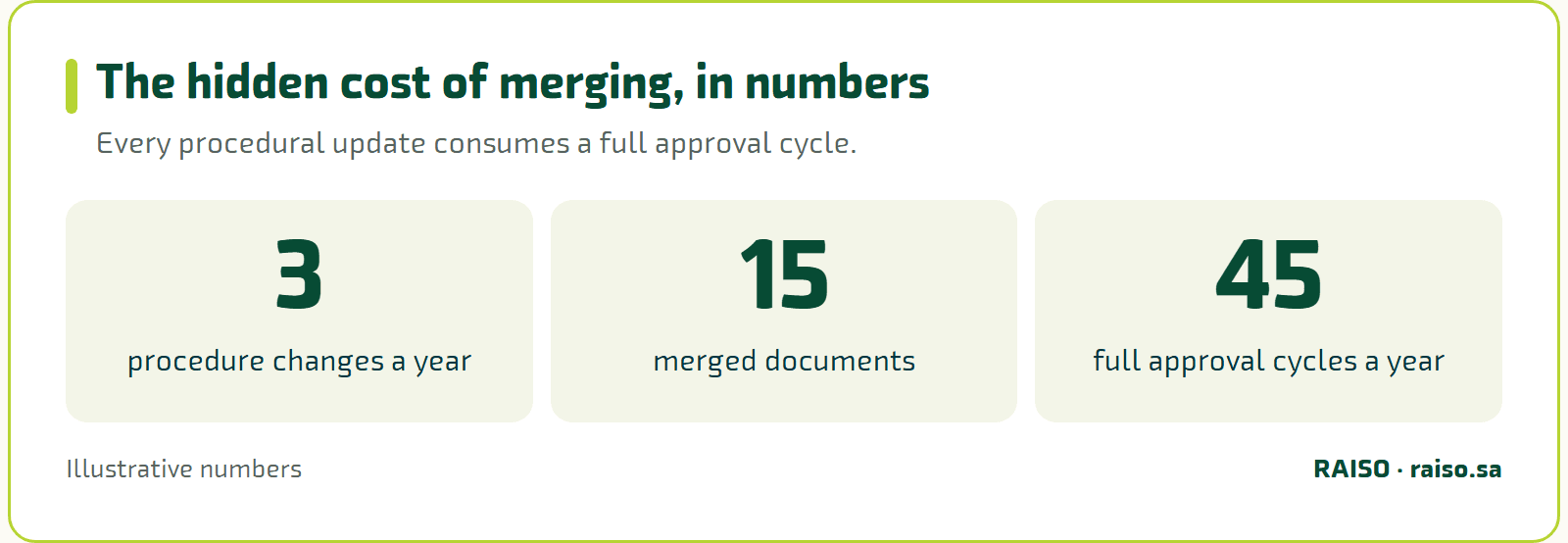
Under a merge every procedural update, however small, consumes a full approval cycle: a committee meeting, circulating a draft, waiting for approvals, issuing a new version, informing everyone. If a procedure changes three times a year, a normal rate in modern work environments, that is three full approval cycles for a single document. And if the organization has fifteen merged documents, it is forty-five cycles. This cost does not show in the budget, but it drains leadership time and team energy.
And when updates become costly people stop making them. Documents stay old, and employees learn to ignore them and work from knowledge passed on by word of mouth. Over time document debt builds up: a widening gap between what documents say and what happens in operations, until the system loses its credibility as a reference.
Separation keeps documents alive because it makes updating easy and cheap. A procedure is updated whenever need arises without disturbing governance levels. So documents stay close to reality, and documentation remains an asset to rely on, not a burden to avoid.
“In the case now: Lama counted how many times procurement steps had changed since the document was issued. Four times, and three of them were actually made in the work without entering the document, because no one wanted to start a new approval cycle. Lama saw that her document had gone stale before its second birthday.”
“How much changed in one procedure in your organization during a year? And how much of it entered the document? The difference between the two numbers is your document debt.”
When is merging acceptable?
The rule in this thesis is separation. But sound governance does not mean rigidity in every situation, and every rule has narrow exceptions that do not cancel it but confirm it. The skill is in knowing the limits of the exception so that it does not become an excuse.
Startups in their early stages
When the structure is flat, the manager is the executor and speed is the top priority, merging can be accepted for a time. But with growth and more layers, separation becomes a necessity. And the smart startup separates from day one, because building the right habit early costs far less than restructuring later under the pressure of growth.
Zero-tolerance instructions
And there are cases where the method of execution is an inseparable part of the principle itself. The steps to evacuate a building in a fire are an example: there is no room for local judgment. Here the policy is the procedure, and the steps are the principle. In these very narrow cases (zero-tolerance procedures) merging is acceptable and even advisable.
The test in both cases is a single question: does changing the method of execution change the principle itself? If the answer is yes, merging is acceptable. If no, separation is required. With this one question the leader settles each case without confusion.
“In the case now: Lama applied the question to every clause in her document: does changing this method change the principle? Registered mail or platform? No. An evaluation committee of three members or five? No. Prohibition of conflicts of interest? Yes. She came out with a short list that goes to the policy, and a long list that goes to the procedure.”
“Take three clauses from a merged document and run the question on them: does changing the method of execution change the principle? Which layer does each belong to?”
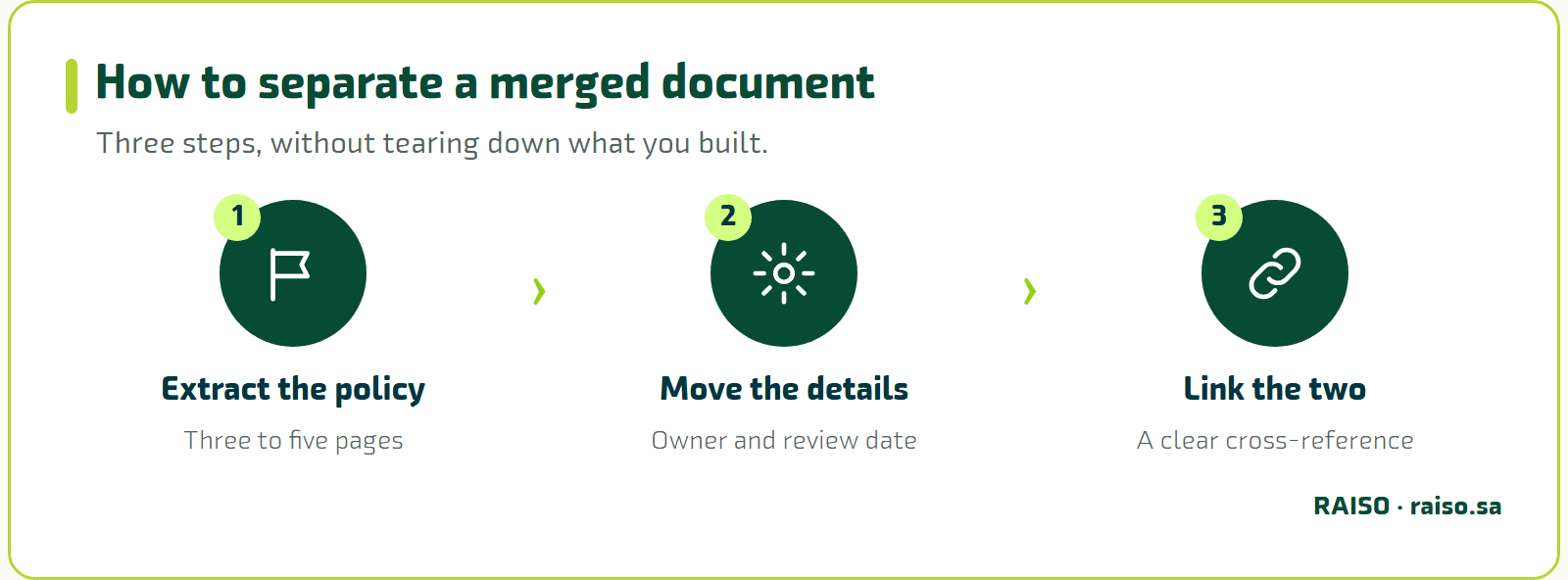
How to separate a merged document: three steps
Lama was convinced of separation, but she still had to carry it out without tearing down what she had built. She noticed it was simpler than she expected if she went in order, and that each step solves one of the gaps she had lived through.
- Extract the policy
Gather the principles, limits and authorities into a short document, three to five pages. Write it in the language of will: what do we want, and why? With not one execution step. Present it to the board once for approval.
- Move the details into procedures
Put steps, forms and roles into one or more documents owned by the process manager. Give each procedure a named owner and a review date, and a rule stating that amending it needs the manager’s approval, not the board’s.
- Link the two with a clear reference
In each procedure, a sentence saying: this procedure carries out principle such-and-such of policy such-and-such. In the policy, a list of the procedures that carry it out. This way the auditor knows where to start, and the employee knows why he does what he does.
And here appears the difference the whole thesis looks for. When the procurement manager decides to move to an electronic reverse auction, he is amending the procedure, not the policy. As long as the move achieves best value for cost and ensures transparency, it touches the policy in nothing. The amendment needs the approval of the procurement manager or executive manager, not the board, and is done in days, not months.
“In the case now: Lama now has a four-page procurement policy approved by the board, and three local procedures: one for Riyadh, one for Jeddah, one for Dubai. Two months later the Jeddah branch changed how it evaluates suppliers. Its manager approved the amendment in two days, and the board did not even learn of it, because it was not a principle. When the auditor visited the company he found the policy in five minutes.”
“Choose one merged document in your organization. Write the first sentence of the policy extracted from it, and the first sentence of the first procedure.”
Document engineering is a leadership decision
A question deeper than all the above remains: why do many organizations keep merging despite all these arguments? The answer is usually not ignorance of standards but a shortfall of vision. When document engineering is treated as a routine administrative task handed to a mid-level employee, he produces what seems logical to him: one document containing everything. When it is treated as a strategic leadership decision, the result changes.
A leader who understands that policy is the voice of the board and procedure the voice of the process manager will not allow the two voices to be mixed in one document. Not only because the standard forbids it, but because he understands that this mixing weakens the moral authority of the policy, restricts operating freedom in the procedure, and produces an organization less mature than it deserves to be. And in the context of the institutional transformation Vision 2030 organizations are living through, this engineering awareness becomes a condition for building governance able to scale.
“Sound governance does not mean shackling the organization with restrictions. It means setting a safe, clear fence within which operations move with freedom and confidence.”
The policy is that fence, and the procedure is the movement inside it. When you free your procedures from the prison of policies, you give your organization the ability to breathe, adapt and grow, while keeping its dignity, controls and credibility. Policy sets the destination and protects the organization, procedure draws the route and gets the work done, and each has its place that is not disputed.
“In the case now: Lama wrote at the end of her report to senior management: our old document was not wrong, but it loaded a moving document with the chains of a fixed one. She attached a table comparing eleven weeks with four days, and the hour she spent defending with the ten minutes. Management adopted a new rule: no new document is issued before asking: is it a policy or a procedure?”
“Write in one sentence a rule you would propose to your management for asking of every new document: is it a policy or a procedure? And who owns it?”
What do you take with you?
Six ideas that sum up the journey:
- Policy is fixed and expresses will and limits; procedure moves and describes execution. Merging puts them in one rhythm.
- The first gap: mismatched lifecycles. A small procedural amendment goes through the policy’s entire approval cycle.
- The second gap: the audit scope trap. Procedural detail inside a policy is held to account as a principle.
- The third gap: central principle, local execution. They are achieved together only by separating.
- The test for exceptions is one question: does changing the method of execution change the principle? Yes, merge. No, separate.
- Document engineering is a leadership decision, not a routine task, and begins with three steps: extract the policy, move the details, link the two.
If you return to where we began, you will see that Lama’s question was never: how many files do we have? It was: who governs and who moves? When you know the answer you know where to put each sentence, and which document needs the board and which needs a manager.
If you want to separate your documents with specialists, and build a policy layer and a procedure layer on your organization’s real documents, this is what RAISO’s policy and procedure management practice works on. Explore the practice, reserve a seat in the course linked to it, and start with one merged document that you separate in the three steps.