



Choosing a Process Modeling Tool
In most organizations the documents are there on paper: written policies, approved procedures, guides published on the intranet. Then you walk onto the floor and watch people do the task another way. No one is negligent here. The work moves every week, while the document stays frozen at the moment it was written.
In this article you will learn how to choose a process modeling tool in a way that closes this gap instead of deepening it. We follow one case from start to finish: an excellence specialist faces a tool decision and needs one she can defend before senior management and the technology team alike. You will leave with a sequence of practical steps: seeing why documentation dies, understanding a procedure as a connected family, telling two categories of tools apart, defining your purpose, scoring the options with a weighted matrix, and building the method that keeps the tool alive. Each section ends with a small exercise to apply to your own organization.
Mona and one amendment to a regulation
“You will follow Mona, an excellence specialist looking for a process modeling tool. In each section we see where she stood, what she discovered, and how that brought her closer to a decision. At the end we gather the whole decision on one page.”
Mona is an organizational excellence specialist in a mid-sized, hypothetical organization with one hundred and forty approved procedures, all in Word and PDF files on a shared folder. One morning she receives notice of an amendment to the delegation-of-authority regulation, which changes who approves financial and administrative requests. The general manager asks her for a list of every procedure the amendment touches, before the end of the week.
Mona starts opening files one after another and searching them for the words “approves” and “authorizes.” It takes nine days. When she hands in her list of twenty-three procedures, it turns out two weeks later that the affected ones were really thirty-one. Six were never opened, because their wording is “the request is submitted to the authority holder” and never uses the word approval, and two were old copies on an employee’s laptop.
Mona was not at fault. She worked with everything she had. But she discovered that a question that looks simple, which of our procedures are affected?, cannot be answered with confidence when procedures are separate files.
“Mona, the organization and the numbers here are written for illustration only and do not refer to any real entity.”
That same week the technology team makes a suggestion: we have an enterprise architecture tool, and we think your department should use it. Mona is now facing one practical question: which tool is right for my organization, so that I close this gap rather than deepen it with the wrong one?
“Five minutes, now: pick a recent regulatory change in your organization. Write how many days you needed to identify every procedure it touches, and how many you found late. That is your personal number, and we will return to it in the last section.”
When documentation dies
Think about what happened to Mona. The documents exist, approved and published. Yet they did not help when she needed them. What went wrong with them?
The problem is that procedure documents do not equal practice. Daily work moves fast, regulations change, structures shift, new systems arrive. A Word file stays as it was the day it was written. And without a tool tied to a database, it is impossible to update every document touched by the same change at the same moment. So some stay outdated, and no one knows which.
We call this dead documentation: documentation that exists legally and is absent practically. It is more dangerous than no documentation at all, because it gives a false sense of discipline. The external reviewer finds the document, management feels reassured, but the employee never returns to it because he knows it does not describe what he actually does. Each time he discovers that, his trust in the whole administrative system erodes.
And no single source of truth
Then comes a second problem that makes the first worse. Ask any employee in Mona’s organization where the approved version of a given procedure is. One will say: on the shared folder. Another: with the excellence department. A third: I have my own copy, because the original does not fit reality. So truths multiply, and each department has its own.
When this happens you cannot say with confidence: this is what the organization does. That is why one digital platform, run by a clear method, updated regularly and treated as the only official reference, is no longer an optional improvement but an operational necessity.
“Dead documentation is more dangerous than no documentation, because it gives a false sense of discipline: the document exists legally, but is absent in practice.”
“In the case now: Mona wrote two sentences at the top of her page: our documentation is dead because it does not move with the work, and our copies are many because there is no single source. She realized she is not looking for a tool that draws prettier, but one that keeps a procedure alive and the reference single.”
“Write an example your organization has lived of a procedure with more than one copy. Where is the approved copy in fact? Who knows?”
The procedure family: why a procedure never works alone
Why did Mona’s search take nine days? Because the procedure she was after is not an independent sheet. A procedure belongs to a family. It is tied to a policy, the policy is governed by a regulation or law, and both serve a strategic goal. Each procedure has roles that perform it, steps that may carry risks handled by controls, inputs, outputs and performance indicators, and sometimes technical systems it depends on. This connection is what we call the procedure family.
When the regulation changed who approves, one member of the family moved, and Mona had to know who else in the family was affected. Separate files cannot tell her that.
That is why the search for a modeling tool does not start from wanting pretty flowcharts. It starts from a real need: linking the family’s members to each other. When we use a database-driven tool we are not drawing shapes, we are building logical relationships between objects. The family shows in at least four links:
- Strategy and operations
Linking a procedure’s outputs to strategic performance indicators, so each activity an employee performs has value that feeds the organization’s goals.
- Governance and policies
A procedure is the practical translation of a policy. Without a direct link, policies become slogans, or procedures contradict the directions.
- Risks and controls
Every step may carry a risk. Advanced modeling puts the control on the step itself, which eases audit and lowers operational failure.
- Roles and responsibilities
Who performs, who reviews, who approves, who is informed at each step. This clarity prevents overlapping authority and secures accountability.
Now imagine changing a single article in a law. It may mean amending dozens of procedures. If these elements are spread across files and different systems, managing them by hand comes close to impossible.
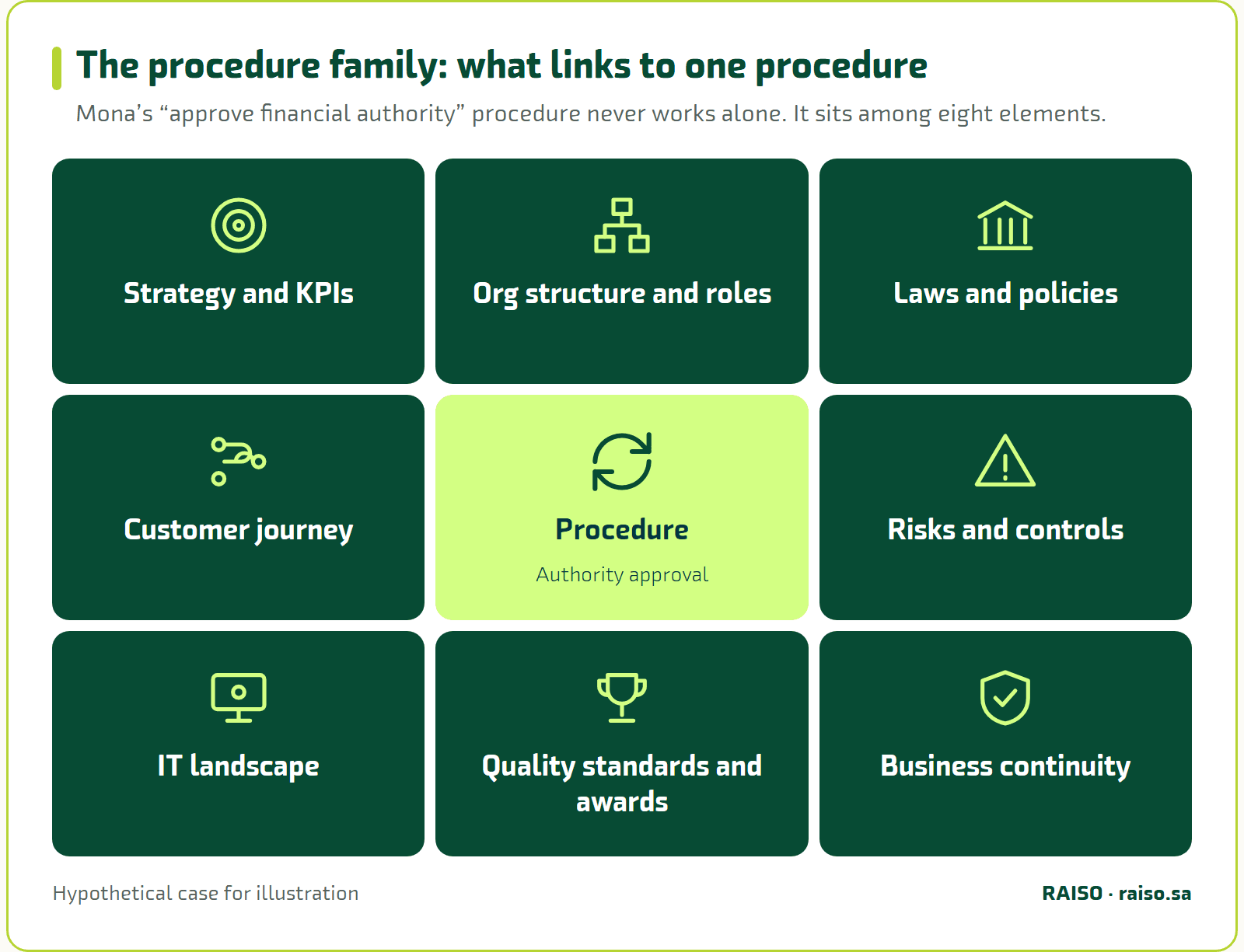
“In the case now: For one procedure, “purchase order approval,” Mona drew a circle around it: the policy linked to it, the regulation that governs it, the role that approves, the risk it controls, and the indicator it serves. For the first time she saw why finding the affected procedures by searching for a word could never work.”
“Choose one procedure in your organization and draw five elements around it: a policy, a role, a risk, a control, an indicator. Which of them do you not know where it is documented?”
Three gaps that scattering creates
When the family’s members are scattered across separate files, the organization loses more than tidiness. It loses three capabilities no mature excellence system can do without. Mona tasted all three in a single week.
- Broken traceability
The policy is in one file, the procedure in another, the risks in a third register, the goals on a separate dashboard. Tracing impact from one element to what it connects to is tiring, error-prone manual work. This is what happened to Mona with the six unopened procedures.
- Impossible impact analysis
The specialist struggles to see the whole picture: how does a policy change affect workflow in a sub-department? Which procedures are hit if a system fails or a person in a given position is absent?
- Lost consistency with growth
As the organization grows and its procedures and systems multiply, the burden of keeping all copies consistent multiplies, until consistency collapses under sheer volume.
The answer may seem obvious: a bigger documentation team and tighter manual discipline. But that is like pouring water into a leaking jar. The answer is that the nature of the tool itself must change.
“In the case now: Mona wrote next to each gap an example from her week: traceability broke at the six procedures, impact was never analyzed because she did not know where to look, and consistency will only worsen when the count reaches three hundred. She understood that no plan will help while the tool is itself files.”
“Which of the three gaps showed up in your last change? Write one example for each.”
From drawing to modeling: the living repository
The answer to dead documentation, scattering and the missing single source lies in one shift: moving from drawing procedures to modeling them inside a central database. We call this repository-based modeling. A repository is a database that keeps each element once, and modeling means each element is defined as an object with its own identity, not as a shape on a page.
In this model every element of the procedure family, policy, step, role, risk, control, system, is defined as an independent object. When the role “HR manager” appears in three hundred procedures, it is not three hundred separate boxes but three hundred references to one object. You edit the object’s definition once and it changes everywhere it is called. This subtle difference between drawing and modeling is what separates documentation that dies with time from documentation that stays alive.
Had Mona’s organization owned such a repository the day the amendment arrived, the role “financial authority holder” would have been one object, and every procedure tied to it would have appeared with a single click. Thirty-one procedures in seconds, not nine days.
Four advantages this approach gives, each treating one of the gaps:
- Live linkage: when a policy changes or a regulation is updated, the effect spreads to the linked procedures, ending dead documentation at the root.
- Instant impact analysis: before any change you know every affected procedure, system and unit with one click, so the decision rests on a full view.
- Simple visual access: searchable interfaces show each employee what concerns his role, so the procedure reaches whoever needs it without giant manuals.
- A platform for dialogue and innovation: comments and notes inside the platform turn a procedure from a rigid order into a space for improvement, since people who run a procedure know its weak spots best.
And reusing objects is not a technical luxury. It is the basis of consistency. Through it the same activity is called in several procedures, repeated activities in different departments are found and merged to raise efficiency and cut waste, and relations among processes, systems and data are understood, so decisions rest on facts, not impressions.
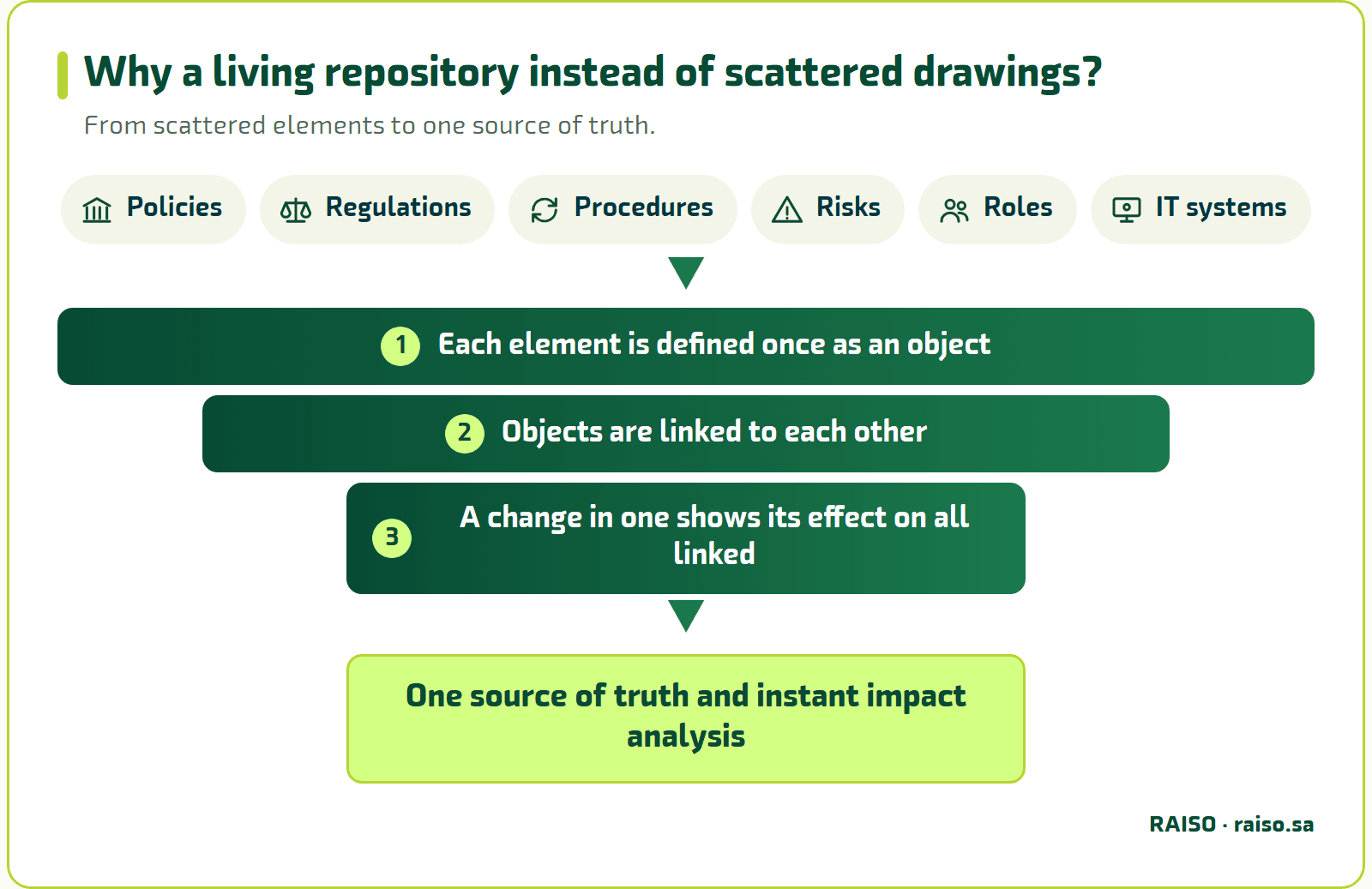
“In the case now: Mona found her first criterion. Every tool on her list must hold role, risk, control and policy as independent, reusable objects. A tool that only gives pretty drawings leaves the list.”
“Write one question to ask any tool vendor to find out whether it is a real repository or a drawing program. For example: if I rename a role once, how many places change?”
The first trap: mixing architecture tools with process tools
When Mona began tabulating tools, she ran into the most common and costly mistake: she assumed the technology team’s architecture tool would do what she needs. Some tools are called enterprise architecture tools, others business process management tools. They are two different things at their core.
The first focus on systems, applications and data flows, and serve digital transformation teams, systems architects and technology managers. The second focus on processes, roles, responsibilities, risks, controls, policies, inputs and outputs, and serve excellence and quality departments, process owners and the employees who execute. A different audience means a different design, a different visual language, and different things the tool was built around.
The core differences between the two categories:
- Focus: the first looks at systems, applications and data; the second looks at processes, roles, risks and policies.
- Audience: the first is for systems architects and technology managers; the second is for process managers, employees, and quality and excellence experts.
- Purpose: the first seeks system integration and lower technical complexity; the second seeks higher human performance and policy compliance.
- Standards: the first uses ArchiMate and UML; the second uses BPMN 2.0, EPC and flowcharts.
- Example categories: in enterprise architecture, BiZZdesign, Alphabet and MEGA; in business processes, ARIS, SAP Signavio, BIC (GBTEC) and Nintex. These are illustrations, not recommendations.
In mature organizations the two types complement each other: architecture tools provide the high-level frame and process tools provide operational detail. But when forced to choose, pick the tool that speaks to the plain employee. Sound execution matters more than sound planning when the subject is daily work procedures. The real mistake is choosing a tool that does not serve the actual beneficiary, one that stays aimed at the programmer in complex language while the field reader is the one who should benefit.
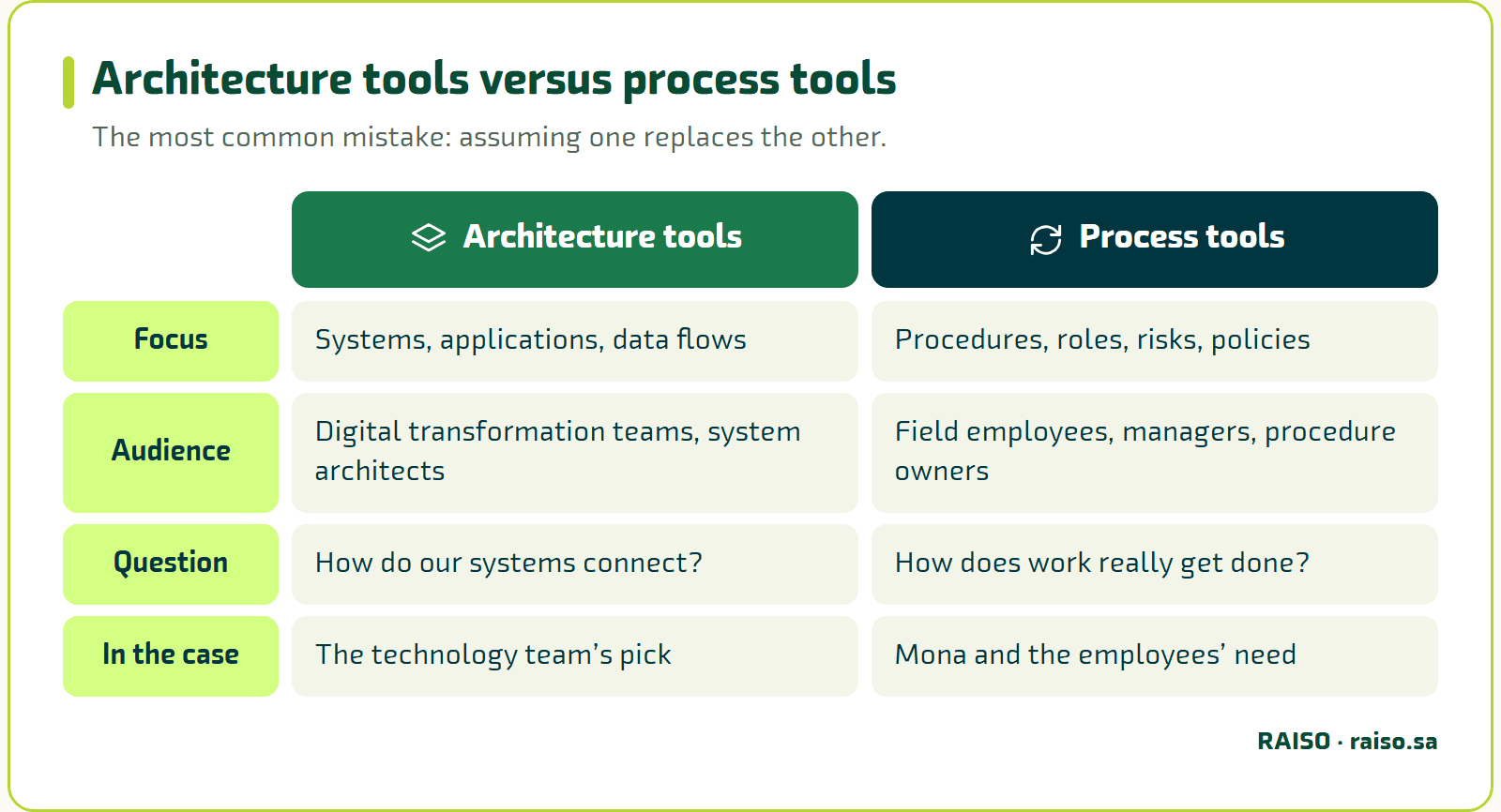
“The tool that speaks to the plain employee is the first priority, because sound execution matters more than sound planning when the subject is daily work procedures.”
“In the case now: Mona sorted the tools into two columns and placed the technology team’s tool under enterprise architecture. She did not call it poor. She said it was designed for another reader. She wrote: our reader is an employee in procurement, not a systems architect.”
“Write who the primary reader of a procedure is in your organization, by job title: how many are they, and what is the most complexity they will tolerate in a tool?”
The second trap: letting technology choose alone
The technology team’s suggestion to Mona was not wrong in its intent. It is natural for the choice of a modeling tool to go to the information technology team, since it is software installed and tied to systems. But this is the second trap: when the question is reduced to its technical side.
The tool is not merely a technical platform. It is an enabling and operating tool for the organization that directly shapes how people understand and apply processes. The technology team looks at it from systems engineering, integration and reduced complexity. The excellence team looks at it from simplifying procedures, building awareness, unifying practice and enabling employees to execute clearly.
Both teams want better performance. But a different purpose means a different right tool. And the technology team often already owns architecture-oriented tools, so choosing alone it leans toward a tool that speaks to technologists. Yet the original purpose of documenting a procedure is that a simply informed employee understands it and works by it.
How to turn the choice into a joint decision without conflict:
- Start with a session with the technology team to hear what matters to it: integration, security, hosting. These are real conditions that belong in the criteria.
- Ask it in turn to listen to what matters to the field employee: simplicity, search, comments. These are real conditions too.
- Let the excellence specialist lead the decision, with technology as a partner holding the right to object on technical conditions, not a decision reduced to one recommendation.
“In the case now: Mona sat with the technology director and said: I will assess tools with criteria that include you and the employee, and I will make integration with our systems a written criterion. He relaxed, because he saw his view would not be sidelined but would enter the matrix. The committee became a joint one.”
“Write three conditions your technology team cares about and three the field employee cares about. Which of them conflict?”
Define the purpose, then understand the differences
Choosing a tool is not a purchase but a strategic decision that requires understanding the organization’s present and future needs. Before you sign any contract, settle two axes: what is the purpose of modeling? And then what are the traits and differences of the available tools?
First: what is the purpose?
Ask yourself a frank question: is our purpose communication and compliance, or technology support and digitization? If it is communication, you need an attractive interface, a strong search engine and social commenting. If it is supporting technology and automating complex processes, you need a tool that supports precise technical standards and integrates with development tools. The purpose decides the category of the tool before it decides the brand.
Mona wrote her purpose like this: that an employee opens his procedure and understands it in minutes, and that we know the effect of any change at once. So her purpose is communication and compliance first, impact analysis second. Technical automation is a later stage.
Second: what are the differences between tools?
The market is full of options, and each has strengths and weaknesses that suit one context and not another. Here is a reading of common categories as illustrations, not recommendations:
- ARIS: very strong and built on huge databases, supporting all levels of excellence and enterprise architecture; but its interface is heavy and hard for non-specialists, it needs intensive training and a technical team to support it, and its cost is high.
- SAP Signavio: a modern option focused on user experience and social collaboration. Its collaboration hub makes it easy for employees to read and comment on procedures, and suits organizations seeking reach and awareness.
- BIC (GBTEC): offers a balance between structural strength and ease of use, with quick setup and a simpler interface, while keeping a strong database that supports complex linkage.
- BiZZdesign: a leader in enterprise architecture offering a suite for broad digital transformation, best for technology teams wanting to link processes to infrastructure and data precisely.
- Nintex: stays away from the complexity of global standards and focuses on simplicity, good for organizations wanting quick documentation and instant understanding without technical modeling.
“In the case now: Mona cut her list from nine tools to three after applying her purpose and her category. The first is strong and complex, the second readable for the reader and with a good database, the third simple and fast but limited in linkage. She is now ready for a systematic comparison.”
“Write your purpose in one sentence and pick the category that fits it. Then name one category you rule out and why.”
The weighted selection matrix
Here comes the instrument that moves the decision from impression to comparison. A weighted matrix is a table in which each criterion gets a weight by its importance, each tool is rated on it, and the result is calculated. It lets you justify your decision to senior management in the language of numbers, not personal preference. You are free to adjust the weights to your organization’s priorities and maturity stage.
Six suggested criteria with weights:
- Ease of use for the reader, 30%: so information reaches the simply informed employee and the tool is truly adopted. It carries the highest weight because it settles adoption from failure.
- Strength of the database (repository), 20%: to ensure linkage across the procedure family of policies, risks and strategy.
- Social collaboration features, 15%: to turn a procedure into an innovation tool through comments and discussion.
- Governance and compliance (GRC), 15%: to support risk management, control and internal audit in a built-in way.
- Integration with other systems, 10%: to link procedures to technical systems such as resource planning and customer relationship systems.
- Cost and speed of return, 10%: to ensure budget fit and quick visible results for senior management.
Calculate the result by multiplying each tool’s rating on each criterion, from one to ten, by that criterion’s weight, and summing. Mona ran the calculation on her three hypothetical tools, and these figures are illustrative, not an assessment of real products:
- Tool one (strong and complex): ease 4, repository 9, collaboration 5, governance 8, integration 8, cost 3. Result 6.05.
- Tool two (readable for the reader): ease 9, repository 7, collaboration 8, governance 6, integration 6, cost 7. Result 7.5.
- Tool three (simple and limited): ease 9, repository 4, collaboration 5, governance 3, integration 4, cost 9. Result 6.0.
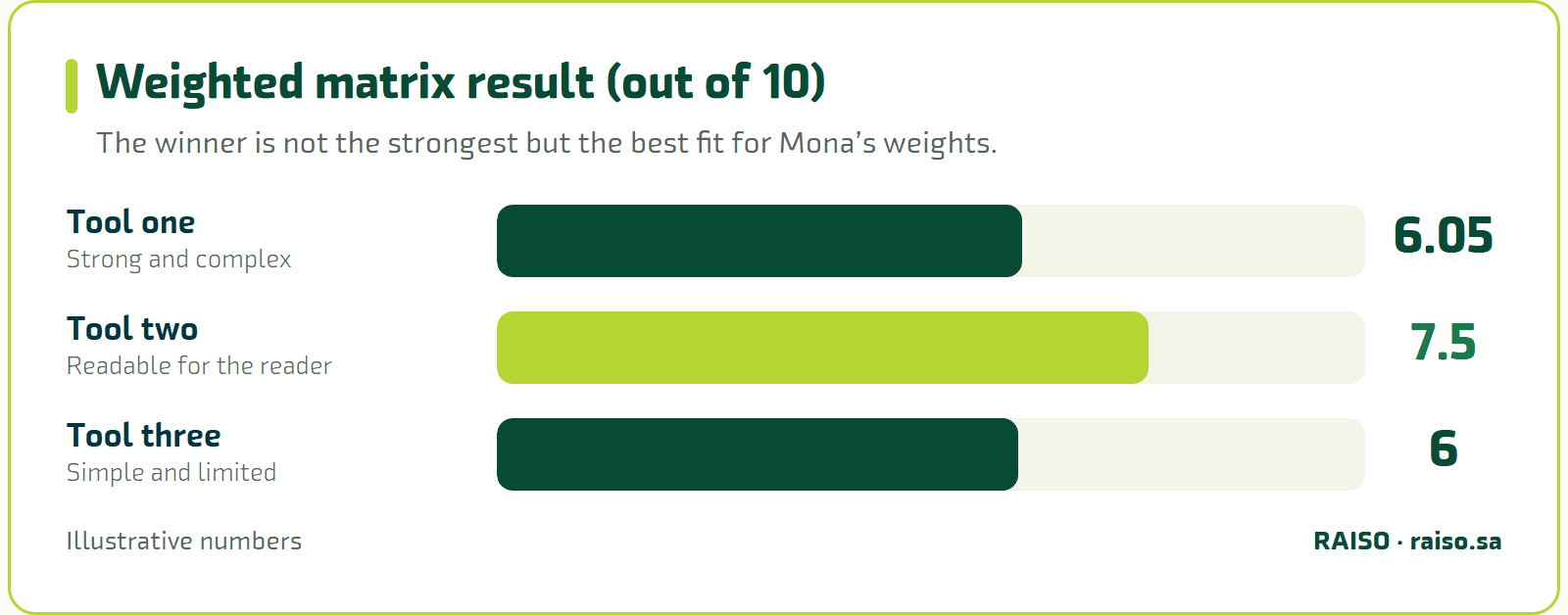
The winner here is not the strongest technically but the best fit for Mona’s weights. That is why setting the weights honestly before scoring is more important than the scoring itself. Had she changed her weights because the technology team pushed, the result would have changed, and she would know she chose by pressure, not by purpose.
And remember a rule that must stay in mind: every tool does the job to different degrees. Some are strong but complex, some easy but limited, some lean technical and some lean toward communication. The right tool is the one that gives the balance your organization needs at its current stage.
“In the case now: Mona showed the matrix to the joint committee, and the technology director objected to the integration weight of ten percent. They discussed it calmly and agreed to raise it to fifteen at the expense of cost. Tool two stayed in front, and everyone left having shared in the result.”
“Build your matrix: write your criteria and their weights before looking at any tool. Make the weights total one hundred.”
The method before the tool
After Mona chose the tool she thought the work was done. But she remembered herself searching through Word files and asked: what stops this tool from becoming a new shared folder with a different face?
The answer is nothing, unless there is a method. Documenting procedures with an advanced tool, with no mechanism or rules for updating and alignment, is exactly like documenting them on paper and putting them in drawers: no one knows about them, and their data becomes inaccurate over time. The tool alone does not create excellence. The method does.
Three pillars of an alignment method
- Procedure lifecycle
When is a procedure reviewed? Who holds the right to edit? How are publishing and approval done before it? Write this for each procedure.
- Process culture
Train employees not only to use the tool, but to think in processes and to contribute to improving procedures.
- Strategic link
Make sure excellence is not an isolated island but the engine that connects leadership’s ambitions to the reality of employees.
In other words, the tool is the infrastructure, while governance, roles and responsibilities, and the update method are the spirit that keeps that infrastructure alive. An organization with a modest tool and a sound method is better off than one with the strongest tool and no governance.
Mona also proposed a small pilot before signing any contract: three real procedures from one department, modeled in the candidate tool, with one shown to a field employee who is asked: did you understand it? Did you find what you were looking for? That employee’s answer is worth ten vendor presentations.
| # | Question for the vendor | Priority | Compliant | Partially | Not compliant |
|---|---|---|---|---|---|
| Repository and modeling | |||||
| 1 | Is every element (policy, step, role, risk, system) an object defined once and reused? | Core | |||
| 2 | Are all models and relationships held in one governed central repository? One source of truth, as in the ARIS repository | Core | |||
| 3 | Does it support BPMN 2.0 and validate a diagram before publishing? Modeling standard (BIC, Signavio) | Important | |||
| 4 | Can documents (guides, forms, minutes) be linked directly to procedure steps? | Important | |||
| Ease of use and adoption | |||||
| 5 | Can an ordinary employee open a read-only portal and grasp their procedure in minutes? Like the Signavio Collaboration Hub | Core | |||
| 6 | Are comments, discussion and notifications available on the procedure itself? | Important | |||
| 7 | Is the interface fully Arabic, with right-to-left writing? | Core | |||
| 8 | Does each employee find the procedures tied to their role through search and filters? | Important | |||
| Governance and lifecycle | |||||
| 9 | Does it keep procedure versions and a log of who changed what and when? | Core | |||
| 10 | Is there a formal approval workflow and review cycles with stakeholders? Process Governance in ARIS and Signavio | Core | |||
| 11 | Are edit rights set by role and by procedure owner? | Core | |||
| 12 | Does a separate publication stage split draft from approved and published? Employees see only the approved (BIC publication stage) | Important | |||
| Risk, compliance and impact analysis | |||||
| 13 | If a policy or regulation changes, does it instantly show every affected procedure? | Core | |||
| 14 | Are controls tied to risks on the step itself and synced with a GRC module? Like BIC Process Control sync | Important | |||
| 15 | Is a procedure linked to policies, regulations, standards and awards? | Core | |||
| 16 | Do ready reports come out for internal and external audit? | Important | |||
| Analysis and improvement | |||||
| 17 | Can it simulate change scenarios before rollout? Simulation in ARIS and Signavio | Important | |||
| 18 | Does it compare actual performance with the designed procedure (process mining)? | Important | |||
| 19 | Are KPIs linked to the procedure and shown on it? | Important | |||
| Integration, security and operations | |||||
| 20 | Are there documented APIs for our systems and single sign-on (SSO)? | Important | |||
| 21 | Where is data hosted, and does it meet local regulatory requirements? | Core | |||
| 22 | Does it connect to enterprise architecture and the IT landscape, or need a separate tool? | Important | |||
| 23 | Is the three-year cost of licence, hosting and training clear, with Arabic support and a reference client? | Important | |||
Questions built from the capabilities of leading process platforms (ARIS, Signavio, BIC). Ask them in the pilot demo and tick the answer. Any "Not compliant" on a Core item is grounds to exclude.
“In the case now: Mona wrote a lifecycle for the “purchase order approval” procedure: reviewed every six months, owned by the procurement manager, with amendments approved by the excellence manager. She scheduled a short training session for staff and linked the procedure to the request-completion-time indicator. The method fit on a single page.”
“Write for one procedure in your organization: who owns it? When is it reviewed? Who approves changes?”
The Saudi context and what comes next
In the Saudi work environment, and with Vision 2030 placing government performance efficiency and organizational excellence at the front of its priorities, managing work procedures is no longer an administrative luxury. It is a necessity for keeping pace with fast local and global change. And with growing national transformation requirements and excellence awards such as the King Abdulaziz Quality Award, a digital platform for managing procedures becomes a condition for sustaining excellence and compliance with changing regulations.
The pace of regulatory change makes instant impact analysis a practical advantage, not a theoretical one. When a new regulation is issued, the organization needs to know at once which policies and procedures are affected, not begin a manual search across dozens of files. That is what Mona lost in nine days. Here repository-based modeling moves from a nice-to-have improvement to an operational compliance tool that protects the organization from a gap between what the regulation requires and what it does.
In the end there is no perfect tool for everyone. You are the one who decides what suits your organization by its purpose and maturity. But what must not leave your mind is that documenting procedures with any tool, without a method for updating, without governance and without defined roles and responsibilities, is like documenting them on paper and placing them in drawers.
“In the case now: Three months later a new amendment to another regulation arrived. Mona opened the tool and asked for the procedures linked to the affected role. They appeared in minutes, and she arranged a meeting with their owners the same day. Nine days became two hours, and six forgotten procedures became zero.”
“Go back to your personal number from the first section: how many days did you need? And how many would you need with a repository tool and a method? That is the return you present to your management.”
What do you take with you?
Six ideas that sum up the journey:
- A document that does not move with the work is dead documentation, more dangerous than none because it gives a false sense of discipline.
- A procedure belongs to a family: strategy, policy, risk, control, role. A family cannot be managed with separate files.
- The answer is to move from drawing procedures to modeling them in a central repository where elements are objects that can be reused.
- There are two categories of tools: enterprise architecture and business processes. Choose the one that speaks to the employee who executes.
- Do not leave the choice to the technology team alone. Make it a joint decision led by the excellence specialist.
- Define the purpose, weigh the criteria honestly, then build the method that keeps the tool alive. The tool alone does not create excellence.
If you return to where we began, you will find that Mona’s question was never: which tool is best on the market? It was: which tool keeps our procedures alive so that an employee understands and works by them? The difference between the two questions is the difference between a decision reviewed after a year and a decision that lasts.
If you want to apply these steps to your organization with specialists, and build your matrix and your method on your real procedures, this is what RAISO’s procedure management practice works on. Explore the practice, reserve a seat in the course linked to it, and start with three procedures on which to test your choice.