


Circulate Knowledge, Don’t Just Document It
In many organisations, the work on knowledge begins with a decision that seems perfectly sound: let us build a platform, gather the procedures, and ask every department to upload what it has. The budget is spent, the folders fill up, and the project is declared complete. Then something breaks on the floor, and someone calls the same person they called before the platform existed. The documents are there, but the answer still sits with one man.
This article argues that documentation is a single snapshot of a long journey, and that knowledge is managed not when it is stored but when it moves. We follow one case from start to finish, Nora, Mansour and a packaging plant, to learn the SECI spiral developed by Nonaka and Takeuchi. You will come away with the difference between explicit and tacit knowledge, four stations for steering the flow of experience, and signs that show where the spiral has stalled in your own organisation, with a short exercise in every section.
Nora opens the repository
“We follow one case from start to finish: Nora, maintenance manager at a packaging plant. In each section we see what changes for her, and at the end we compare what she used to measure with what she measures now.”
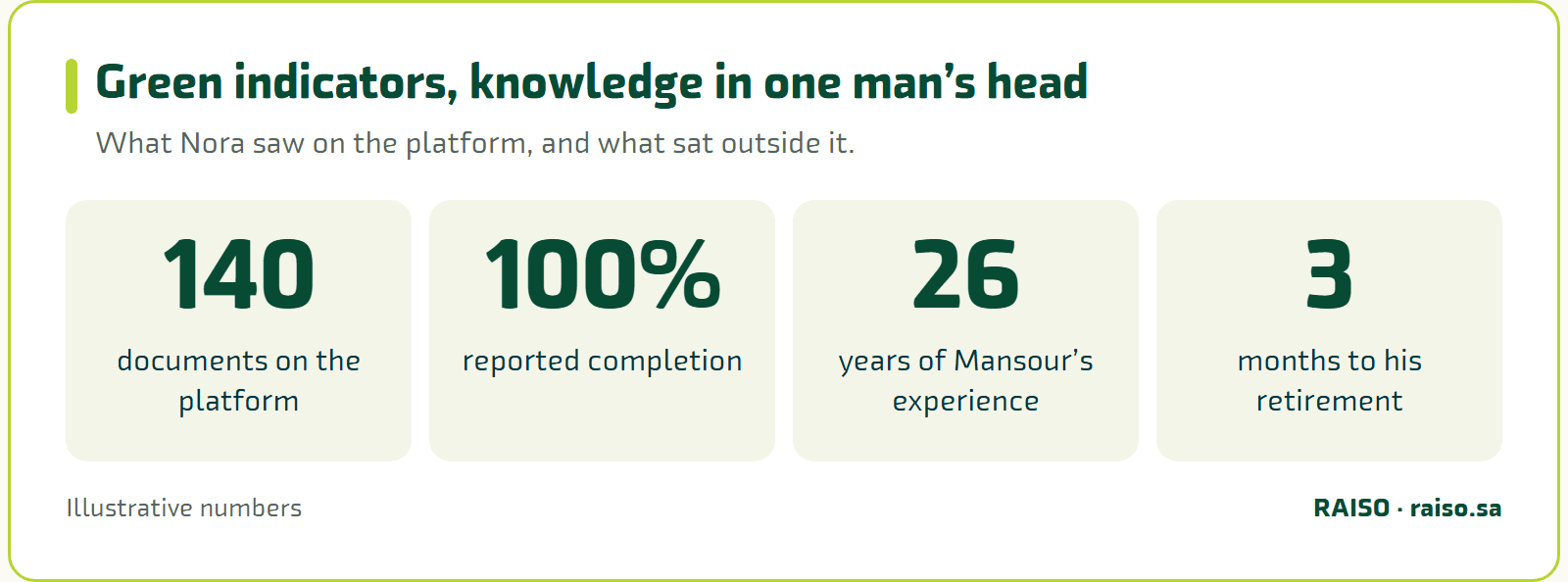
Nora manages maintenance at a packaging plant. A year ago the company launched a knowledge documentation project, and her team was asked to collect everything: equipment manuals, shutdown procedures, fault reports. A hundred and forty documents went onto a polished platform, and everyone applauded at the closing meeting.
On a Sunday morning, filling machine number three stopped. Faisal, the new technician, opened the platform and typed the machine’s name. Three documents and fourteen reports came up. He read for twenty minutes and did not find a single sentence explaining why this machine, of all of them, stops in high heat.
He called Mansour. Mansour is a senior technician with twenty-six years in the plant, retiring in three months. He came over, ran his hand along the machine’s body, listened for a moment, and said: “That is not the fault. Open the side fan cover.” Ten minutes later the machine was running.
“Nobody was late for work and the platform lacked no document, yet the whole answer sat in the head of a man who would leave in three months.”
“Nora, Mansour, Faisal and the numbers here are composed for illustration only and do not refer to any particular organisation.”
That evening Nora sat and thought. A hundred and forty documents, and Faisal still needed Mansour. Ask her about the project and she would say its indicators were green: the document count was rising and completion stood at a hundred per cent. But those indicators measure one thing only, how full the repository is. They do not measure whether anyone learned anything.
What actually happened in this story?
- The answer moved from the platform to a person. Mansour became the reference, and his departure means the reference disappears.
- The repository became decoration. Everyone knows it exists and nobody opens it when things get tense.
- Every breakdown got more expensive: technicians’ time, a stopped machine, production waiting.
“Five minutes, now: recall the last time something important broke in your work. Who fixed it? And was their answer written somewhere any colleague could reach?”
Why didn’t the repository help?
When knowledge reaches the leadership table, thinking goes straight to tools: which system do we buy, where do we store it? Then the project is handed over as though knowledge had been managed. What actually happened is that content was produced. The difference between producing content and managing knowledge is not one of degree but of kind.
Documentation is a tool, and its value is measured by what it changes in the work, not by how much it produces. When it turns from a means into an end, it becomes a tidy store of things nobody uses. That is more dangerous than open chaos, because tidiness suggests achievement: the reports say everything is complete, while the real problem, that knowledge does not move, stays exactly where it was.
A repository keeps a still picture of knowledge at the moment it was captured. Knowledge itself keeps moving between people’s minds, their practice and their documents. When we freeze one moment of that motion and take it for the whole picture, we have grasped the shadow and left the body. That is why the gap remains however large the repository grows.
Nora began to see this. But she needed a sharper question: what kind of knowledge did we document, and what kind did we leave out?
Where the case stands now: Nora changed her question from “how many documents do we have?” to “what do the documents not know?” That alone moved her from satisfaction to curiosity.
“Write in one line what your knowledge indicator measures today. Is it the number of documents, or their effect?”
What is in Mansour’s head?
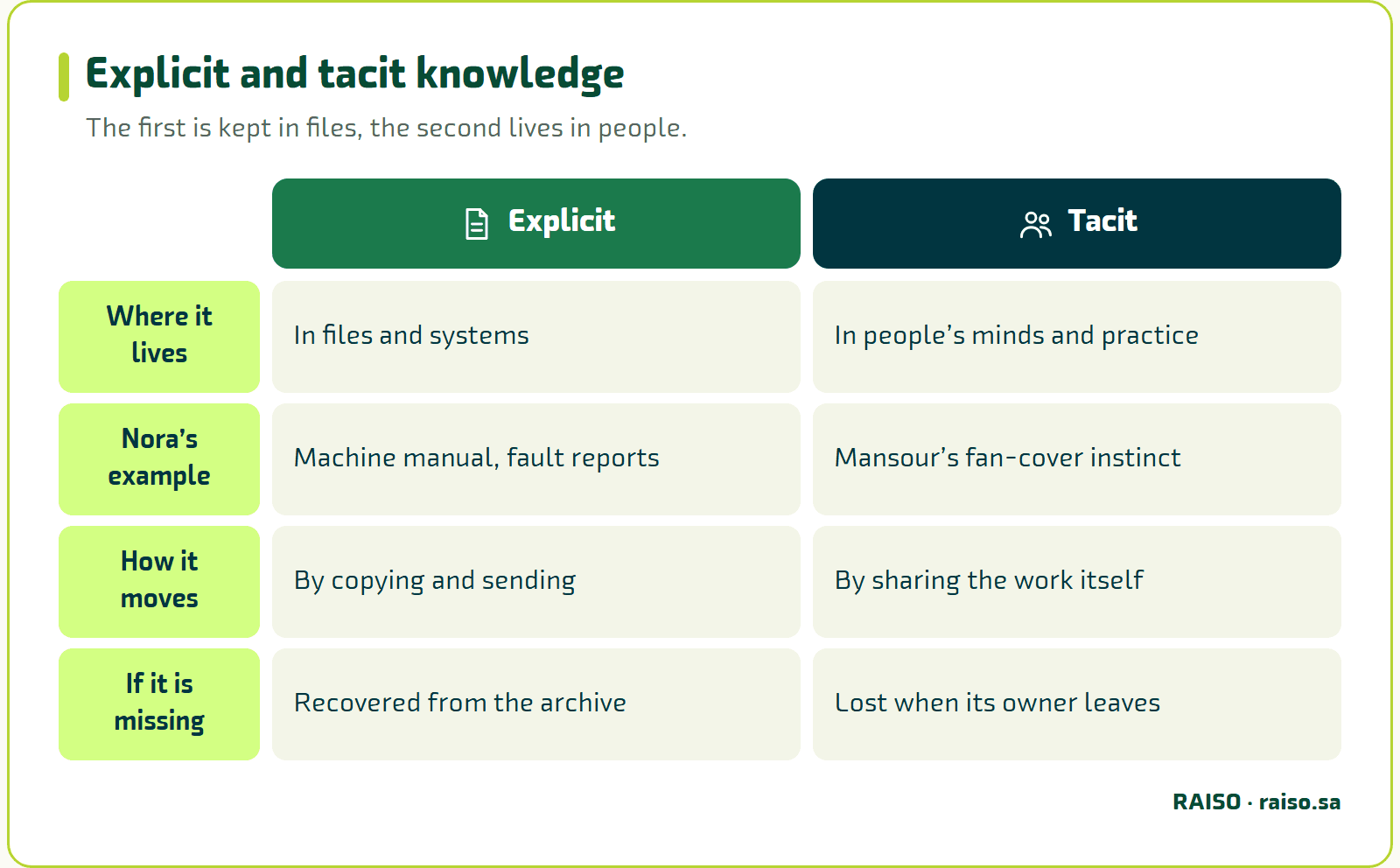
Knowledge comes in two kinds. The first is explicit knowledge, which can be put into words, numbers and drawings: the written policy, the documented procedure, the user manual, the fault report. It travels by sending, it is read in the absence of its author, and it is easy to count. That is why organisations love it.
The second is tacit knowledge, which lives in people rather than files. When Mansour listened for a moment and ran his hand over the machine, he was not reading from written memory. He was using a judgement built over twenty-six years: a certain sound, a certain heat, a faint smell. Ask him how he knew and he would say, “I felt it.” This is what the philosopher Michael Polanyi meant when he said we know more than we can tell.
Three traits make tacit knowledge both hard and precious:
- Hard to express: its owner may not know how he knows what he knows, so he cannot write it down.
- Tied to context: it takes its meaning inside a particular situation and loses much of it when lifted out.
- Truly competitive: when everyone holds the same standards and documents, what your technicians know and others do not is the difference.
Writers in this field often quote estimates that only a small share of the knowledge actually in circulation can be documented. We do not cite a specific figure here, because the numbers differ from one organisation to another. The meaning is what matters: the part that is easiest to measure is the least valuable, and the deepest part is unseen and uncounted. An organisation that manages only the explicit holds the shell tightly and lets the core leak away with every person who leaves.
Where the case stands now: Nora realised that what her platform held was equipment manuals, while what Mansour knows about how the machines behave never entered the platform at all. She had gathered what could be gathered and left behind what the usual methods cannot gather.
“Pick one expert in your organisation and note three things they know that no colleague could state accurately about them. Do not ask them yet. Just write what you think.”
How does experience leave the head?
The project office proposed a quick fix: ask Mansour to sit at a computer for a week and write down everything he knows. He sat for one day and wrote two pages about the order of periodic maintenance, which is already in the manuals. The things that make him Mansour he did not write, because he did not know where to begin.
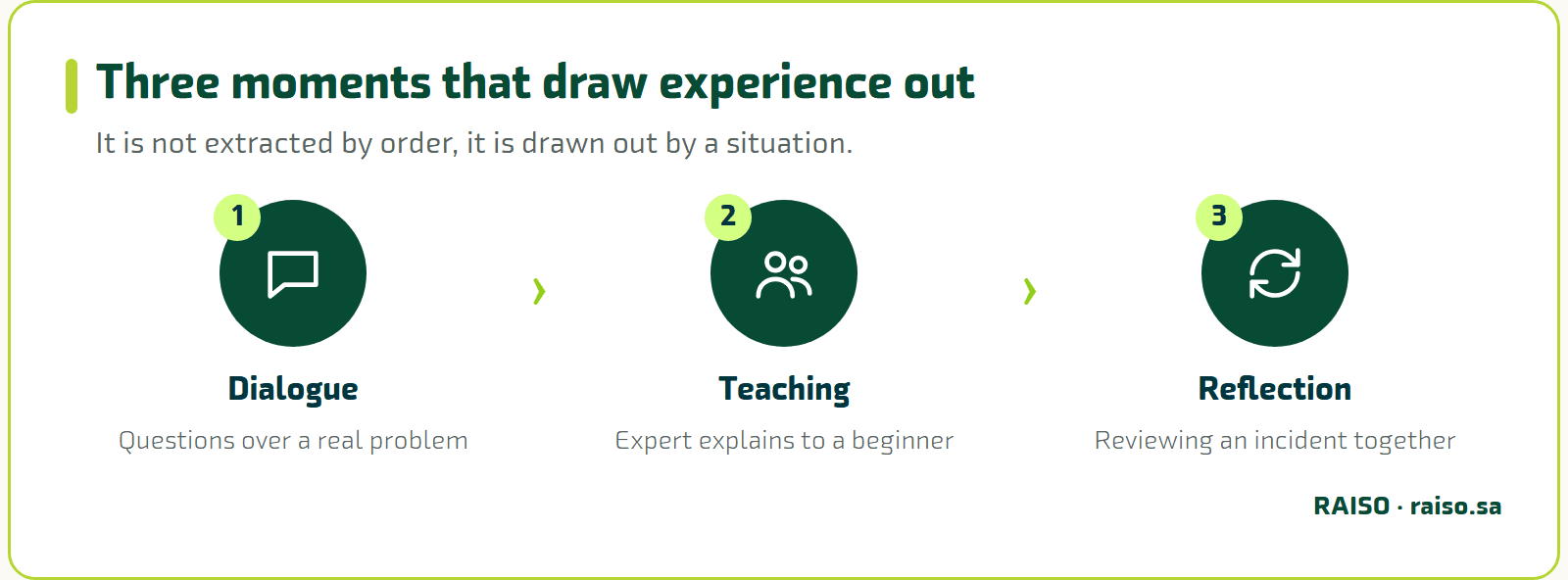
It was not his failing. Tacit knowledge cannot be extracted by order; it is drawn out by a situation. And it emerges in three particular human moments.
- Dialogue
When the expert sits with colleagues before a real problem, their questions draw out his intuition, and he has to say aloud what he used to do without thinking.
- Teaching
When the expert explains to a beginner, he discovers the structure behind his own instinct, because he is trying to make it understandable.
- Reflection
When the expert reviews a past incident with those who shared it, he reorders what happened and understands why his move worked or failed.
These moments do not arrive by chance. They need a safe setting in which the expert feels that sharing what he knows does not diminish his standing but extends his reach. And they need a method that makes them organised and productive instead of leaving them hostage to passing occasions.
Where the case stands now: Nora dropped the request for solitary writing and had Mansour work with Faisal for two full weeks on the shop floor. Nobody asked him to write anything. He was asked to work and talk, and to explain to Faisal what he was doing and why.
“Put a thirty-minute session in your diary this week between an expert and a beginner on real work. No paper and no slides, only work, observation and questions.”
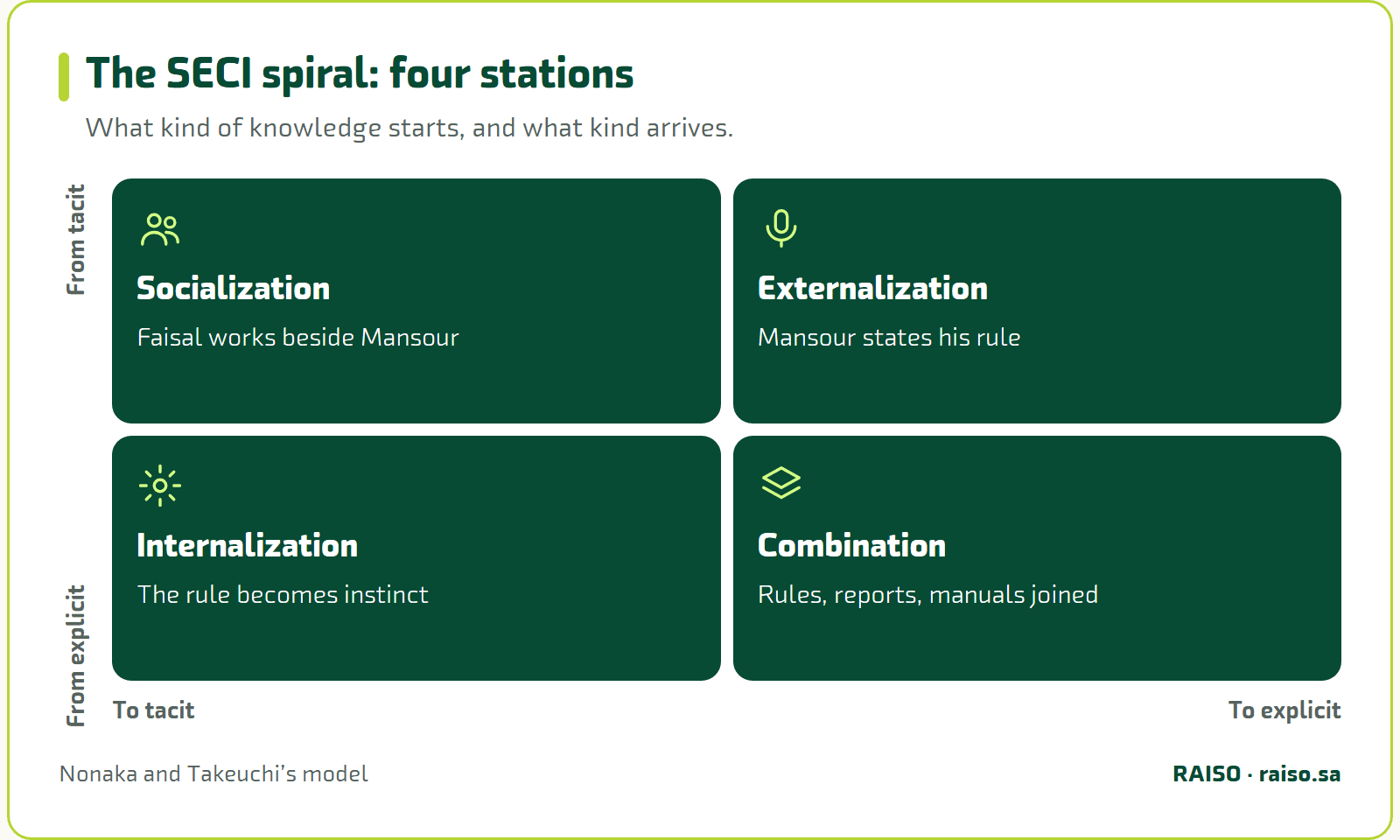
The SECI spiral: four stations for knowledge
In 1995, Ikujiro Nonaka and Hirotaka Takeuchi presented in The Knowledge-Creating Company a model that changed how organisations think about knowledge. Their idea is that an organisation’s value lies not in what it knows at a given moment but in its ability to keep creating new knowledge. Their model is called SECI, after the first letters of four stations through which knowledge turns between tacit and explicit in a spiral that rises with each cycle.
The four stations, and at each one what Nora did:
- Socialization: tacit to tacit
Intuition passes from person to person through shared experience. Faisal works beside Mansour, watching and imitating, and picks up what no document carries. Experience is gained before it is put into words.
- Externalization: tacit to explicit
Experience turns into language. This is where real documentation happens, but documentation born of live conversation. When Faisal asked Mansour why he opened the fan cover, Mansour heard himself state a rule he did not know he had.
- Combination: explicit to explicit
Explicit knowledge from different sources is gathered, organised and connected until it becomes deeper understanding. Nora combined Mansour’s rules with fault reports and manuals, and patterns appeared that nobody had seen.
- Internalization: explicit to tacit
Knowledge returns to the floor. When a technician applies the rule again and again, it becomes instinct, which is new tacit knowledge. The cycle closes and starts again at a higher level.
“An organisation’s value lies not in what it knows at a given moment but in its ability to keep creating new knowledge.”
Where the case stands now: Nora drew the spiral on a board in her office and put a question at each station: where are we? She found that the whole documentation project sat in two stations only, an incomplete externalization and something resembling combination. Socialization and internalization had no place at all.
“Draw the four stations on a sheet and write under each one initiative currently running in your organisation. Which station is left empty?”
Where does the spiral stall?
Most organisations stop at the second station. They gather expertise, document it, upload it and announce completion. In doing so they cut the spiral in half: they turned some tacit knowledge into explicit, but never completed the combination, and never returned the knowledge to the floor to become living experience again.
Three symptoms show that the spiral has broken:
- Content without use: plenty of documents available and nobody consulting them in daily work. That is what we saw with Faisal.
- Errors that repeat despite being documented: the lesson sits in a report but never became a habit, so the same mistake happens again.
- Sharp loss at departure: when veterans leave, gaps appear that nobody imagined were so deep.
| Station | Initiative | Question it answers |
|---|---|---|
| Socialization | Accompaniment: three weeks beside an expert | Does the beginner work with the expert on real faults? |
| Externalization | Lessons session after every major fault | Was the lesson written in shop language? |
| Combination | Monthly workshop for an updated guide | Did experts’ rules meet reports and manuals? |
| Internalization | Trial each new rule on one shift | Did it work, and what changed? |
Each initiative moves knowledge from one state to another; none just produces content.
The most dangerous thing about the break is that leadership cannot see it. Indicators look healthy, the document count climbs, reports reassure, while the ability to learn does not grow. So the organisation doubles its documentation instead of completing the spiral, treating a “lack of content” with more content, when the real fault is that knowledge never completes its cycle.
The spiral has one fuel, which is people. It turns not by technology or by memo, but when an employee changes from a consumer of content into a producer of knowledge. That takes three things together:
- Knowledge safety: the employee feels that sharing what he knows does not threaten his standing or expose a weakness to be used against him, but is valued.
- Enabling structures: communities of practice and regular exchange sessions, where sharing knowledge has a fixed place and time.
- Designed motivation: recognition tied to giving knowledge, not to hoarding it.
Where the case stands now: Nora noticed that Mansour hesitated to speak in front of the new technicians. She asked him, and he said he feared they would think him boastful, or that management would decide he was no longer needed once his expertise had been transferred. So she adjusted the method: exchange sessions became public recognition of the expert’s role, and Mansour’s name was written on every rule drawn from him.
“Ask yourself: if our expert shared everything he knows tomorrow, what would happen to his standing here? Would we reward him, or risk embarrassing him?”
Designing initiatives station by station
Once you know where your spiral stalled, designing initiatives becomes closer to engineering. Each station has its own kind of initiative serving its function, and a gap in one station should not be treated with a tool built for another. This is RAISO’s approach to knowledge circulation: we do not build a knowledge project separate from the work, but fold circulation into the operations where knowledge is produced and used, asking first what the organisation knows, what it does not, and who carries the critical knowledge.
At Nora’s plant the plan became:
- For socialization: an accompaniment programme in which each new technician works beside an expert for three weeks on real faults.
- For externalization: a short lessons session after every major fault, run by someone who asks and does not judge, with the lesson written in plain shop language.
- For combination: a monthly workshop that brings the experts’ rules together with fault reports and manuals into one updated guide.
- For internalization: every new rule is trialled on one shift, and the people who tried it are asked: did it work, and what changed?
Notice that no initiative here aims at producing content. Each one aims at moving knowledge from one state to another. With this understanding the organisation stops wasting effort on documentation nobody uses.
Technology has its place in the picture, but third, not first. People are the source, processes are the context, and technology is the means. A tool does not create behaviour; it amplifies behaviour that already exists. Without a culture of circulation, a platform will not produce one. Nora did not abandon her platform. She changed its job: it became the place where what comes out of the sessions is published, not the place expected to generate knowledge.
Where the case stands now: Six weeks later Nora had twelve technicians who knew the fan-cover rule, instead of one. When machine three stopped again, Faisal did not call Mansour. He opened the cover himself and told his colleagues afterwards that the sound had told him. Experience had become instinct in him. That is internalization, and it is the start of a new cycle.
“Take the empty station from your earlier exercise and design one small initiative for it that starts next week. Then write how you will know it worked.”
From repository to capability: how do you measure success?
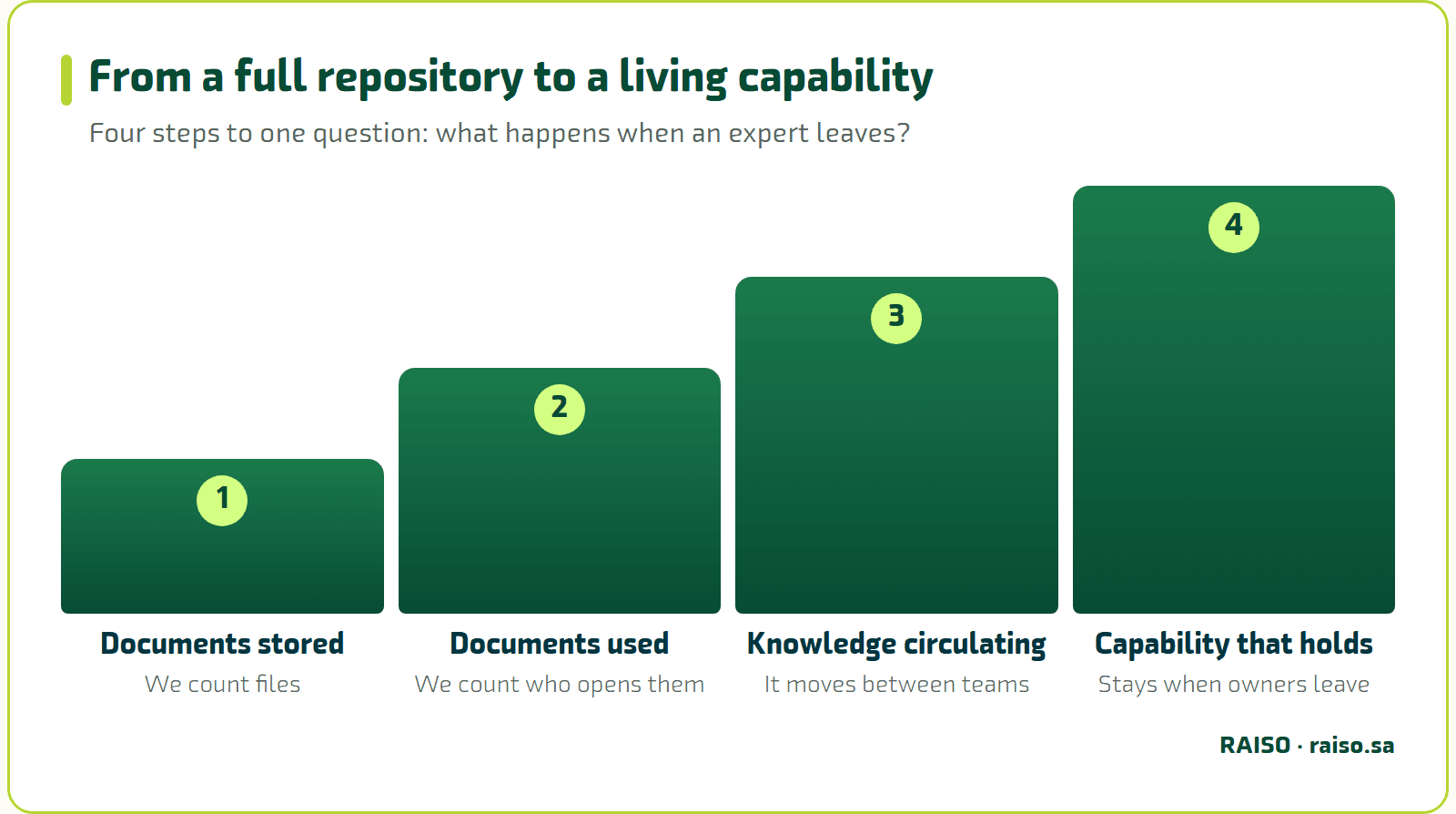
The last question is really the first one to ask before buying any tool: how do we measure the success of knowledge management? If the measures are the number of documents and the number of pages, we are measuring how full the repository is, not how alive the knowledge is. A wrong measure leads to wrong behaviour: more documentation that nobody reads.
Measures that look at effect, not size:
- Is the rate of repeating errors we have met before falling?
- Do good practices pass from one team to another instead of staying on one island?
- Does the competence of individuals and teams grow over time because of what circulates?
- Does knowledge stay available after its owners leave?
The most honest test is what happens when one of the pillars leaves. If capability collapses with one person, the knowledge was never managed; it was hosted in a human being. A successful organisation does not define itself by what it documented, but by what it learned and what it can do today because of what it mastered yesterday.
Where the case stands now: Nora removed the “number of documents” indicator from her dashboard and put three in its place: how many people know each critical rule, how fast a fault we have seen before is fixed, and how many rules have been trialled on the floor. When Mansour retired three months later, they held him a farewell, but the plant did not stop for a day.
“Closing exercise: write the names of three people whose departure tomorrow would stall something important. Then give each one a SECI station to begin with this month.”
What do you take with you?
- Knowledge is of two kinds: explicit, which is written and sent, and tacit, which lives in people. The more valuable part is the one that is not seen.
- Documentation is one snapshot. Knowledge moves in a spiral of four stations: socialization, externalization, combination and internalization.
- Most initiatives stop at the second station, so documents pile up while capability does not grow.
- Tacit knowledge is not extracted by order. It is drawn out through dialogue, teaching and reflection in a safe setting.
- People first, then processes, then technology. And the measure is effect, not size.
We usually begin by asking how many documents we hold. The better question is what happens to our experience when its owners leave. If the answer is that something is lost, you do not need a bigger repository, you need a spiral that turns.
At RAISO we work with organisations to map their knowledge, find where the spiral has stalled, and design initiatives that move knowledge inside the work itself. If critical expertise sits in the hands of one person in your organisation, we suggest starting this week with a single step: a joint working session between that expert and whoever will follow them. To go deeper, explore RAISO’s knowledge management practice, or write to us at marhaba@raiso.sa and we will help you draw the first map.
“The case, names and numbers in this article are hypothetical, for illustration only, and do not refer to any particular organisation.”