



Procedures: The Glue That Holds the Organization Together
Every department in the organization works hard, and every department improves what is in its hands. Yet quality slips, customers wait longer, and staff feel a frustration whose source they cannot name. These look like scattered symptoms: one department complaining about another, an improvement here creating a problem there, an invisible gap widening between offices. But they are usually symptoms of one disease: procedures that work alone.
In this article we learn that a procedure does a bigger job than describing work steps. It is the joint that ties strategy to execution, structure to action, regulation to practice, risk to control, technical systems to daily work, and the organization to its customer. We will follow one hypothetical case, Layla, owner of the license-renewal procedure in a service authority, from the day she improved her procedure alone and things got worse, to the day she built it a card linking it to everything around it. You will leave able to look at any procedure from six directions, and with one tool for carrying that view into a procedure you own.
Layla and the Procedure That Improved Alone
Layla owns the license-renewal procedure in a hypothetical service authority. It was slow, so she set to work. She removed a paper copy of one form, trimmed an internal review step, and shortened the notice her team sends to the applicant. Two months later she saw that the procedure in her department was clearly faster.
But something strange happened. Complaints from applicants about delay went up. Layla traced the requests and found that some stopped at the compliance department, because the field she had removed from the form fed a report compliance needs. Some stopped at audit, because the step she had trimmed was a control the risk department relies on. And some did not show in the technical system at all, because the new form did not match its fields.
Layla had fixed her procedure and broken a chain she did not know existed. The error was not in her effort. It was that she saw her procedure as an island.
“An organization is no stronger than the weakest joint between its departments, and procedures are those joints.”
Where the case stands now: Layla sits down with three colleagues from compliance, risk and technology, and hears one sentence in different forms: “If you had asked us before changing it, we would have told you.” She realizes that an improvement made without sight of its surroundings raises local efficiency and lowers the efficiency of the whole.
Try it now: recall the last improvement you made to a procedure. Who was affected by it without being consulted? Write the names.
A Procedure Is a Fabric, Not a List of Steps
When we say “procedure”, a narrow picture jumps to mind: a numbered list of steps describing how a task is done. That picture is right at its minimum, but dangerously incomplete. A good procedure is not only a description of what is done. It is a point where several threads meet: the strategy thread coming from above, the structure thread that says who acts, the authority thread that grants decision power, the regulation thread that sets limits, the risk thread that watches for what may go wrong, the technical-system thread that carries the work, and the customer thread that lives the result.
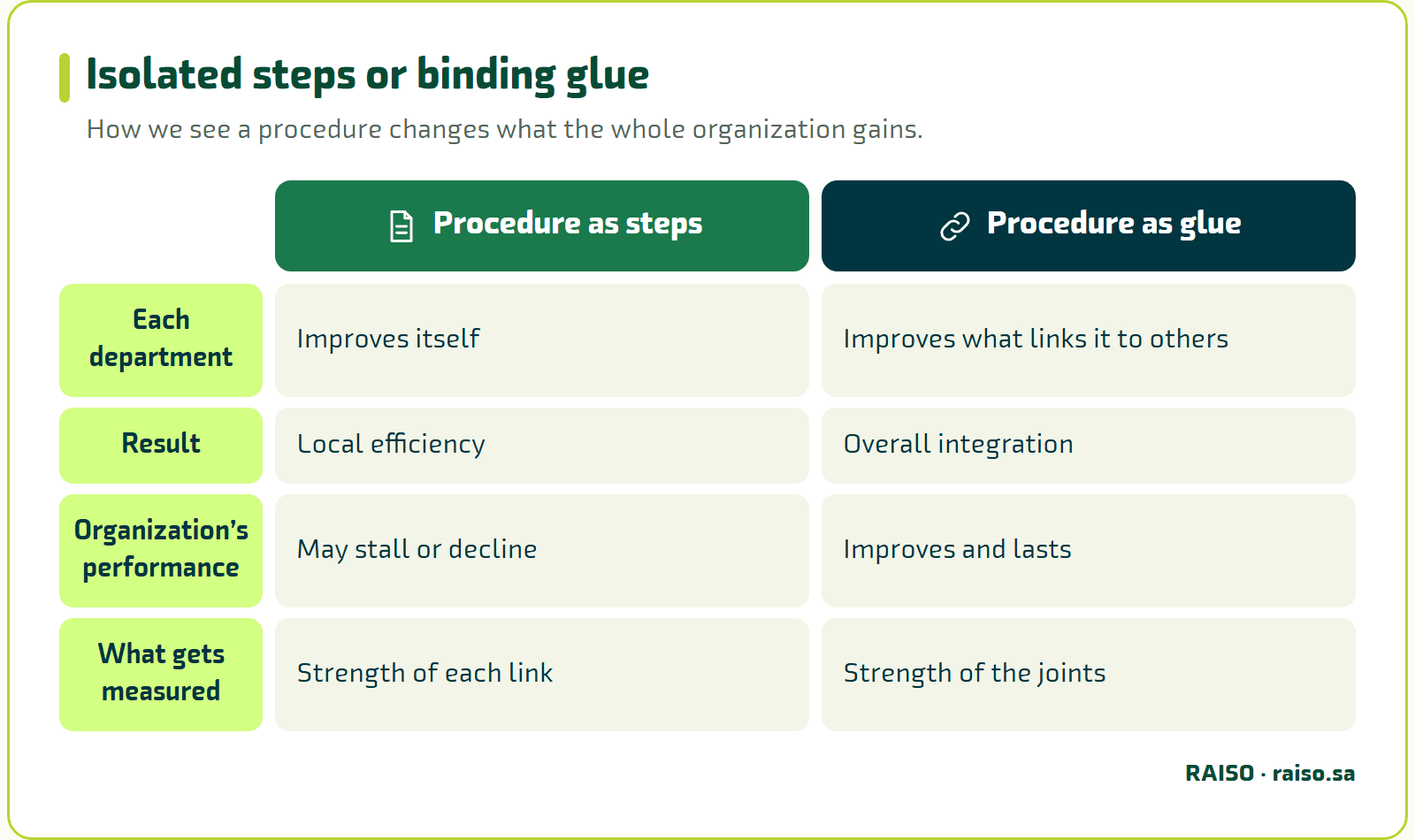
Here is the thesis this article rests on. When we see procedures as isolated steps, we write them in isolation, run each one in isolation and improve it in isolation. Procedural islands appear that nothing links. When we see them as a binding fabric, we design them aware of what comes before and after, above and below, and they become one system in which strategic intent flows until it reaches the customer.
The difference between the two views is not linguistic. It changes the fate of the organization. One that treats its procedures as steps piles up local efficiency at the expense of integration: each department improves itself, and then everyone is surprised that the organization as a whole has not improved, and may even have declined. One that treats them as glue builds overall integration, even if it looks slower at first, because it knows that the strength of a chain is not in each link alone but in the strength of the joints between the links.
Where the case stands now: Layla draws the license-renewal procedure in the middle of a page and seven threads around it. At each thread she writes the name of the department concerned. She is surprised to find she knew only three of them.
Try it now: draw a procedure you know in the middle of a page, and around it the seven threads: strategy, structure and authority, regulation, risk, technical system, customer, and quality standards. Give each a name or a question mark.
Procedures and Strategy: From “We Want” to “We Do”
Strategy sets the destination, but by nature it speaks at a high level: we want to expand, we want to lead, we want to be the first choice. These are noble phrases, but they accomplish nothing by themselves. Between intent and result there is a distance, and only one bridge crosses it, called the procedure. It turns “we want” into “we do”, and “where to” into “how”.
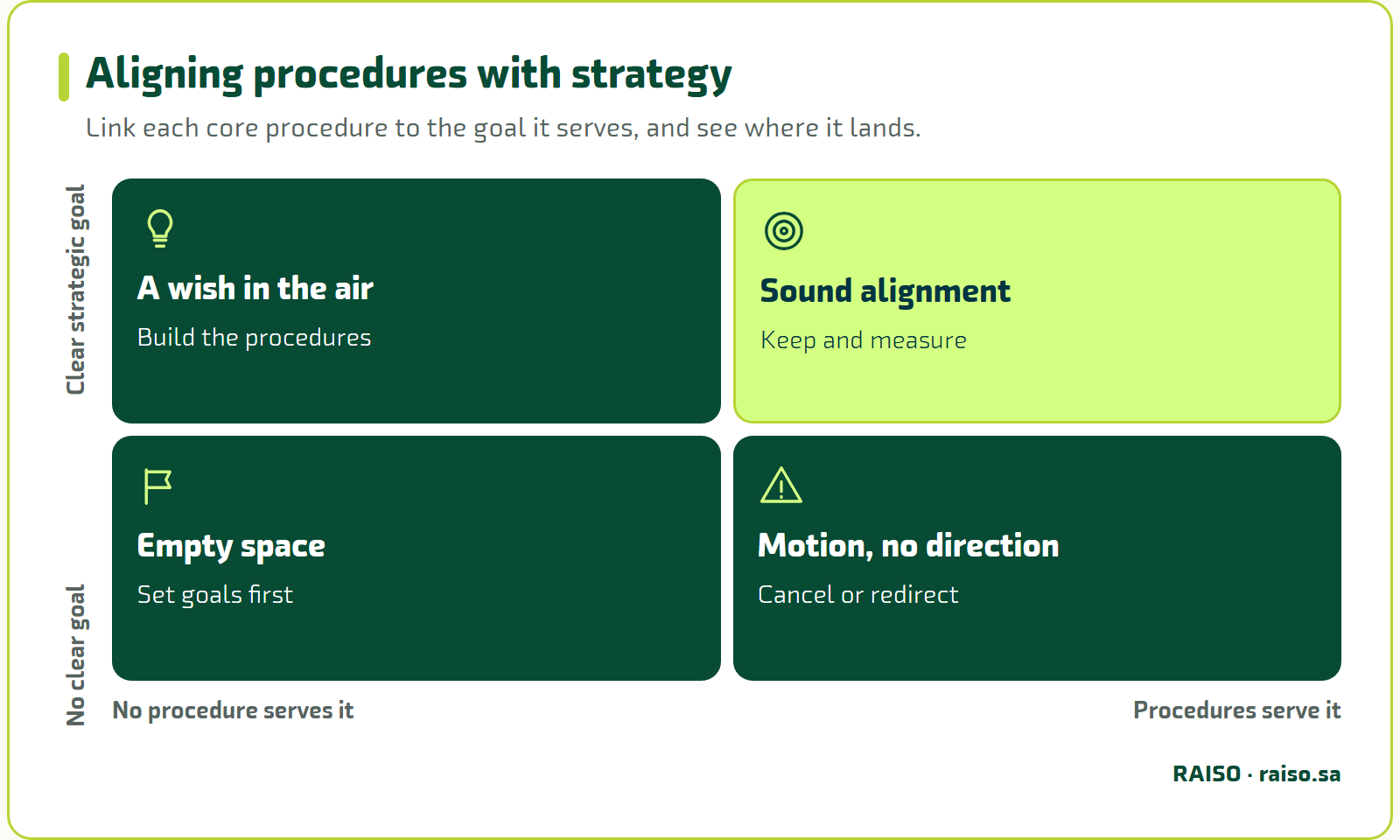
Take a strategy focused on international expansion. That sentence alone opens no market. What opens one is a series of specific procedures: how do we open an office abroad and what are the licensing steps? How do we contract local distributors and by what criteria? How do we adapt the product to local cultures and who approves the adaptation? Strategy without these procedures is a wish, and procedures without strategy are motion without direction.
In this context a practice emerges called procedure-to-strategy alignment. We link each core procedure to the strategic goal it serves, and discover three truths that may shock. Procedures that consume effort and serve no goal deserve to be cancelled. Strategic goals hanging in the air with no procedures behind them deserve to be built. And procedures that conflict with each other and serve contradictory goals deserve to be aligned.
Organizations working within the Vision 2030 path know this well. They adopt ambitious goals and are measured by strict indicators, and the gap between declared ambition and actual execution is measured and held to account. So linking procedure to strategy becomes a condition for survival, not only for distinction.
Where the case stands now: Layla asks: which strategic goal does the license-renewal procedure serve? She finds in the authority’s plan a goal that reads “improve the applicant’s experience and cut the time of key services”. That is the goal against which she should measure any improvement, not her department’s time alone.
Try it now: write in one sentence the strategic goal that one of your procedures serves. If you cannot find a goal, ask: why does this procedure exist, then?
Procedures, Structure and the Authority Matrix
The organizational structure defines roles and responsibilities and draws the lines of reporting. But by itself it is a static skeleton: boxes on a chart and lines between them. What breathes life into it? Procedures. Without them the structure turns from an organizing tool into a source of conflict. Responsibilities overlap and two departments fight over one task, or tasks fall into the gap between departments because nobody owns them.
The procedure settles this confusion. It says who starts, who receives, who approves, who is informed. Picture a company launching a new product that needs cooperation between research and development, marketing and operations. The structure says they are three departments, each with its manager. The procedure says when R&D hands specifications to marketing, what joint reports pass between them, and when coordination meetings are held. The procedure is what makes the structure speak and work.
Next to the structure comes the authority matrix, which says who holds the power to take which decision and up to what limit. But like the structure, it is ink on paper until a procedure turns it into practice. Suppose the matrix lets department heads approve spending up to a certain amount. That text guarantees nothing. What guarantees compliance is a procedure that sets how a spending request is submitted, who approves before execution, and how the approval is documented and kept. When the procedure is built into an electronic system that routes approvals automatically by each authority’s ceiling, the matrix turns from a document into reality.
Where the case stands now: Layla reviews her procedure and finds a step approved by an employee who lacks approval authority under the matrix, and another step nobody owns when the specialist is away. For each step she writes the owner’s name and authority limit, and closes the gap by appointing a deputy.
Try it now: take the steps of one procedure. Beside each, write: who performs it? Who approves it? Do they have the authority under the matrix? What happens if they are absent?
Procedures and Regulation: From Text to Practice
Laws and regulations are the legal frame in which the organization works, and internal policies are its own governing will. But both say what must be, not how it will be. The procedure answers how. Take a law that obliges companies to keep a certain level of workplace safety. That obligation does not protect a single worker by itself. What protects them is a procedure that turns the obligation into practice: periodic safety inspection with a known schedule and a named owner, mandatory training on safety protocols, and precise documentation of every incident or potential injury.
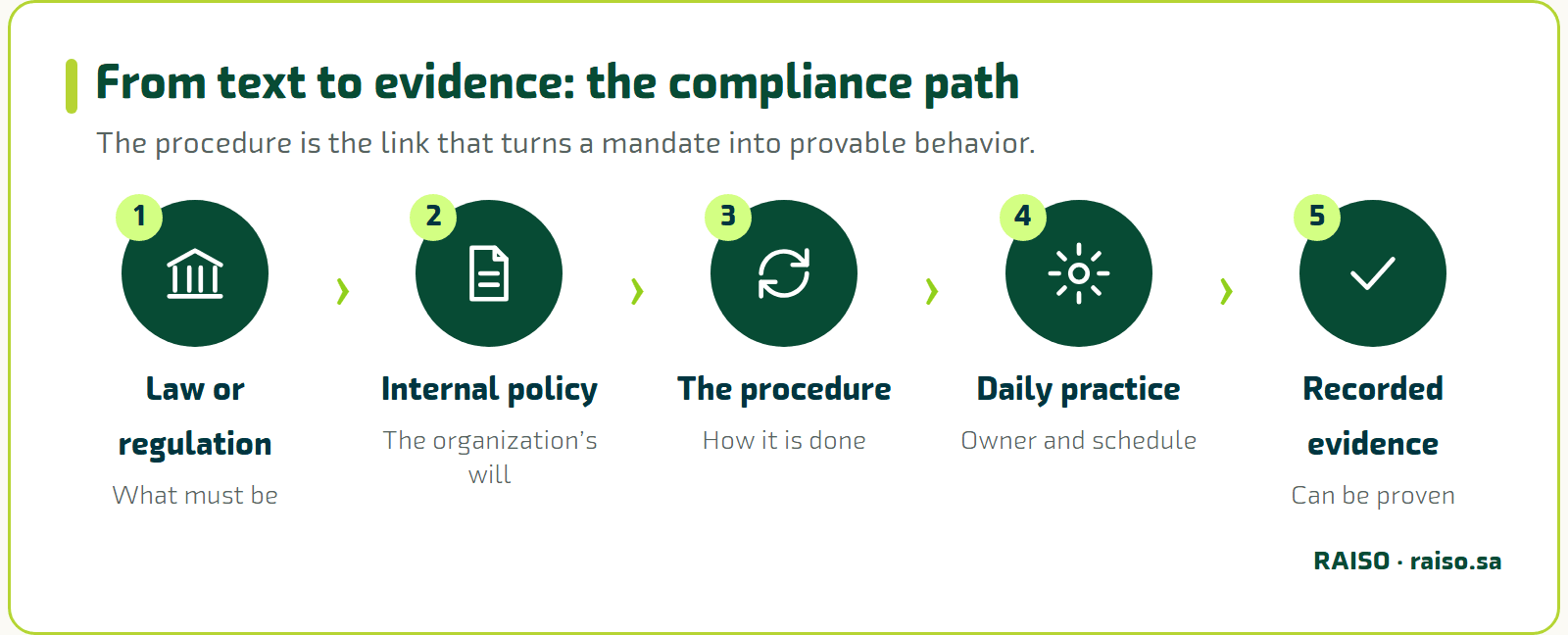
Through that procedure, compliance turns from a claim on paper into behavior that can be proven. The translation is a fine institutional skill: every new law or updated regulation should not stay a text that is read and filed in a compliance folder, but be broken down into its operating requirements and built into existing procedures.
When an organization masters this translation, compliance becomes an organic part of how it works, not an extra layer imposed on top. The cost of compliance itself falls, because the employee does not need to memorize the regulation. It is enough to carry out the procedure.
Where the case stands now: Layla asks compliance for the regulatory provisions that govern license renewal. She discovers the field she removed serves a specific legal requirement: proof that the authority verified a certain document before renewal. She restores it, but redesigns it to be filled automatically from the system instead of typed by hand.
Try it now: pick a regulatory provision that touches your procedure. Write beside it: which step in my procedures proves I comply with it? If there is no such step, that is a gap.
Procedures and Risk: Control Inside the Work
Risk is part of every process. And because risks materialize inside processes, not outside them, their natural place of control is inside the procedure, not in a separate register. Many organizations build a detailed risk register, updated each quarter and sent to a committee, which then stays far from the employee at whose hands the risks occur.
Here comes risk-to-control linkage inside the procedure. At each step where a risk might arise, we plant a control that prevents it, detects it or softens its effect. In an organization working in a high-risk environment such as finance, it is not enough to say financial risks are high. Steps are built into the procedure to identify and assess risks: regular review of financial data by a named owner at a set time, strict limits on authority, and documentation of every exception.
When controls are built into procedures this way, risk management turns from a separate periodic activity done by a specialist unit into a continuous practice that happens in every transaction. And each employee, without noticing, becomes a first line of defense, because the control is built into how they work. This is what separates an organization surprised by crises from one that prevents them before they occur.
Where the case stands now: Layla sits with the risk colleague and asks about the step she trimmed. He explains: it used to stop renewal for an applicant with an open financial obligation. She restores the step, but turns it into an automatic check inside the system, so the control stays and the waiting disappears.
Try it now: name a risk from your organization’s risk register that concerns a procedure you know. Where is the step that prevents or detects it? And does the person carrying out the procedure know it is a control?
Procedures, Technical Systems and Forms
A technical system plays a vital role in modern organizations, but alone it guarantees no result. It is a tool, and a tool needs a way of use. Consider a company that relies on a customer-relationship system to follow sales and interaction. The system itself is an empty box waiting for data. What makes it a source of value is the procedure that sets how it is used: entering every piece of customer information within twenty-four hours of the interaction, naming who updates the system regularly, and a mechanism to verify data completeness before any deal is closed. Without that procedure the system fills with incomplete data nobody trusts.
The relation in the opposite direction is just as important. When a procedure is automated inside the system, following it becomes automatic rather than optional. The system does not allow a mandatory step to be skipped, routes the transaction to the right authority, and logs every action for audit. It turns from a data store into a guardian of the procedure that imposes discipline without human effort.
Forms and requirements management is tied to systems. Forms are the fields that gather data, and requirements are what the output must satisfy. The procedure decides when these forms are reviewed, who updates the requirements, and how gathered data becomes fuel for improving the next cycle. In this way the organization becomes a being that learns from its data. And this is what Layla forgot when she deleted a field from a form without asking who reads its data.
Where the case stands now: Layla stands with the technology team and decides not to amend the paper form only for someone to copy it by hand. She agrees with them on a single form inside the system, with fields filled automatically where possible, and automatic routing of the request to compliance and risk. For each field she writes a line: why it exists, and who reads it.
Try it now: open a form you use at work and ask of each field: who reads this field and why? Fields nobody reads are waste, and fields that lack a reader are a gap.
Procedures, Customer Experience and Excellence Standards
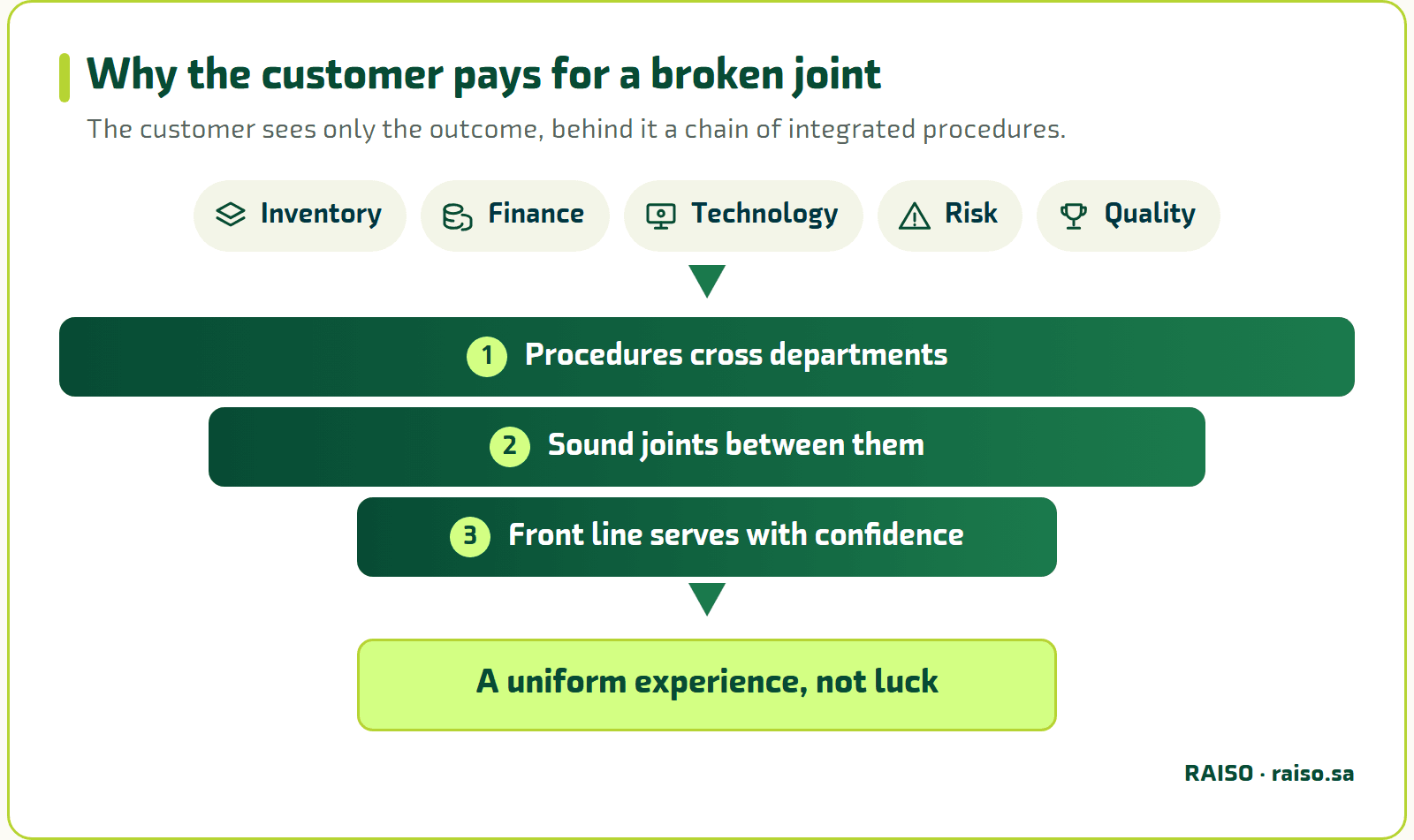
All this internal integration stays abstract until it reaches the point of truth: the moment the customer touches the organization. The customer does not see your strategy, your structure or your risk register, but lives your procedures in every interaction. Customer experience seeks to improve every aspect of interaction, from the first point of contact to after-service. And procedures are what ensure the experience is delivered in a uniform way that does not depend on the employee’s mood or the customer’s luck.
Here the real test of integration appears. An excellent experience is not produced by the customer-service department alone, but by a chain of integrated procedures across many departments the customer never sees: inventory that keeps the product available, finance that completes refunds quickly, technology that keeps the digital channel running. When one link of this hidden chain breaks, the customer pays the price however skilled the front-line employee.
Then come excellence standards and international quality models, which aim to improve performance and secure quality. But they remain a hanging aspiration until they take shape in a daily procedure. When an organization pursues a quality certificate such as ISO 9001, procedures are what set how compliance with the standards is secured: continuous quality monitoring with clear acceptance criteria, and precise documentation of each activity so it can be reviewed and audited. When these requirements are planted in the procedure itself, excellence becomes a sustained practice, not a seasonal event.
This leads to the deepest principle in this article: continuous improvement must strengthen the glue. At each improvement we have two choices. The first is to add an isolated fix that solves a local problem and creates a new gap with what surrounds it, which is what Layla did the first time. The second is to design the improvement so that it increases the procedure’s linkage with what comes before and after, strengthening the whole fabric and not one link in it. Mature organizations always choose the second.
“At every improvement ask two questions: did the step get better? And did the integration of the system increase? The second is what builds the organization in the long run.”
Where the case stands now: Layla traces the journey as the applicant lives it: from submitting the request to receiving the renewed license. She finds the applicant contacts three departments without knowing which is responsible. So she adds an automatic message to her procedure telling him where his request stands, and ties it to the quality standard the authority uses to document the service.
Try it now: trace a procedure through the customer’s eyes. How many departments does it pass through without the customer seeing them? And which link, if broken, would make the customer pay?
The Procedure Card at 360 Degrees
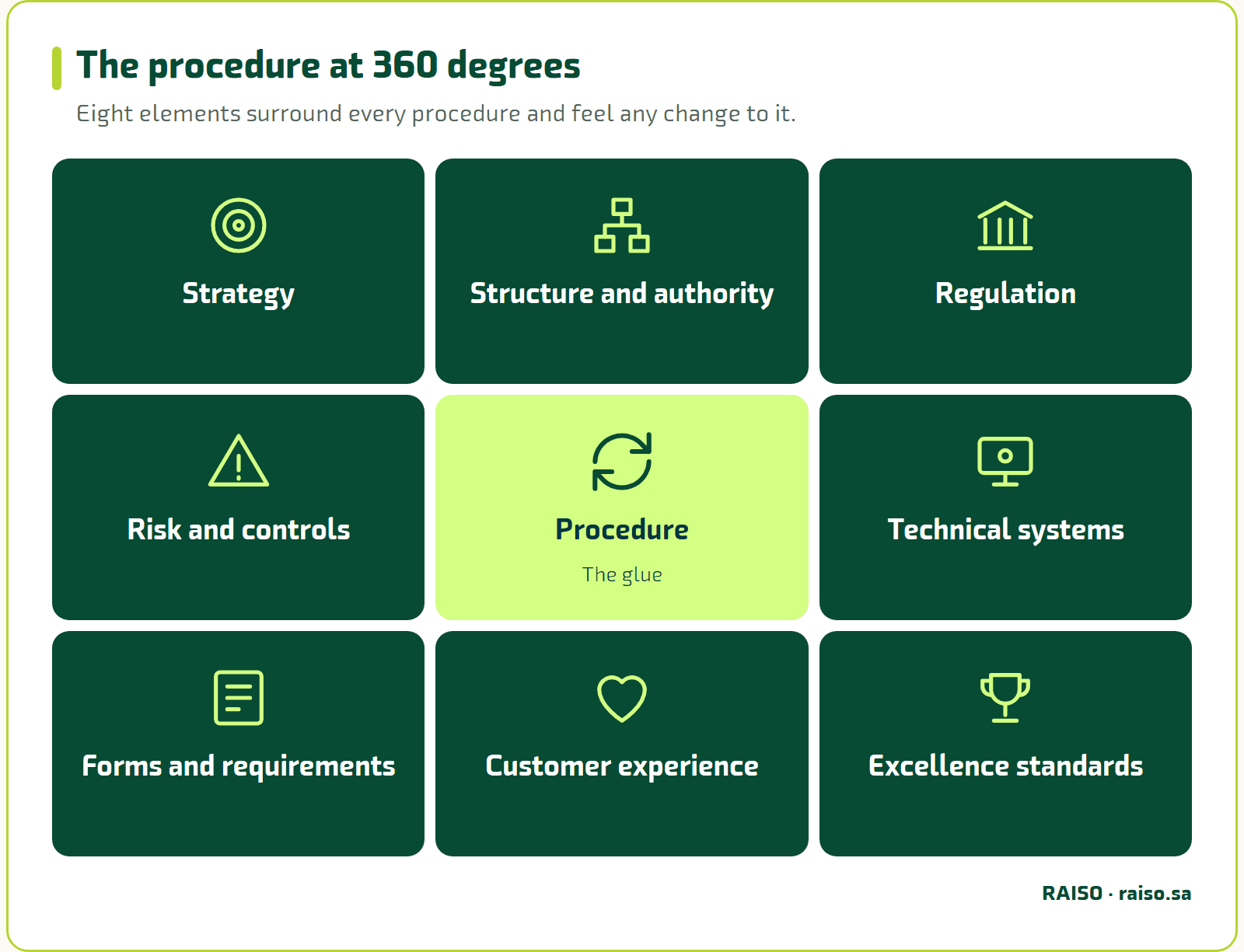
The threads so far gather in one idea: understanding the procedure at 360 degrees. It means not seeing it as isolated steps, but seeing with it, at once, the strategy it serves, the structure that carries it out, the authority that governs it, the regulation that binds it, the risk it guards against, the system that carries it, the customer who lives it, and the standard that measures it.
This understanding is not an analytical luxury. It is what creates shared understanding among everyone who deals with the procedure. When an employee knows why a step is asked of him, what risk it wards off and what goal it serves, he moves from a blind executor of an instruction he does not understand to an aware partner in a system where he knows his place. That awareness makes the difference between formal compliance performed reluctantly and real commitment that comes from understanding and holds when no one is watching.
Shared understanding produces good and lasting performance. Lasting, because it does not depend on particular individuals who carry the knowledge in their heads and take it away when they leave, but on understanding woven into the procedure itself that stays after them. Good, because a whole view exposes points of friction, duplication and gaps that stay hidden from a partial view.
To bring the idea close, picture the organization as a living body. Strategy is the brain: it thinks and decides the destination. Structure is the skeleton: it gives the body its form. The procedure is the muscles: what ties the brain’s intent to the movement of a limb, and turns an abstract nerve signal into a concrete act. An organization with a brilliant brain and a sturdy skeleton but wasted muscles is paralyzed, knowing its destination and unable to move toward it.
And as a muscle grows strong with regular exercise and wastes with neglect, a procedure grows strong with continuous integrated improvement and wastes with neglect and fragmentation. And as no muscle works apart from the network of muscles around it, a procedure does not serve its purpose apart from the procedures around it.
From this, Layla produced a one-page card she attaches to every procedure she owns, with eight questions:
- Strategy
Which strategic goal does this procedure serve?
- Structure and authority
Who performs each step, who approves it, and do they hold the authority?
- Regulation
Which regulation or policy does it translate, and where is the evidence of compliance?
- Risk
What risk does it guard against, and where is the control inside the steps?
- Technical system
Where is the procedure executed and what is automated in it?
- Forms and requirements
What fields does it collect, who reads them, and when are they reviewed?
- Customer
Where does the customer touch this procedure, and what do they see of it?
- Standard
Which quality standard does it secure, and how does improvement continue without breaking joints?
| Element | Question | Met | Partly met | Not met |
|---|---|---|---|---|
| Strategy | Which strategic goal does this procedure serve? | |||
| Structure and authority | Who performs each step, who approves it, and do they hold the authority? | |||
| Regulation | Which regulation or policy does it translate, and where is the evidence? | |||
| Risk | What risk does it guard against, and where is the control inside the steps? | |||
| Technical system | Where is the procedure executed and what is automated in it? | |||
| Forms and requirements | What fields does it collect, who reads them, and when are they reviewed? | |||
| Customer | Where does the customer touch this procedure, and what do they see of it? | |||
| Standard | Which quality standard does it secure, and how does improvement continue without breaking joints? |
Fill it for one procedure you own, ticking the fitting column.
Where the case stands now: Two months later Layla improves the license-renewal procedure again, but this time starts from her card. She gathers the parties concerned for one hour and decides with them what is cancelled, what is automated and what stays. Service time shortens, and the sudden stops at compliance and audit disappear.
Try it now: fill the card for one procedure you own, in thirty minutes. The questions you cannot answer are exactly your weak joints.
What You Take With You
We return to where we began, with a deeper understanding. An organization that treats its procedures as isolated steps turns, little by little, into an archipelago of islands: each department a self-sufficient island that masters its internal work and ignores what surrounds it. One that treats them as glue becomes a single system. Layla moved from the first to the second by one change: she began to see her procedure from every side before changing anything in it.
If five ideas stay with you from this article, let them be these:
- A procedure is a binding fabric, not a list of steps, and an organization’s strength lies in the strength of the joints between its departments.
- Link each core procedure to a strategic goal; cancel what serves no goal, and build what lacks a procedure.
- Translate regulation and risk into steps and controls inside the procedure, and do not leave them in separate files.
- Build the procedure inside the technical system with one form and fields that have a reader, and let the system guard it.
- Before every improvement ask: did the step get better, and did the integration of the system increase?
Now to action. Choose one procedure you own, fill the eight-question card, and sit for one hour with those affected by it before any change. And if you want to go deeper into building procedures and linking them to strategy, risk and the customer, we invite you to explore RAISO’s course on process and procedure management, and to apply it to a real procedure in your organization.