



Why Excellence Initiatives Fail Before They Begin
A director general walks into a meeting convinced that the organization deserves excellence. Respected international models are presented, and he hears that another entity applied one and its results jumped. He agrees, the budget is approved, a team is formed, and an elegant launch event is held. Six months later the reports arrive: modest indicators, silent employees, and polished files that look nothing like what happens at the desks. Everyone asks the usual question: why didn't we execute with more seriousness?
This article suggests the question itself is wrong. The initiative did not fail because someone fell short in execution. It failed because it was built on an imagined picture of the organization, a picture nobody examined before the work began. We will follow one case from start to finish: Salma, launching an excellence initiative at a service agency. In each section we meet one of six failure patterns, then see how her situation changed once she addressed it. By the end you will have a practical way to start from your own reality: how to write an honest diagnosis, how to fix a measured starting point, and who should be in the room when decisions are made.
Salma launches her initiative
Salma leads organizational excellence at a hypothetical agency that issues licenses to small businesses. The complaint is known everywhere in the agency: licenses take too long. In a senior management meeting everyone agrees on the answer, and the director general says, "We need an international excellence model. Let's implement it." Salma is excited; this is her chance. She picks a well-known framework, forms an eight-member committee, and books the ceremony hall.
Three months later her desk is covered with documents: new policies, process maps, an evidence guide for assessment. But the queue of applicants has not shortened. When she asks the reception supervisor what she thinks of the initiative, the answer comes with a polite smile: "Lovely. We'll see." Nobody objects, and nobody changes.
The story is hypothetical and its numbers are only illustrative, but its outline is familiar to anyone who has worked on an improvement initiative. Salma's first question will be the one we usually avoid: what did we assume before we started?
“An initiative that starts from an untested assumption is very good at walking in the wrong direction.”
Failure starts in the assumption, not the execution
When an initiative stumbles, everyone looks for the collapse in the execution phase: the team was late, commitment weakened, leadership support faded. That autopsy starts in the wrong place. The decision that sealed the initiative's fate was made months before execution, in a quiet moment nobody noticed: the moment we assumed we knew our reality.
Every initiative carries a mental picture of the organization: how processes run, where the problems are, who does what, why things get delayed. That picture is the diagnosis. Most of the time it is never written, tested, or reviewed. It is simply assumed. Leaders gather in a room, sketch the process on a board as the attendees remember it, agree on "the problem," and move to the solution. But what is on the board is the process as imagined by people who do not run it daily, not as lived by the person behind the service counter.
Here is a fallacy we all share: we treat diagnosis as a quick, obvious step, when it is the hardest and riskiest stage of the whole initiative. A doctor who prescribes before examining is not called fast; he is called reckless. Yet we accept that an initiative costing millions can launch on a diagnosis that took a single meeting.
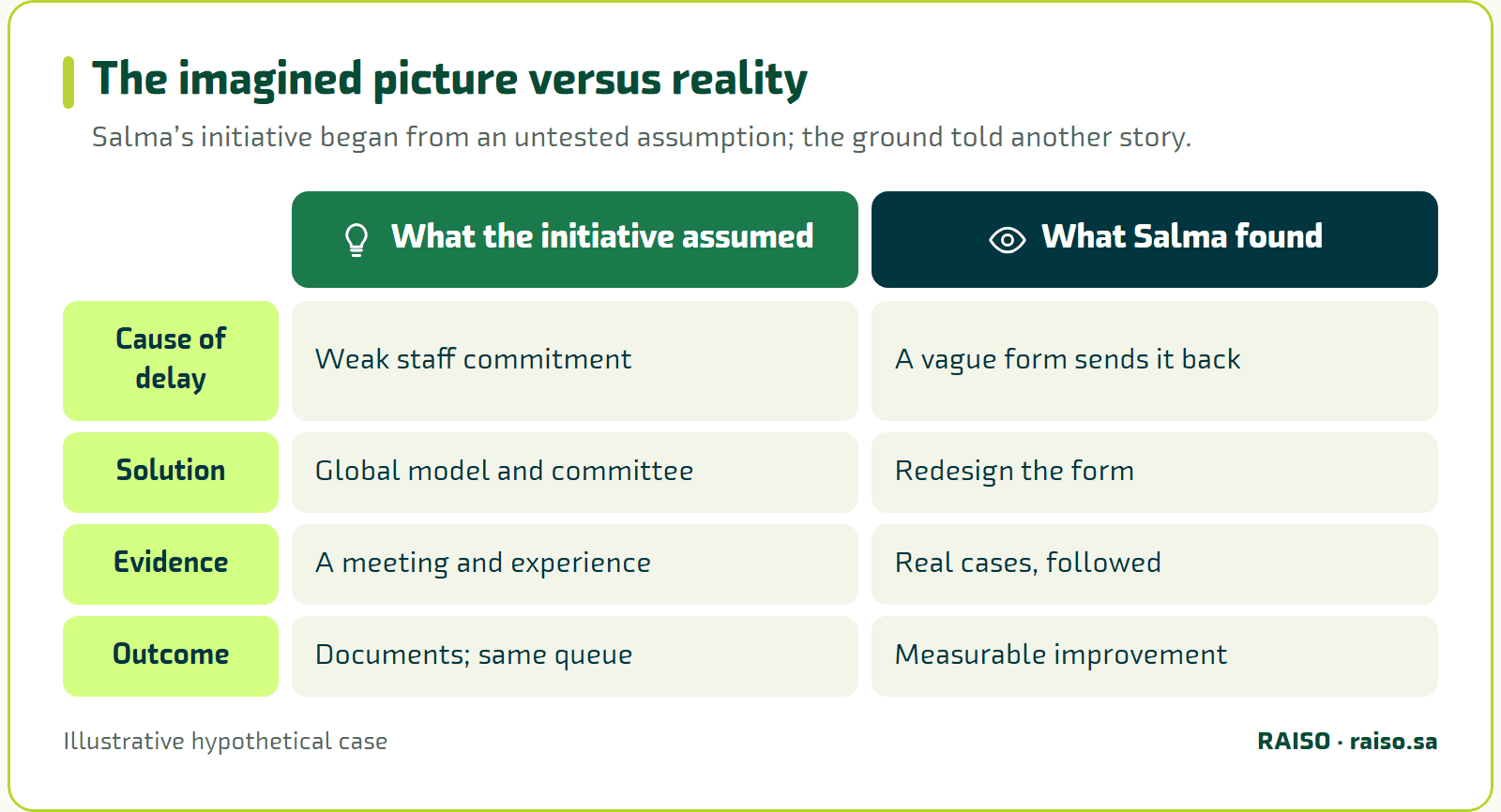
The result is that all the effort is aimed at a problem that may not be the problem. And the better the team executes, the deeper the wrong solution sets, and the harder and more expensive it is to retreat.
Salma now: she returns in her mind to the meeting where the initiative was launched and asks one question: what did we believe caused the delay? She writes three assumptions on a sheet: "Employees don't follow procedures," "we need automation," and "the global framework will handle the rest." Then she notices what she had missed before: nobody tested a single one of them.
“Write down at least three assumptions behind an initiative you are working on now. Next to each, write one question: what evidence have I seen with my own eyes?”
Pattern one: starting without a diagnosis
The simplest and most common pattern is an initiative that starts without examining reality at all. No measurement of the operational baseline, no serious attempt to understand how things run before trying to change them. The whole understanding phase shrinks to leadership impressions and memory, and the team jumps straight to designing a solution.
There are understandable reasons. Pressure for results makes diagnosis look like a delay with no visible value. Trust in experience says, "We know our organization; we have worked here for years." And in many organizations the culture rewards fast motion and penalizes patience, so whoever asks for time to examine looks hesitant.
But a leader's experience, however deep, remains a view from above. An executive sees a process as it appears in reports and dashboards. Between what rises upward and what happens below there is a steady gap: reports are cleaned and polished on their way up, so the picture arrives tidier and simpler than reality. A decision built on a cleaned picture is built on missing information from the start.
The cost is that the initiative may solve problems that do not exist, or ignore the real one. An organization that automates a broken process gets a faster version of the chaos. Another launches a huge training program when the flaw is in the design of the work, not the skill of the people doing it.
Salma now: she decides to sit three days in the reception section and follow five license applications from arrival to issue. She finds something nobody mentioned in the meeting: three of the five came back to the applicant twice for missing attachments, because the application form does not say which attachments are required. The problem is not employee commitment. It is an unclear form.
“Pick one process in your organization and follow one real case through it, from start to finish, without asking anyone for an opinion. Note every wait, every return, every handoff.”
Pattern two: copying a model instead of understanding it
When an organization decides to pursue excellence, the first thing it usually does is look for a model that worked elsewhere. A company applied a methodology and jumped ahead, or an agency adopted a famous framework and won an award. The experience is imported whole, with its tools, vocabulary, and steps, in the hope that the result repeats. This is where the mistake lives: we replaced understanding with copying.
A successful model is a solution designed for a particular problem in a particular setting. It did not succeed because it is good in itself, but because it fit the reality of the organization that applied it: its culture, its operational maturity, the nature of its sector. When you carry the solution without carrying the understanding of the problem it was built for, you carry the shell and leave the substance.
Global excellence frameworks, valuable as they are, were designed as mirrors in which an organization can look at itself, not molds to pour itself into. When an agency treats a framework as a checklist to satisfy an outside assessor, excellence turns from a real practice into a paperwork ritual: evidence is gathered, policies are written, files are prepared, and reality stays as it was.
“A global model is the answer to a question another organization asked. Whoever imports the answer without asking the question first gets a correct answer to a problem he does not have.”
Worse, copying switches off thinking. With a ready model in hand we feel excused from the effort of understanding our own situation, so the model becomes a substitute for diagnosis rather than a tool of it. We spend months fitting the organization to the model, instead of spending days understanding the organization and then choosing what fits from the model.
Salma now: she rereads her framework with a new question. She no longer asks "what does it require of me?" but "which part answers the problem of the unclear form and the missing attachments?" She finds two criteria that touch her problem, decides to start with them, and postpones the rest until she knows what she actually needs.
“Take any framework your organization works with and write, in one line, the original problem it was designed for. Then write a second line: do we actually have that problem?”
Pattern three: no operational baseline
Imagine a doctor who starts treatment without measuring the patient's blood pressure or temperature. How will he know the treatment works? That is exactly what many initiatives do when they launch without a measured operational baseline: an accurate, documented picture of reality as it is now, before any intervention. It is the starting point against which everything afterward is measured.
An operational baseline is not numbers for decoration. It is measured answers to simple questions: how long does the process really take from start to finish? How often is a task redone because of an error? Where does work pile up and wait? How much of an employee's time goes to work that adds value, and how much to correction, review, and waiting? Without those answers, every later claim of improvement is an opinion that can be neither proven nor disproven.
The absence of a baseline creates two problems. First, we do not know where to start, so we diagnose by instinct: "the process is slow." How slow? Compared with what? Second, and worse, we will never know whether we improved. Months later, when the team is asked about impact, it has only impressions: "things are better and people are happier." Those do not survive one executive question: by how much, and what is your evidence?
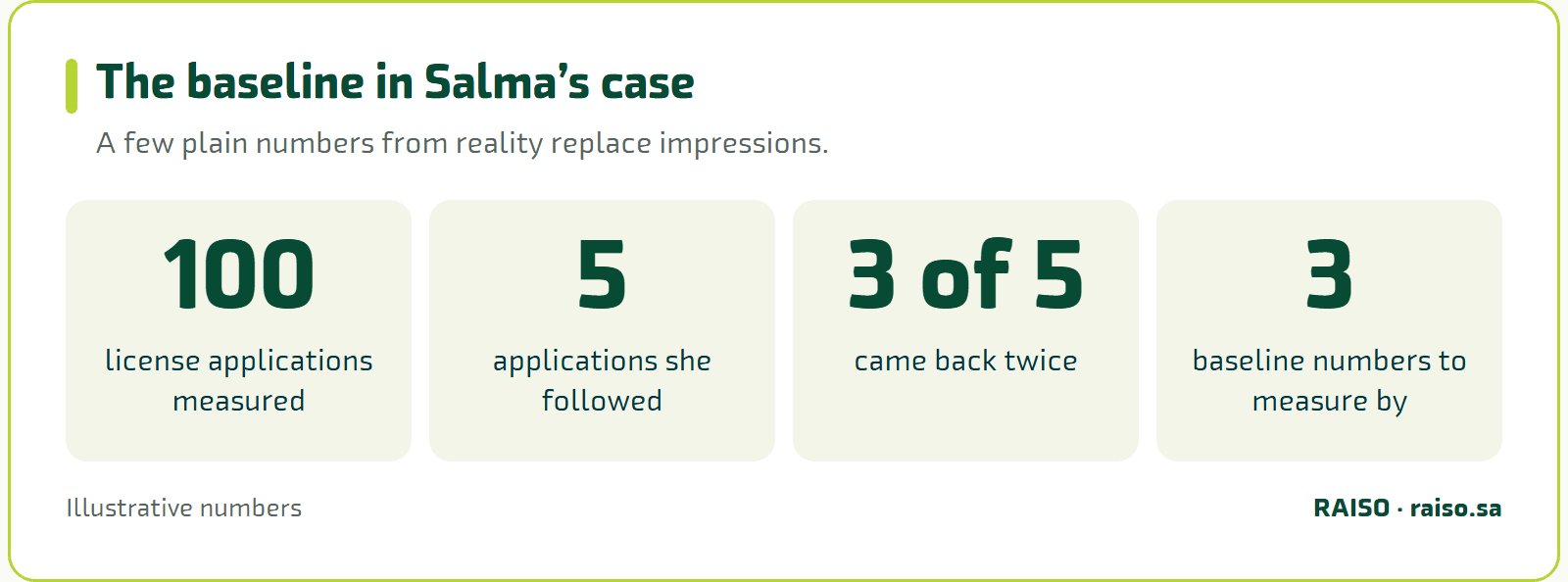
There is a political cost as well. An initiative with no reference cannot prove its worth, so it becomes vulnerable to cancellation at the first budget squeeze. Work that may have been useful dies because it could not prove it was useful.
Salma now: she measures a hundred license applications from the past months and ends up with three plain numbers. The average time from submission to issue, the share of applications that came back for missing attachments, and the number of offices a single application passed through. The numbers are not pretty, but they are the first real thing in the initiative's file, and every improvement will be measured against them.
“Choose three questions about the time, errors, or waiting in a process, and answer them with numbers from at least twenty past cases. Keep the sheet. It is your baseline.”
Pattern four: leadership theater instead of commitment
Every major launch has a familiar scene. The executive opens the event with an inspiring speech, announces that excellence is a strategic priority, and the photos are taken and shared on internal channels. If it stops there, this is not commitment but leadership theater. It is among the most dangerous patterns because it imitates real support so precisely that it fools everyone, including the leader.
The difference between theater and commitment shows after the party. Commitment means the leader gives time, not only words: attends progress reviews regularly, asks hard questions, makes costly decisions that remove obstacles, and reallocates resources when needed. Theater settles for symbols: a speech at the beginning, absence afterward, and a sudden preoccupation with something "more important" when the initiative hits its first wall.
Employees read these signals with remarkable accuracy. They listen less to what the leader says than they watch what he does. If they see that the person who launched the initiative with enthusiasm attended none of its reviews, they understand the message at once: this is not a real priority. So they give it the same amount of attention its own leader gave it, which is a ceremonial amount.
Theater also has a hidden link to a wrong diagnosis. When the diagnosis is built in a closed room, it is hard for a leader to commit deeply, because deep down he is not sure the stated problem is the real one. Commitment is born of conviction, conviction of understanding, and understanding of an honest diagnosis. A leader who has seen the numbers with his own eyes commits because he knows. One handed a presentation merely complies.
Salma now: she asks the director general for one hour, not to present a plan but to show him the three numbers and walk him to the reception section to see a returned application for the second time. He comes back from the tour quiet, then says, "Put the initiative review in my calendar every two weeks, and I will attend." For the first time, support turns from a sentence into an appointment.
“Ask yourself or your leader: what is the one hard decision we have made in favor of this initiative since its launch? If there is no answer, that is the theater.”
Pattern five: an initiative without an owner
Many excellence initiatives are born orphans. They launch with momentum, then are handed to a "committee," a "task force," or a department already busy with its own work, with no single person who truly owns the initiative and answers for its result. When responsibility is spread across everyone, it is in fact on no one.
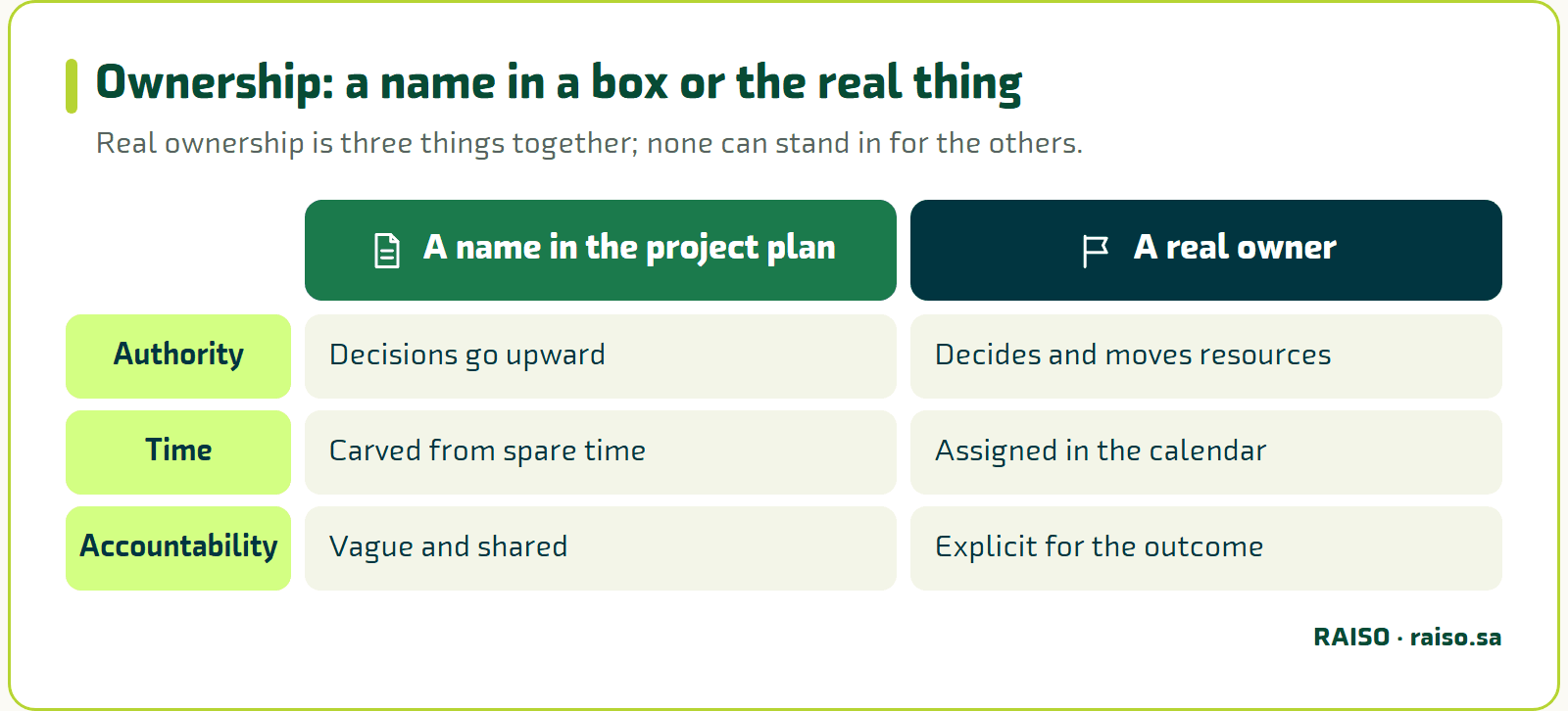
Ownership is not a name in the "responsible" box of a project plan. Real ownership is three things together: the authority to decide and move resources, time that is actually assigned rather than carved from an empty calendar, and explicit accountability for the outcome, success or failure. If any of the three is missing, ownership is a title with no content.
Without an owner, the initiative stalls in ways that are hard to trace. Pending decisions pile up because nobody has the authority to settle them. Conflicts between departments over priorities stay without a referee. And the momentum dies slowly, not by an explicit decision to stop but by neglect until it is forgotten. This slow death is worse than a clear cancellation, because it drains resources without freeing anyone to look for an alternative.
This pattern meets diagnosis at an important point. When the diagnosis is vague, the right owner is hard to name, because the problem itself has no clear edges. When the diagnosis shows where the problem lies, in which process and under which department, the natural owner appears on his own. A good diagnosis reveals the problem and also reveals who should own its solution.
Salma now: it turns out the problem sits in three points that belong to the licensing department itself: the form, the list of attachments, and the handoff of applications between offices. She proposes making the head of licensing the initiative owner, with authority to change the form, three days a month set aside in his calendar, and a report he delivers personally to the director general. The eight-member committee becomes an advisory team.
“Write the name of the person who owns your initiative today, and next to it the authority, the time, and the accountability. If you cannot find all three written down, the initiative is still an orphan.”
Pattern six: change fatigue, and the thread that ties them together
When a new initiative knocks on the door of an employee who has known the organization for years, it does not find an empty mind ready for enthusiasm. It finds a mind weighed down by the memory of earlier initiatives launched with the same noise and then evaporated. This is change fatigue, a tax the organization pays for every initiative that started and never finished.
It is not laziness or blind resistance but a rational response. The employee has watched the cycle repeat: a big announcement, early enthusiasm, new training and forms, then fading, then a quiet return to how things were. After two or three rounds he learns that the best strategy is to wait. He does not oppose openly; he goes along on the surface and keeps doing his real work as before, confident that the initiative will pass like the ones before it.
The irony is that change fatigue is a direct product of accumulated wrong diagnoses. Each earlier initiative solved problems the employee did not see as real, and ignored what he struggles with daily. A vicious circle forms: a wrong diagnosis produces a failed initiative, failure produces fatigue, fatigue makes the next initiative harder, and if that one fails too, the fatigue deepens.
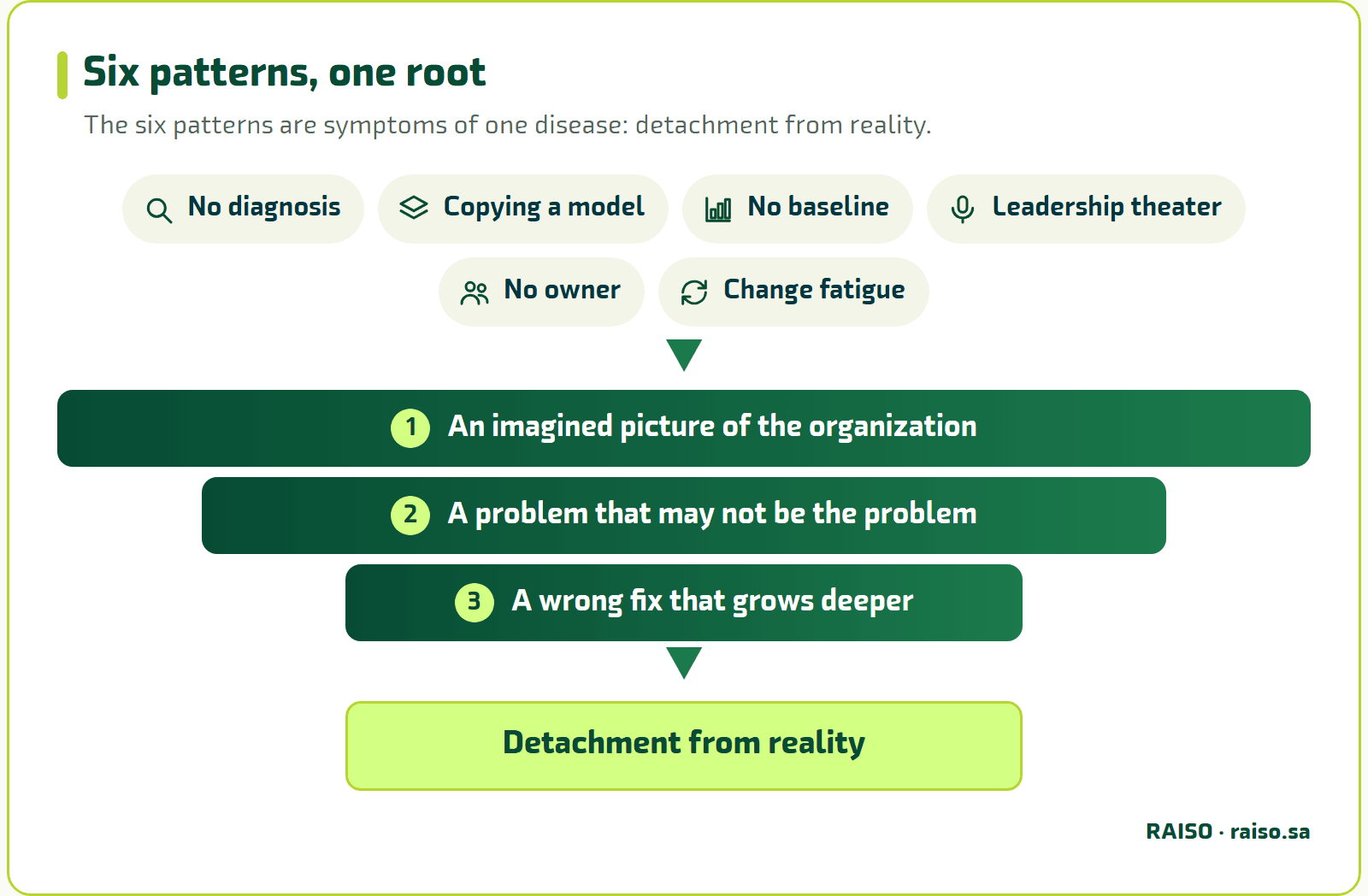
Now the common thread is visible. The six patterns are not six diseases but one symptom in different faces, and the disease is detachment from reality: starting from a picture of the organization rather than from the organization. Starting without a diagnosis is a refusal to examine reality. Copying models replaces understanding it with an imported understanding. No baseline is a neglect of measuring it. Leadership theater is weak commitment because it does not rest on conviction. No owner is the fruit of a blurry diagnosis. And change fatigue is the inheritance of earlier initiatives that detached from reality. Instead of treating each symptom separately, we treat the root, and the symptoms recede together.
Salma now: in a meeting with staff she noticed everyone nodding and nobody speaking. So she asked plainly, "What have we tried before that did not work?" They talked for an hour about two earlier initiatives. Then she told them she had started this time by following applications, and she put the returned-application case in front of them. One said, "This is the first time someone has seen what we see every day."
“Ask three people who do the work: which initiative was launched and never finished, and why do you think so? Listen without defending. This is a direct measurement of change fatigue in your organization.”
| # | Question | Pattern it reveals | Met | Partly met | Not met |
|---|---|---|---|---|---|
| 1 | Did we examine reality by following real cases before choosing the solution? | Starting without a diagnosis | |||
| 2 | Do we know the original problem the framework we apply was built for? | Copying a model | |||
| 3 | Do we hold measured numbers from past cases to judge improvement by? | No operational baseline | |||
| 4 | Has the leader made one hard decision for the initiative since launch? | Leadership theater | |||
| 5 | Does the owner have written authority, time, and accountability? | An initiative without an owner | |||
| 6 | Have we listened to implementers about past initiatives that stalled? | Change fatigue |
Tick each honestly; the gaps are your starting point.
How real excellence begins: from the operational baseline
If a wrong diagnosis is the root of the illness, the cure is a commitment to an honest diagnosis before choosing any solution. That is why RAISO developed its diagnostic approach, CorexSight™: an organized entry point for understanding an organization's operational baseline as it really is, not as it appears in reports or is assumed in meeting rooms. The idea is simple but rarely applied: before we prescribe, we examine the patient properly.
The goal is not a thick report that sits in a drawer. It is a realistic, measurable picture of how processes actually work, where value is lost, and where the gap lies between what is documented and what is practiced. It turns diagnosis from an impression gathered in a meeting into a disciplined practice that listens to reality at its source. Here are five principles any serious organization can adopt, whatever method it uses:
- Go to the source: understand the process where it actually runs, by listening to those who do the work every day, not only to what reaches the top.
- Measure before you change: fix a reference baseline for time, quality, and waste, so you know where you start and can prove your impact later.
- Separate the documented from the practiced: look for the gap between the written process and the running one; most of the flaw lives there.
- Define the problem before the solution: resist the pull toward models until you hold an accurate, evidenced description of the problem.
- Involve those who will live the change: make the people who do the work part of the diagnosis, and you build both a truer understanding and deeper acceptance.
When an initiative starts from this foundation, the six patterns flip. There is no starting without a diagnosis, because the diagnosis is the starting point. No blind copying, because the solution is chosen after the problem is understood. A measured baseline proves the impact. Leadership commitment is deeper because it comes from conviction. The owner is clear because the diagnosis showed where the problem sits. And trust returns, because the employee sees at last that someone understood his reality before asking him to change.
Salma now: she writes a one-page diagnosis in four paragraphs. The problem: applications come back twice because of an unclear form. The evidence: three baseline numbers and five cases she followed herself. The owner: the head of licensing. The first step: redesign the form within three weeks. Two months later she measures the same numbers again and finds that returned applications have clearly dropped. She did not need an award to know that something had changed.
“Write a one-page diagnosis for an initiative you work on: the problem, the measured evidence, the owner, and the first step. If you cannot write the evidence, then your first job is to collect it.”
“Excellence does not begin with the ambition to be better. It begins with the courage to see ourselves as we actually are.”
What you take with you
First, take this: an initiative's failure is read from its assumptions, not its execution. Second, the six patterns, starting without a diagnosis, copying models, no baseline, leadership theater, no owner, and change fatigue, share one root: detachment from reality. Third, the cure is not a louder initiative but a more honest diagnosis: go to the source, measure, separate the documented from the practiced, define the problem before the solution, and involve the people who do the work.
In the wider transformation underway in Saudi organizations under Vision 2030, this lesson matters even more. The Vision pushes entities, public and private, toward a wave of improvement initiatives. That momentum is a blessing if it comes with maturity about how to begin, and a large waste if every initiative starts from the same wrong diagnosis. An organization that learns the lesson gains a quiet but decisive advantage: it directs every riyal toward the real problem because it knows what the real problem is. That asks for a rare virtue, intellectual humility: a leader who can say, "Let us examine before we decide."
Start today with one small step: pick one process in your organization, follow one real case through it, and write down what you see. And if you want to do it with an organized method and a team of experts beside you, contact RAISO to book a diagnostic session that starts from your operational baseline, before you decide which model to adopt and which solution to buy.