



Measurement Without Targets: Is It Possible?
Hind opens the performance dashboard on Monday morning and everything is green. Processing time is inside the target, and every indicator sits on the right side of its line. Then she opens her email and finds five complaints from beneficiaries whose requests dragged for days. The number says the work is excellent, the people say otherwise, and Hind does not know which to believe.
This article offers an idea that can sound provocative in a culture that worships numeric targets: once you set a hard target, the data begins to bend. That is not a verdict on anyone's character. It describes a behavioral law running quietly in the background. It is also not a defense of chaos or a call to give up ambition. What we propose is a practical alternative called trend-based measurement: reading the direction and variation of performance over time rather than judging it pass or fail against a threshold. It extends what we wrote earlier in "Metrics, Not Indicators," but asks a further question: not where to put the number, but whether we need it at all. In each section we follow Hind as she discovers what lies behind her dashboard, so that you leave with a small experiment to run on one process in your own organization and with the ability to tell natural variation from a real signal.
Hind and her green dashboard
Hind runs the beneficiary service center at a hypothetical agency. A year ago management set a clear goal: "Every request is processed within 48 hours." The number went on the dashboard, tied to team evaluations, and everyone began working toward it. In recent months the share inside the target has run above ninety-three percent. The story is hypothetical and its numbers only illustrative.
Yet the complaints did not drop. So Hind does what a dashboard cannot: she traces thirty requests herself. She notices that some complex requests are closed before the last twenty-four hours run out, and then a new request with a new number is opened for the beneficiary, restarting the clock from zero. Other requests are tagged "waiting for beneficiary" so they drop out of the count, though nobody asked the beneficiary for anything. Nobody is lying in any ordinary sense. Everyone is simply dealing with the number the way the number wants to be dealt with.
And here Hind's question begins: is the problem staff who "game" the system, or a target that makes gaming the easiest path?
“A numeric target does not measure performance; it measures how skilled people are at pleasing the number.”
How distortion is born from a target
To see why a target bends reality, follow the number's journey from the moment it is fixed. When a hard target is set, such as "close the request within 24 hours," "keep errors under 2%," or "reach 95% satisfaction," we send one unmistakable signal: what matters is landing on the right side of the line. And people respond to the signals they receive, not to the intentions we hold privately.
The distortion happens in three successive layers. The first is behavior: people rearrange their work around the threshold rather than around its value, serving what is near the line first and postponing what is far from it. The second is classification: when reality is hard to improve, reality gets redefined. A complex case is closed and reopened under a new number, or filed outside the counted scope. The third, and the most serious, is reporting: when even reclassification is not enough, the reported figure becomes the product of a quiet negotiation between what happened and what should be said to have happened.
The cruel irony is that each layer burns real effort that could have gone into improving the work. An employee who spends an hour reclassifying a case to take it off the late list has not improved service by a single minute; only the number improved. So a target turns from an incentive for performance into a tax on honesty, paid twice: once in wasted effort, and again in the decision later made on a figure that does not mean what you think it means.
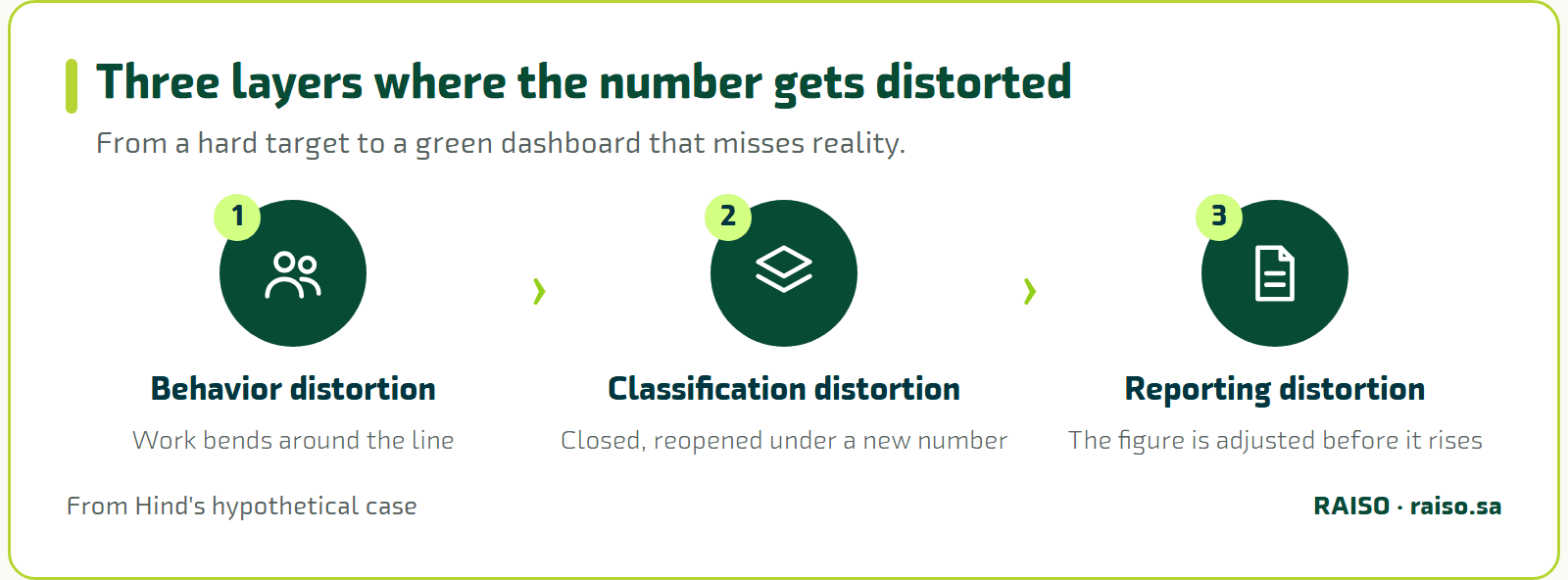
Hind now: she sketches what she found in thirty requests across the three layers. First layer: teams handle requests close to the 48-hour line first and push the hardest ones back. Second: requests reopened under new numbers and the "waiting for beneficiary" tag. Third: a weekly report that gets adjusted before it goes up. She understands that the green dashboard is not one person's lie but the logical outcome of a system that rewards the color green.
“Pick a metric tied to a target in your organization. Write three ways a sensible, sincere person could make the number look better without the work getting better. If you cannot think of any, ask the people who do the work.”
Goodhart's law: when a measure becomes a target it stops being a measure
This is not a passing remark but a law formulated by the British economist Charles Goodhart in 1975, in the context of monetary policy, before it turned out to fit almost every human measurement system. Its common form says: when a measure becomes a target, it ceases to be a good measure. The reason lies in the relation between observer and observed. A good measure works quietly at the edge of a process, capturing what happens without interfering. But once we attach a reward, a penalty, or a verdict to it, we pull it into the center of the process as an active participant, and it starts changing the very thing it was meant only to observe.
The distinction worth holding firmly is the one between a measure and a target. A measure says: this is what is happening. A target says: this is what must happen, and you will answer for it. The moment we add the second sentence, we spoil the first. So the heart of the problem is not that numbers exist but that we turn them into pass-fail thresholds. The number is innocent; the threshold is what contaminates it.
Because the law is sometimes misread, a clarification: it does not say measurement is useless, and it does not say people are corrupt. It says that any measure we put pressure on becomes a target for direct optimization instead of the reality it stands for, and the heavier the pressure, the wider the gap between the number and what lies behind it. That leads to a counterintuitive conclusion: the cleanest data in an organization may be the data nobody is held accountable for, because it is the only data nobody has a reason to polish.
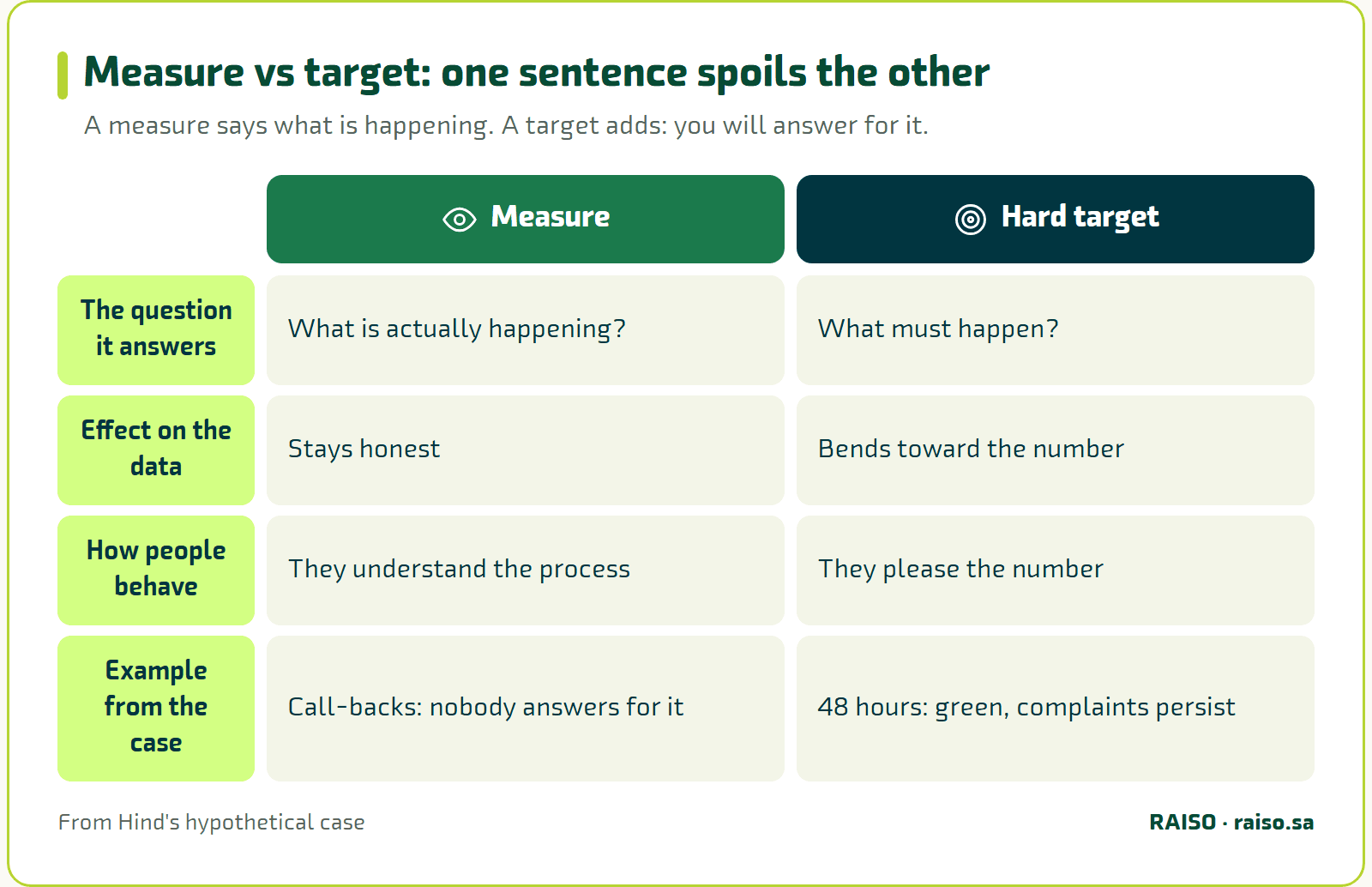
Hind now: she notices that the most honest number in her center is one that appears in no evaluation: how many times a beneficiary calls back to ask the same question. Nobody answers for it, so nobody hides it. And that number, once she looked, told her more about the service than the whole green dashboard.
“Look in your organization for a number nobody is held accountable for, and compare it with what the target dashboard says. Which one is closer to what beneficiaries tell you?”
Deming: management by numeric targets is management by fear
Edwards Deming was no enemy of measurement. He was a statistician first and spent his life teaching organizations how to read their own data. That is why his warning about numeric targets carries special weight: it did not come from someone who dislikes numbers, but from someone who loved them enough to refuse their misuse. In his book "Out of the Crisis," he listed numerical quotas and management by objectives among the "deadly diseases" of management.
His central argument is that most of the variation we see in performance comes from the system itself, not from the individuals working in it. When we set a numeric target and hold an individual accountable for it, we load him with responsibility for something he does not fully control, the performance of the system, and then we are surprised when he turns to tricks. A numeric target does two bad things at once: it puts on the individual what belongs to the system, and it turns data from a tool for learning into a tool for blame.
The deeper consequence is what Deming called fear. An employee who knows bad data will be used against him learns one lesson: do not show bad data. That lesson is ruinous because it kills the learning mechanism at its root. A problem that is not revealed is not solved, and a deviation that is polished over comes back. Measurement without hard targets is not leniency toward performance; it is the condition for people daring to tell the truth, and there is no learning without truth.
Here is the paradox at the heart of management by targets: we set targets because we want better performance, but hard targets create an environment where people fear the data, and an environment that fears its data cannot improve. We get the opposite of what we wanted: a number shining on the wall and a system rotting quietly beneath it.
Hind now: she sits with a team supervisor and tells her plainly that the dashboard will not enter anyone's evaluation this month. Then she asks, "What is really happening with the complex requests?" After a short silence the supervisor says, "We were afraid to say that some requests truly need four days, because the target is two." The first honest sentence in months.
“Ask yourself: if bad data appeared in our unit tomorrow, would anyone dare to show it? What would happen to them? Write the answer as it is, not as you wish it were.”
Shewhart: natural variation and special variation
If Goodhart explains why targets corrupt and Deming explains what they cost us, Walter Shewhart supplies the alternative. In the 1930s, working at Bell Labs, Shewhart developed what became known as Statistical Process Control. His central idea is almost startlingly simple, yet it knocks out the foundation of management by targets: not every change in a number means something.
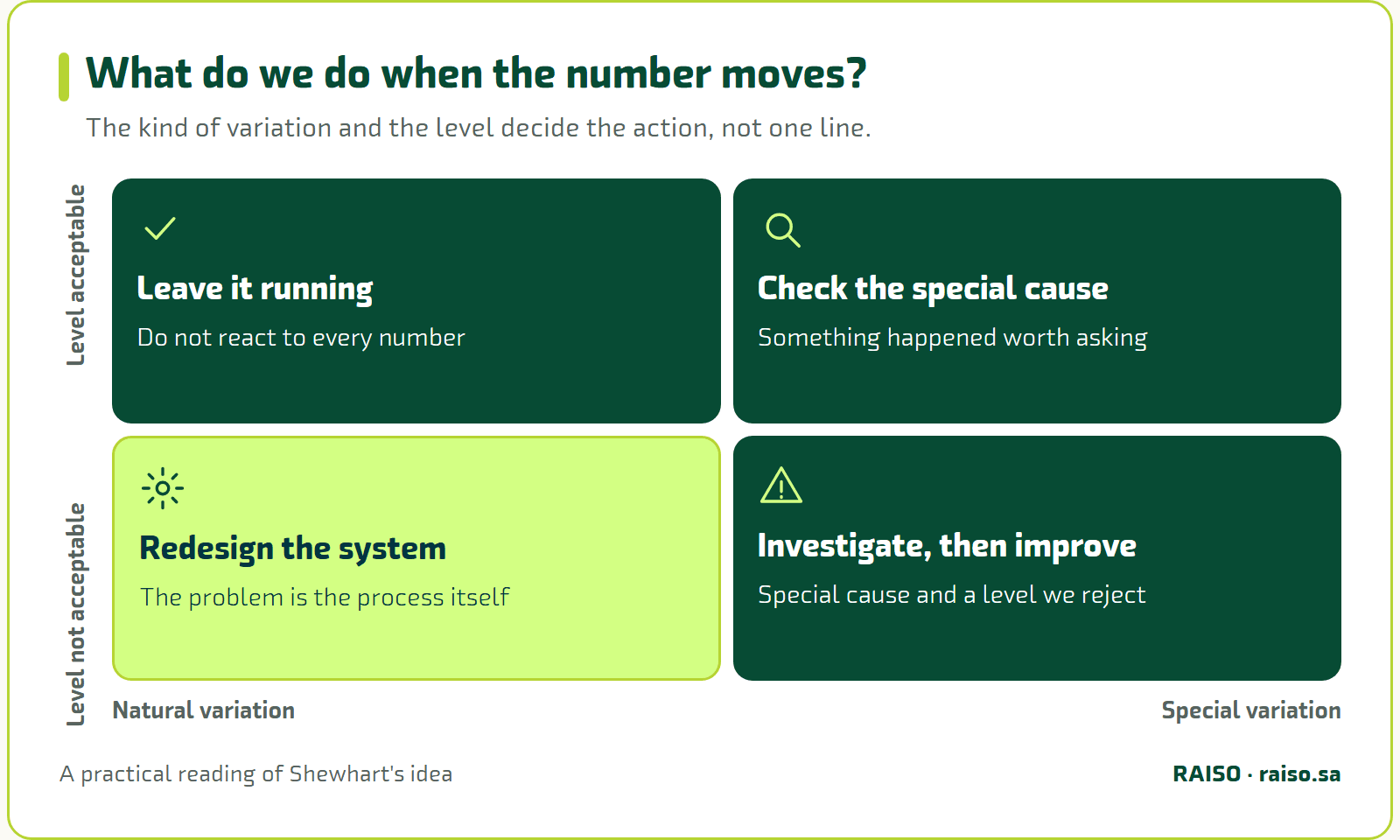
Shewhart distinguished two kinds of variation. The first is common cause variation, the fluctuation built into the nature of any process: always present, pointing to no particular event, and calling for no intervention. The second is special cause variation, a departure from the usual pattern that points to a specific cause worth investigating. The whole skill lies in telling them apart: when is what I see the ordinary noise of the system, and when is it a real signal?
Here is where the numeric target breaks. A rigid threshold treats every number below it as failure and every number above it as success, regardless of whether the difference between them is merely natural variation with no meaning. You may succeed today because luck smiled within the natural range, and fail tomorrow for the very same reason, with the target applauding the first and punishing the second though nothing in the process changed. A target generates false signals: it alarms when there is no danger and reassures when there should be worry.
Trend-based measurement asks the right question: not "did we cross the line?" but "did the behavior of the process change?" That question needs no target to be answered; it needs only the natural range of the process and an eye that reads direction. If performance stays inside its usual range, the process is stable even if we dislike its level, and the remedy is redesigning the system, not scolding individuals. If it leaves its range, there is a special cause worth investigating at once.
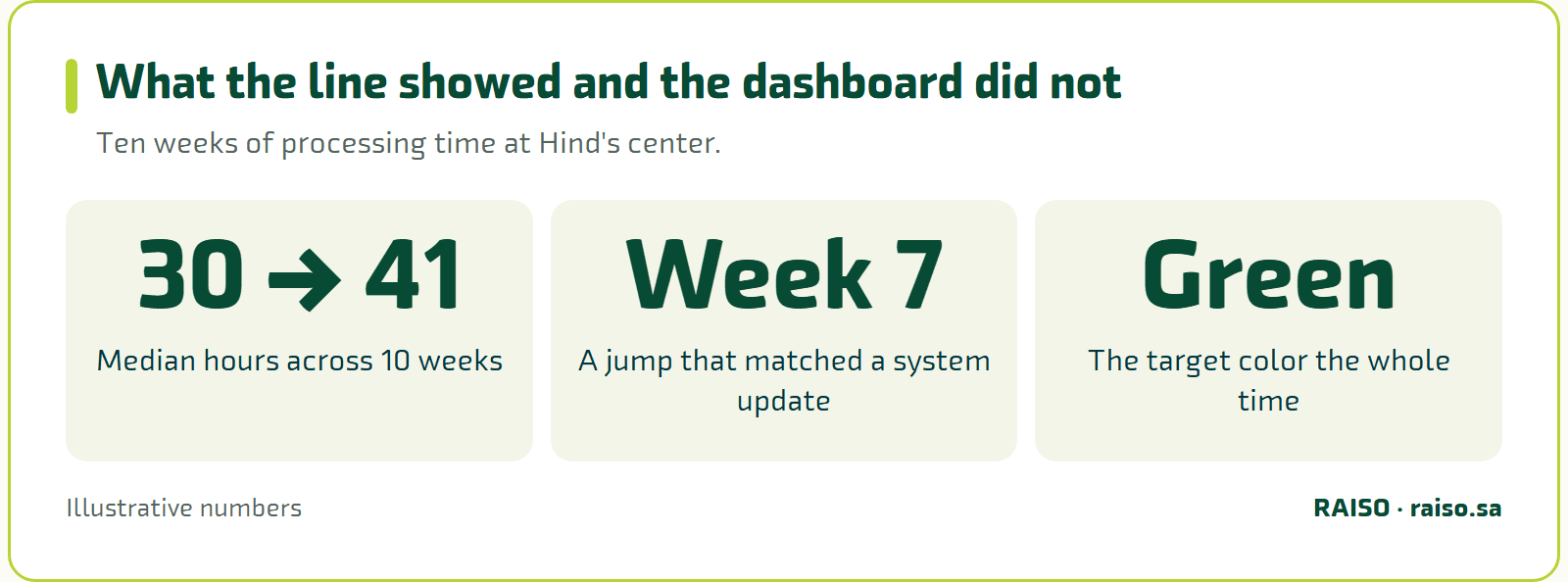
Hind now: she gathers ten weeks of processing time and draws it as a line instead of a colored board, then works out the range in which most weeks fall. Three things appear that the dashboard never showed: the median creeps up from about thirty hours to about forty-one, the week-to-week spread is widening, and in week seven there is a sharp jump that coincided with a system update. The target stayed green the whole time.
“Take a time or error measure for one process, collect its weekly values for at least ten weeks, and plot them on paper. Where do most values fall? Is there a point that clearly departs from the rest?”
What is trend-based measurement?
Trend-based measurement replaces the question "did we hit the number?" with a more honest and more useful one: "where is performance heading, and is its variation natural or special?" It does not abolish the number. It frees it from the job of judging and returns it to its original job, telling the story of the process over time. Instead of a single point hung on a threshold, we read a moving line with a memory. It rests on four elements any process owner can apply:
- Read across time, not at a point
Today's figure is not judged alone but read inside a time series. One high value may be chance; five rising values in a row are a story.
- Set the range of natural variation
We establish the span within which the process swings in its stable state, giving us a reference for telling noise from signal instead of an arbitrary threshold.
- Look for signals, not thresholds
We watch for meaningful patterns: a sustained move in one direction, a sudden jump, a point outside the range, widening variation. These carry meaning; merely crossing a line does not.
- Intervene in proportion to the signal
Natural variation calls for improving the system if its level disappoints us; special variation calls for an immediate look at its particular cause.
A practical contrast: in the traditional approach we set a target, say 48 hours, and paint every request that exceeded it red. The dashboard then tells us who "passed" and who "failed" but nothing about the health of the process. With trend-based measurement we plot processing time across the weeks and see its natural range, and we discover what a threshold never shows: that the average is steady but the spread is widening, or that a jump coincided with a system change, or that the line has been sliding quietly for a month. These are real operational questions, and a threshold is blind to all of them.
Hind now: she reorganizes her weekly meeting. She no longer opens it with "who exceeded the target?" but with the chart itself: "What do you see in the line?" She asks first about the week-seven jump, and the technology team discovers that the update added a verification screen to every request. Nobody would have connected the two if the dashboard had stayed green.
“For one measure, define the range in which most values move (from the usual low to the usual high), then write what would count as a signal worth investigating: a jump? six weeks of rise? a point outside the range?”
But do we not need a standard? And where targets remain legitimate
The most legitimate objection to measuring without targets is this: if there is no line to strive past, what stops a gradual slide into poor performance that merely looks "stable"? Is it not the threshold that pulls us upward? That is a serious objection and deserves a direct answer.
The answer is that trend-based measurement is not the absence of a standard but the replacement of one. Instead of a fixed threshold we leap over once and then forget, our standard becomes the behavior of the process itself across time: is it improving or deteriorating? Is its variation widening or tightening? That is a stricter standard, not a looser one, because it never rewards you for reaching a number and then freezing there; it keeps asking which way you are moving. A threshold lets you rest the moment you pass it, while a trend never does.
| Context | Why the number stays valid | Role of the number |
|---|---|---|
| Contractual or regulatory duty | An explicit limit set by a contract or regulator | An external constraint to honor |
| Safety and risk limits | Crossing it means real harm | A red line that prevents disaster |
| Long-range strategic aim | A quantitative ambition at leadership level | Steers resource allocation |
| A new process with no history | No past data yet | A provisional estimate, later replaced by the natural range |
Here the number is a constraint or an aim, not daily pressure on staff.
As for the danger of "stable but poor" performance, a trend reveals it more precisely than a threshold. When we see that a process is stable inside a natural range but that range sits at a level the beneficiary does not accept, the diagnosis is clear: the problem is not a passing deviation to fix by intervention, but the design of the whole system, which needs re-engineering. A threshold would have hidden this behind the daily noise of passing and failing.
There is also a decisive difference between a strategic aim and an operational target. A strategic aim is legitimate and necessary: to aspire to a service time that delights the beneficiary. But it is realized by redesigning the system to be capable of it, not by hanging a number on individuals and holding them to it daily. Trend-based measurement keeps the ambition whole but puts it in its right place: in the design of the process, not in the evaluation of its operator.
To keep the argument honest, we must admit its limits. Trend-based measurement suits the level of the repeated operational process, where gaming occurs and accumulates. There are contexts where numeric targets remain legitimate, even necessary:
- Contractual and regulatory commitments: when a contract or a regulator imposes an explicit limit, such as a binding response time or a permitted error ceiling, the number is an external constraint rather than an internal motivational tool, and complying is a duty.
- Safety and risk limits: where crossing a limit means real harm to safety, information security, or health, the threshold is a red line whose job is to prevent disaster, not to measure improvement.
- Long-range strategic aims: at the leadership level a quantitative ambition keeps its meaning, such as market share or growth volume, because it steers resource allocation, not the daily behavior of an employee.
- A starting point where there is no history: in a brand-new process with no past data we may need a provisional estimate, to be replaced by the natural range of variation once data accumulates.
The thread joining these exceptions is that in all of them the operational individual is not held accountable for managing the number day by day. The contractual limit is honored by the system, the safety limit is protected by design, and the strategic aim guides leadership. The problem was never that a number exists somewhere. It was turning it into a daily whip on the back of the process owner, who then learns to please it rather than understand his work.
Hind now: she decides to keep the contractual response limit with one external party exactly as written, since it is an outside obligation, and tells the teams that general processing time no longer enters anyone's evaluation. What she asks of them is to read the line and raise the signals. And she tells them the ambition stays: she wants faster service, but she will get there by redesigning the verification screen, not by urging them to hurry.
“Make two lists for your organization: external or safety targets that must stay, and internal operational targets managed through daily pressure. Which of the second could become a trend reading?”
What changes in the operations room
The deepest effect of moving from targets to trends does not show on the dashboards but in how people behave and how they relate to their data. When a process owner knows his measure will not be used to judge him but to help him understand his process, everything changes, and data turns from a threat to be dodged into a mirror to learn from. Hind sees three changes within weeks.
The first change is honesty. In a target environment bad data is an enemy to hide; in a trend environment it is precious information that reveals an opportunity. An employee who does not fear his number records it as it is, and for the first time the organization sees its real situation. That ability alone justifies the whole shift, because every improvement starts from an honest view.
The second is the kind of intervention. A process owner who reads a trend instead of a threshold learns to ask before acting: is this natural variation or a signal? He stops the nervous reaction to every number, the "tampering" Deming warned about, which adds disorder to a process instead of calming it, and he steps in only when a signal deserves it. The outcome is steadier processes and a calmer, more confident owner.
The third, and perhaps the most important organizationally, is how help gets requested. When trends show that a process has slipped out of its owner's control, through widening variation or a decline that local fixes do not touch, he can raise it not as a complaint but as a documented case: "The trend shows steady deterioration for six weeks, I tried this and that, and the problem is in the design of the system, not its execution." This is not an admission of weakness; it is the highest form of professionalism.
Hind now: six weeks later one of her supervisors brings a one-page paper with the line chart and a sentence: "Time has been rising since the update, our experiment with redistributing requests changed nothing, the problem is the verification screen." He would never have dared say this while the target was green. The screen is fixed within two weeks, and the line returns to its usual range.
“Ask your team: when did someone last raise a problem in the design of the work, backed by data? If it never happens, what stops it?”
How to begin, in practice
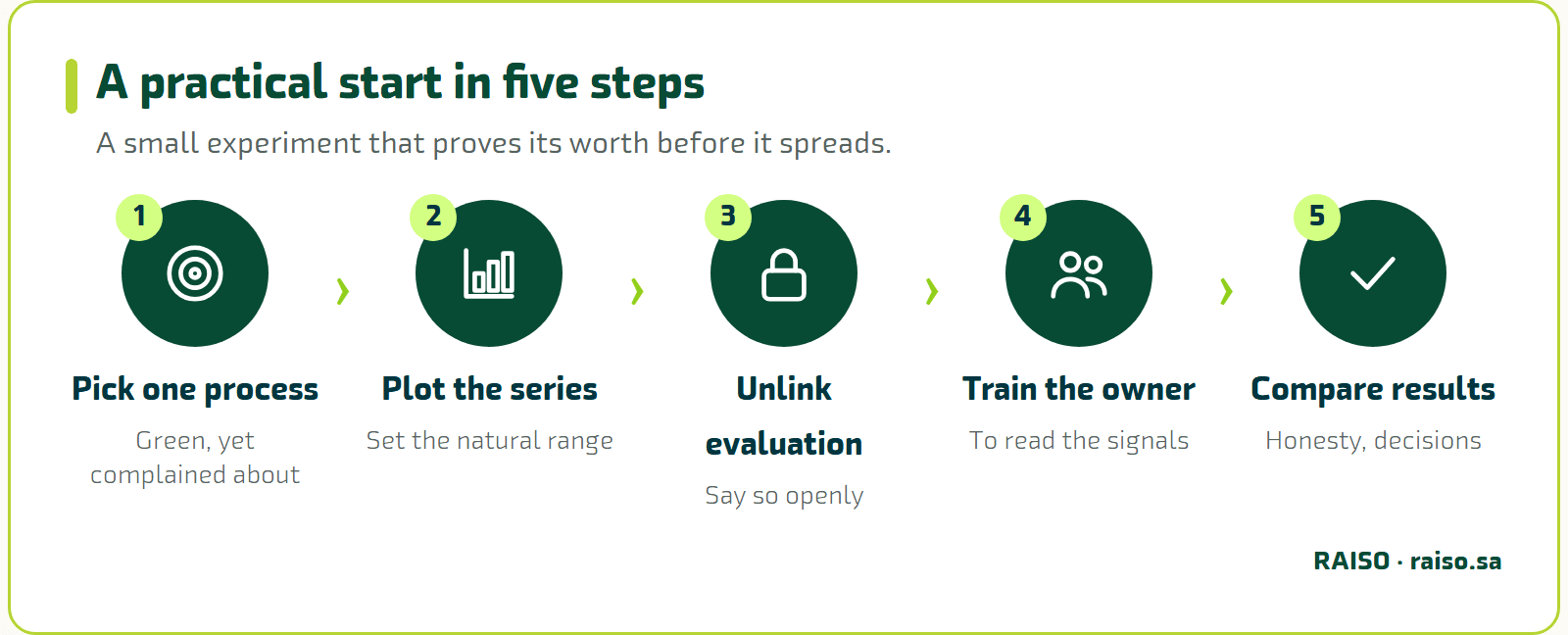
Moving from a target culture to a trend culture does not need a sudden revolution that unsettles the organization, but a considered experiment that proves its worth before it spreads. The smartest entry is to start with a process whose numbers you know look suspiciously "too good," because that is where the most distortion tends to hide, and where the discovery will be most convincing.
- Choose one process for the experiment
Ideally one that meets its target steadily while beneficiaries complain about it; that gap between the green number and reality is the clearest evidence of distortion.
- Gather historical data and plot it over time
Instead of looking at the latest figure, draw the whole time series and read its shape. This is where the real story starts to appear.
- Set the range of natural variation
Work out the span within which the stable process swings, so that this range, not the old threshold, becomes your reference for telling signal from noise.
- Separate the measure from individual evaluation
Announce openly that this measure will not enter anyone's evaluation, and watch how the honesty of the data changes within weeks. That step alone is revealing.
- Train the process owner to read signals
Teach him to tell natural from special variation, to act in proportion to the signal, and to record what he sees and what he does.
- Measure the result and compare
After a while compare the honesty of the data and the quality of decisions before and after. You will probably find your reality was different from what the threshold showed all along.
One frank warning: cultural change is far harder than technical change. Plotting a trend instead of a threshold takes hours; convincing a manager used to asking "did we hit the target?" to ask "where is performance heading?" can take months. So start small and let results speak. When managers see with their own eyes that removing the target exposed a real problem that had been hidden, and that a decision built on the trend was truer than one built on the threshold, the old question starts to fade on its own.
Hind now: she hands her director general two pages: the old chart in its green colors and the new chart with its moving line. She does not ask him to change a policy, only to attend the next meeting and read the line with her. After that meeting he asks her, "Could we do this for the other processes?"
“Take the first step today: write the name of the process that will be your experiment, why you chose it, and a date within the week to plot its data.”
What you take with you
First, a hard target does not measure performance but how skilled people are at pleasing the number, and that is not a flaw in people but a logical result of the threshold, as Goodhart showed. Second, management by numeric targets is management by fear, and fear kills learning, as Deming warned. Third, Shewhart hands you the alternative: read the process across time, tell natural variation from special variation, and act in proportion to the signal. Fourth, this is stricter than a threshold, not looser, and targets remain legitimate for contractual limits, safety boundaries, and strategic aims.
In the Saudi transformation under Vision 2030, where data is meant to be the basis of decisions and not decoration for reports, this distinction becomes strategic. An organization that runs green dashboards that do not match its reality deceives itself before it deceives anyone else, and builds its large decisions on shifting sand. One that dares to measure without false targets holds the most valuable thing it can hold: data that tells the truth.
The question we leave you with is not "what are your targets?" but a deeper and more unsettling one: if you removed the target tomorrow from one of your most "successful" processes, would you discover that you had been measuring performance all along, or your team's skill at pleasing a number on the wall? Try answering it yourself this month on one process. And if you want to run the experiment with a clear method and a team of experts beside you, contact RAISO and we will help you choose the right process, read its trend, and build a measurement culture that tells the truth.