



Building a knowledge-engaged culture
Every organisation has someone who knows how things work. When something breaks, everyone asks them. When two people disagree, they go to them. When a new hire arrives, the advice is: sit with that person. This person looks like a treasure and the team feels comfortable. But the question nobody asks is: what happens the day they leave?
This article tries to answer that question before it becomes real. It separates an organisation that owns an archive of documents from one that owns a living knowledge culture, and it explains in five practical steps how to move from the first to the second. We will follow one hypothetical case through every step: Muneera and the project team she leads after its most senior engineer announces his resignation. At the end you will have a test to measure your own organisation and a small plan to start this week.
Majed leaves on Thursday
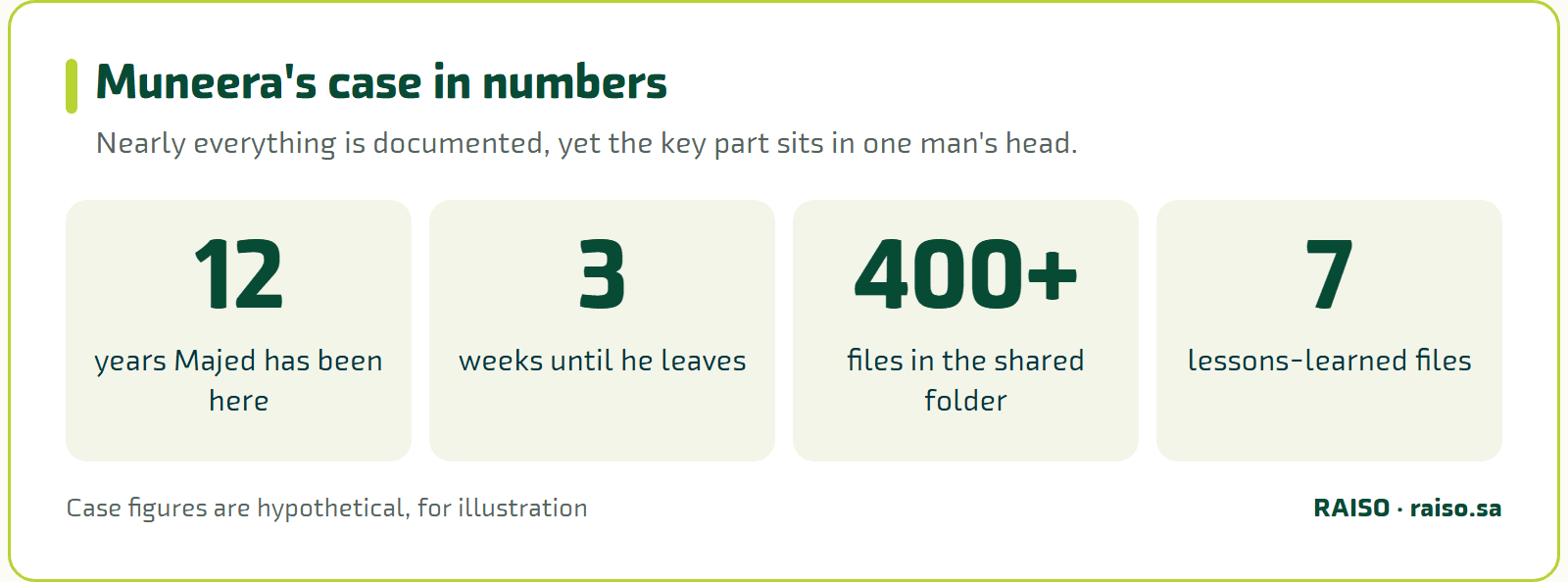
Muneera leads the projects team at a service organisation. On her team is an engineer named Majed who has been there twelve years. He is the one who knows which contractor runs late, which supplier keeps promises, what to ask about at a handover meeting, and how the contingency budget is worked out. When a project stumbles, everyone says: ask Majed.
One morning Majed walked into Muneera's office and told her he had accepted an offer elsewhere and had three weeks left. Muneera felt something close to dizziness. It was not only that she would miss him. She realised that his head held things that existed nowhere else.
She opened the shared projects folder. Nearly everything was there: reports, meeting minutes, contracts, and lessons-learned files for seven earlier projects. More than four hundred files, tidily arranged. But when she asked herself how Majed decides that a project is about to stumble, she found the answer in none of them.
“Everything was documented, and yet the most important part sat in one man's head.”
Where the case stands now
Muneera has three weeks, four hundred files and one question: how to move what is in Majed's head into the way her team works. She knows that asking him to write down everything he knows will not help, because nobody would read it and because Majed himself does not fully know what he knows.
“Take five minutes now: write down three people in your organisation whose departure tomorrow would break something. Beside each name, write what would break.”
Rich documents, poor practice
Why did the four hundred files not help? Because organisations accumulate knowledge faster than they activate it. Every project ends with a report, every problem with a memo, every meeting with minutes. Paper piles on paper until there is a huge archive, but people do not go back to it, because consulting it takes longer than asking a colleague.
The result is what we might call a paper version of excellence. The organisation looks accomplished when its folders are opened, but watched at work it looks no different from any other. Documents describe what happened in the past; what we need is to change what will happen tomorrow.
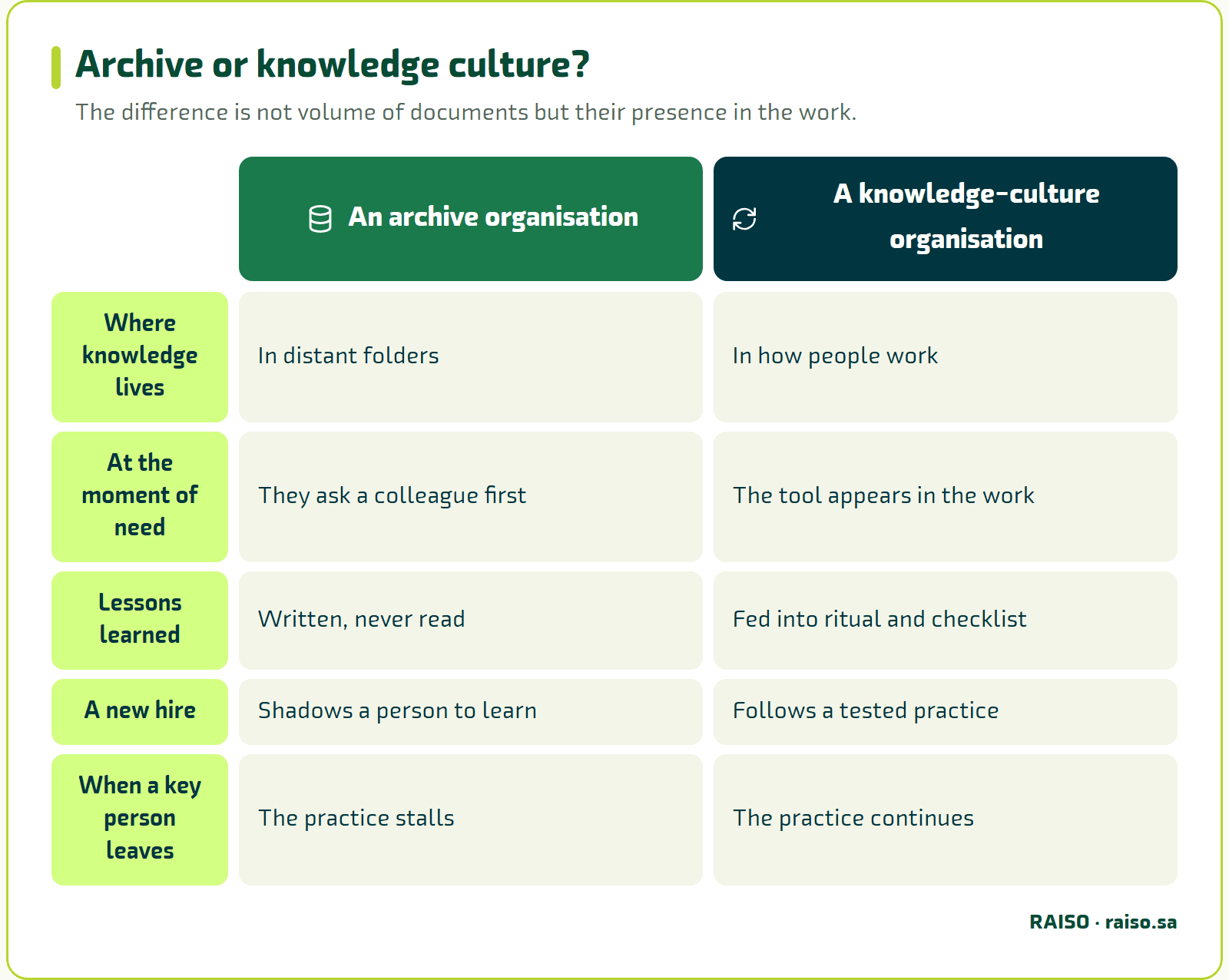
The difference between the two conditions is not volume. One organisation may have only twenty pages, yet each page is present in the weekly meeting, in the checklist and in the review question. Another has thousands of pages that nobody opens. The first has a knowledge culture; the second has an archive.
You know you are facing an archive and not a culture when you see these signs:
- People ask a colleague before they search the folder, because asking is faster and more reliable.
- Lessons learned are written at the end of a project and not read at the start of the next.
- A new hire learns by shadowing a person, not from a written and tested practice.
- Ways of working differ from team to team in the same organisation for no good reason.
Where the case stands now
Muneera reviewed the seven lessons-learned files. She found them honest and detailed, but written like reports: what happened, why, and what we recommend. Nothing in them told a new project manager: in week three, do this. She saw that the knowledge existed but not in a form that could be used.
“Pick the latest lessons-learned file in your organisation and ask: did anyone use it in a later project? How do you know?”
What is living knowledge?
We define living knowledge here in one plain sentence: **it is knowledge that lives in how people work, not in where it is stored.** The question is not where do we keep what we know, but where does what we know show up when people are working?
Living knowledge shows up in three simple forms. The first is **standing rituals**: short, regular meetings in which what we know is put to use, such as a weekly review or a brief session after each handover. The second is **embedded checklists**: short lists placed inside the work itself, not in a distant file. The third is **shared methodologies**: agreed ways of working that are reused across teams and projects instead of each team inventing its own.
| # | Question | What it means in practice | Yes | Partly | No |
|---|---|---|---|---|---|
| 1 | Is the practice written in a usable way? | Steps a newcomer can follow, not a general description. | |||
| 2 | Does it have a fixed time? | What has no time does not happen. | |||
| 3 | Does it have a tool in the workplace? | A list, form or screen that appears at the moment of need. | |||
| 4 | Does more than one person know it? | At least two can lead it without asking anyone. |
Apply them to one important practice in your organisation and tick each.
The third form needs explaining. A methodology is an agreed way of thinking and doing, such as the way risks are estimated at the start of every project. When it is shared, everyone learns it once and uses it everywhere. When it is not, each project manager invents a private method and experience is lost between teams.
One simple test binds the three together, and we call it the key-person test: when a key person leaves, does the practice continue? If yes, you have a knowledge culture. If not, you have an archive, however large.
To apply the test, ask these four questions about any important practice:
- Is the practice written in a way that can be used?
Not a general description, but steps a newcomer can follow.
- Does it have a fixed time?
What has no time does not happen, because daily work swallows anything not booked.
- Does it have a tool in the workplace?
A list, a form or a screen that appears at the moment of need.
- Does more than one person know it?
At least two who can lead the practice without asking anyone.
Where the case stands now
Muneera applied the four questions to what Majed does when he assesses a new project. Nothing written in a usable way, no fixed time, no tool, and no one else who knows the method. She had a clear diagnosis: what Majed does is a real practice, but it lives in his head alone.
“Apply the four questions to one important practice in your organisation and write beside each: yes, partly, or no.”
Step one: map the critical knowledge
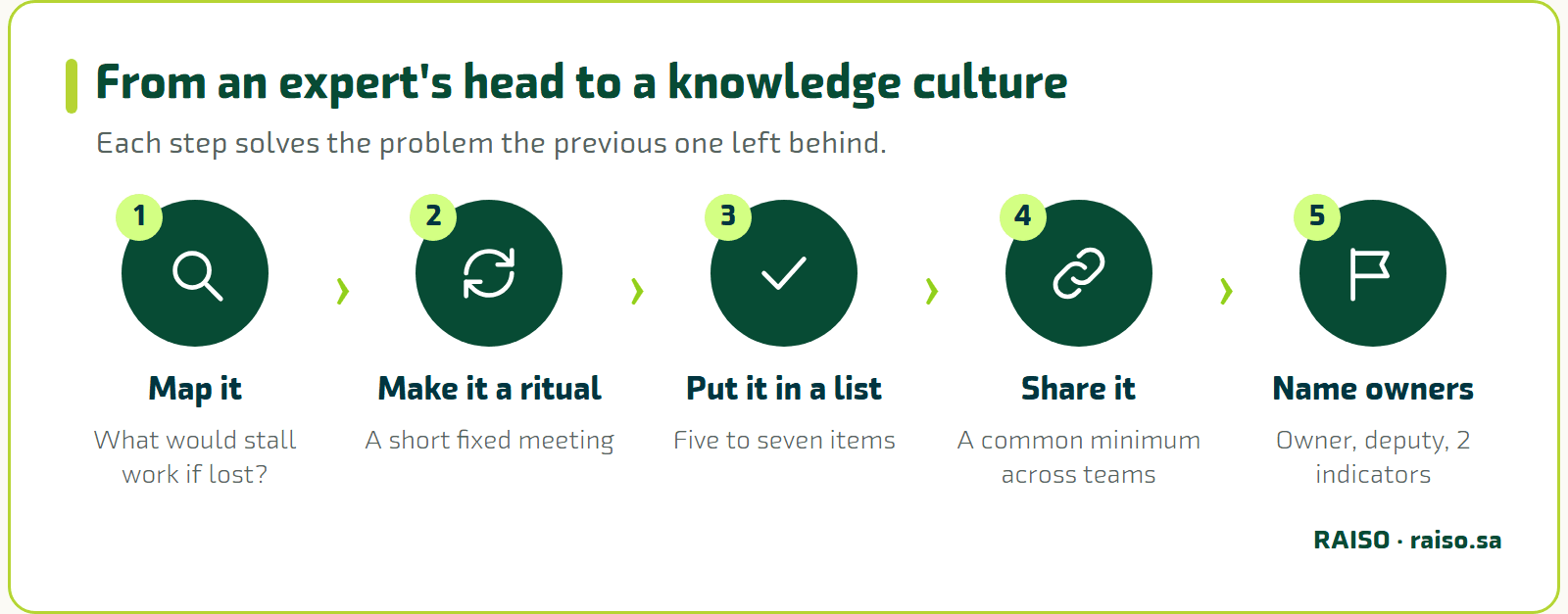
The problem this step solves is that you cannot transfer what you do not know exists. There may be dozens of hidden practices carried out by individuals without anyone noticing. And if you try to move everything, you will drown in detail.
The remedy is to draw a short map of critical knowledge, meaning the knowledge whose absence would stall work or raise risk. Start with a simple question to each key person: which decisions do you make alone, that others do not know how you make? Then ask them to tell a story or two about the last time they made one. Stories are more honest than descriptions, because when experts tell a story they reveal, without meaning to, what they notice and what they ignore.
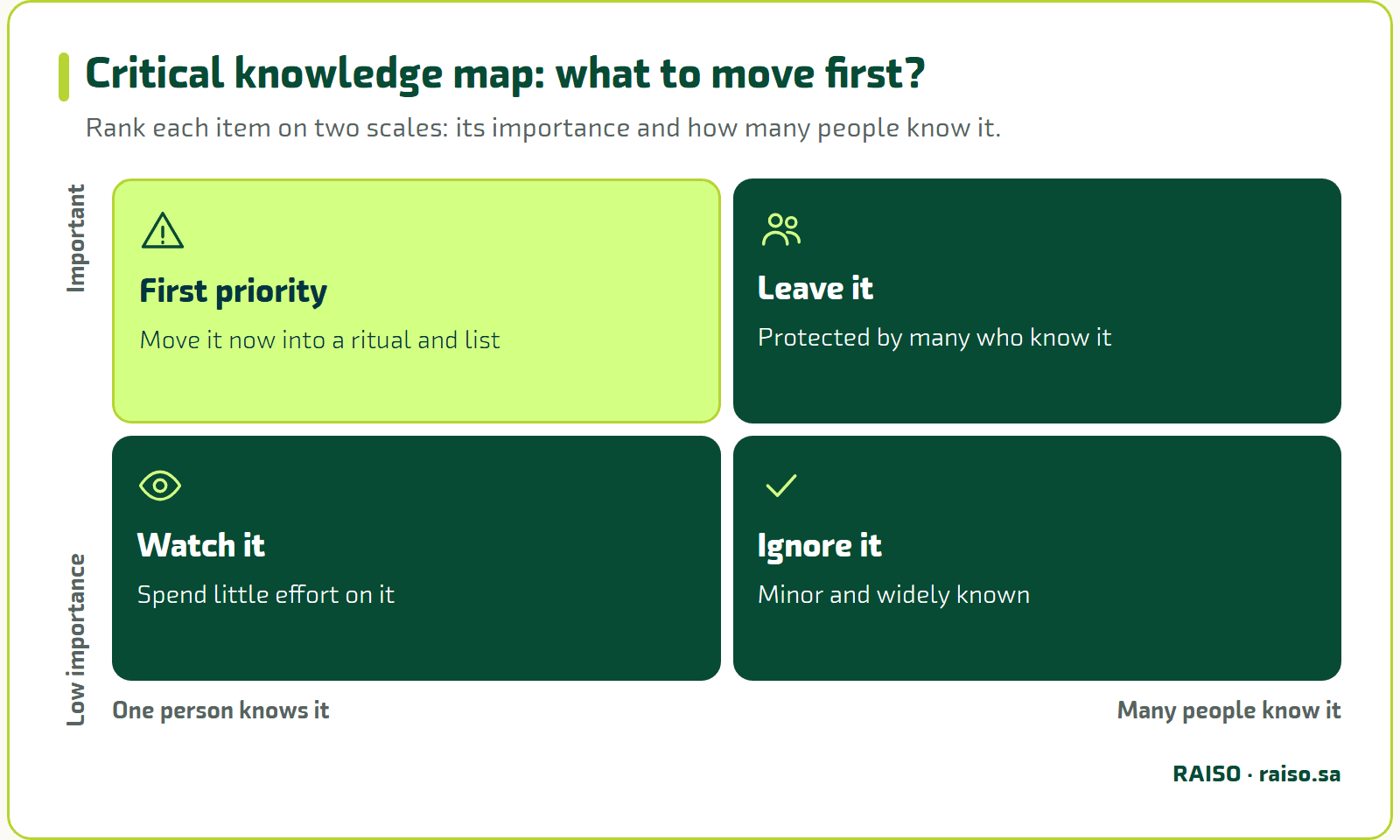
Then rank what you collected on two scales: how important is it, and how many people know it? What is important and known by one person comes first. What many people know, leave. What matters little deserves no effort.
Keep your map to one page with four columns:
- The name of the knowledge in a short phrase, such as how we spot a project about to stumble.
- Who holds it today.
- What happens if it is lost: delay, risk or cost.
- Whether it is written in a usable way: yes or no.
Where the case stands now
Muneera sat with Majed for three short sessions of an hour each. She asked him to recount the last three projects he had judged likely to stumble. She found he watched for three early signals nobody else did: the contractor slowing on small questions, the contractor's representatives changing in meetings, and requests for amendments in the week of the first payment. This was the most important knowledge on the team and it was written nowhere.
“Choose one key person and ask them to tell you the story of the last hard decision they made. Note what they noticed and what they ignored.”
Step two: turn knowledge into a standing ritual
Now that Muneera knew what Majed knew, a new problem appeared: how does this reach the rest of the team? Writing a four-hundred-and-first document would not help. Knowledge does not travel by reading but by repeated use in real moments.
This is where rituals come in. A ritual here is a short, regular meeting in a fixed format in which the team uses the knowledge on a real case. The idea is that people do not learn early signals by reading about them, but by applying them to their own project, in front of colleagues, alongside someone who knows.
A good ritual has three qualities. First, it is short, no more than thirty minutes. Second, it is regular, on the same day each week or month. Third, it is tied to a real decision: what will we do differently after this meeting? If the team leaves without a decision, the time was wasted.
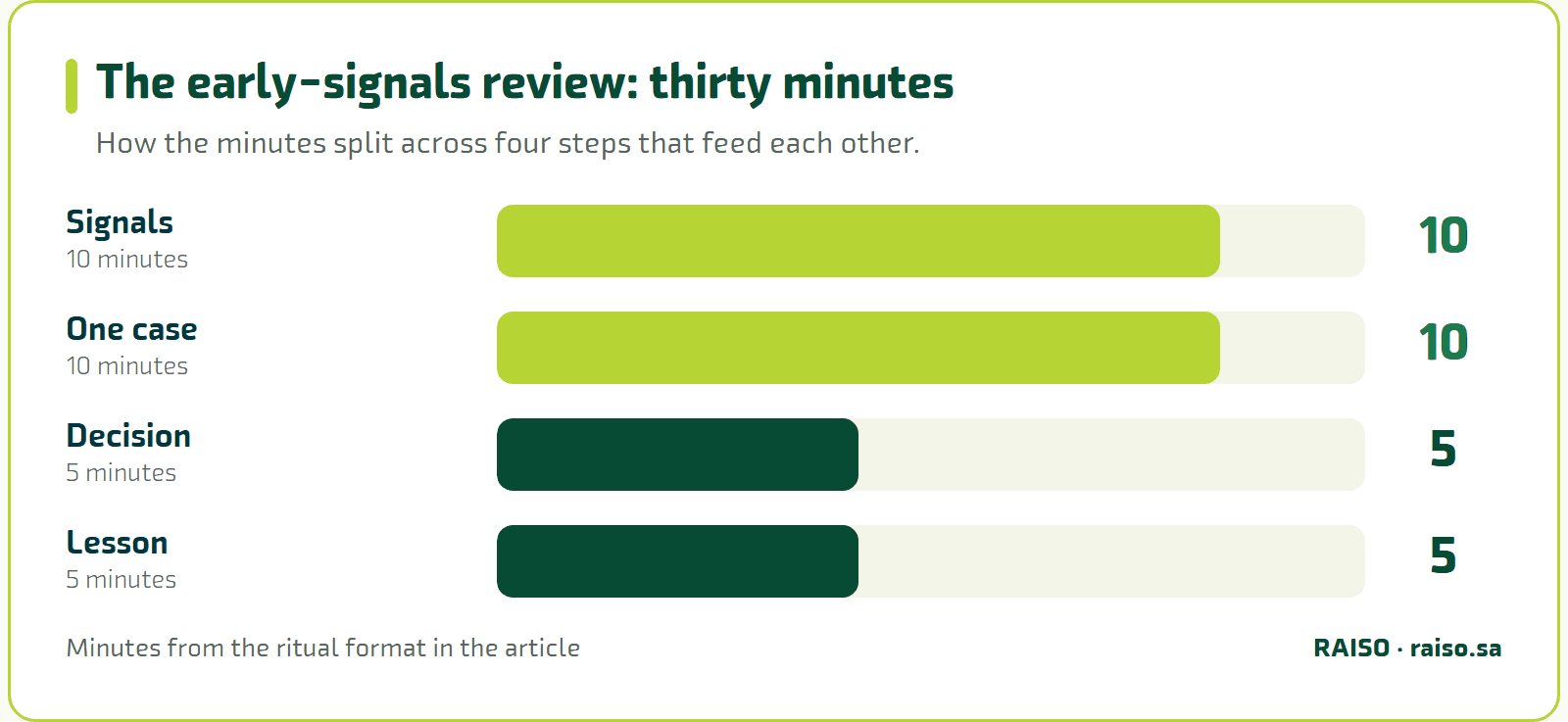
This is the format of the early-signals review that Muneera designed:
- Ten minutes on signals
Each project manager checks their project against Majed's three signals and says: it appeared or it did not.
- Ten minutes on one case
The team picks a project where a signal appeared and analyses together what to do.
- Five minutes on the decision
The team leaves with one specific action, with an owner and a date.
- Five minutes on the lesson
Someone records what the team learned in two lines, added to the signal list if it deserves it.
Notice that the last step feeds the first the following week. This turns knowledge from a still photograph into a loop that improves itself, which is what we mean by living.
Where the case stands now
Muneera started the ritual in Majed's second week and asked him to lead the first two sessions and then step back to the observer's chair. In the third session Salma, a young project manager, ran the whole thing and asked the questions Majed would have asked. Her answers were not his, but they were close, and that is enough to begin with.
“Put a fixed meeting of thirty minutes or less in your calendar, name it, and decide who leads it, who attends, and what decision will come out of it.”
Step three: put the knowledge inside a checklist
The ritual teaches the team, but it does not protect them on ordinary days. On a crowded day a project manager may forget to check the three signals, and the week passes unnoticed. The problem is that people rely on memory, and memory is not to be relied on under pressure.
The remedy is an embedded checklist: a short list of five to seven items placed inside the work itself, in the form the manager fills in each week or on the tracking screen they open anyway. Its point is to carry the burden of remembering, so that the person is free to think.
A good checklist does not repeat everything. It catches what is usually forgotten and costly when forgotten. It does not replace experience; it protects experience from lapses. So ask the expert: what are the things that, if a beginner forgot them, would cost the most? Then make those the items.
Test your checklist with these rules:
- Every item begins with a verb and can be answered yes or no.
- The list has no more than seven items, since anything beyond that gets ignored.
- It appears in the tool the team actually uses, not in a separate file.
- The team reviews it every three months, dropping an item that no longer helps and adding a new one.
Where the case stands now
Muneera and Majed turned the three signals, plus four more drawn from his stories, into a seven-item list and added it to each project's weekly report form. Each week the manager now answers a question such as: did the contractor slow down on any small question this week? They no longer need to remember to ask it.
“Turn three points of an expert's knowledge into checklist items and place them in a form your team uses weekly.”
Step four: make the methodology shared across teams
So far Muneera had rescued Majed's knowledge inside her own team. But the organisation has two other project teams, each working its own way. When a manager moves from one team to another they start from zero. Each team rediscovers what the other has already found, and pays the same price again.
The remedy is to make the method a shared methodology. This does not mean imposing your team's way on others. It means the three leaders sit down and agree the shared minimum: the early signals, the format of the weekly report, and the review time. Beyond that, each team may add what suits it.
A shared methodology succeeds when it is simple and when everyone feels they helped write it. If it arrives from above as a finished template they resist it; if they help make it they adopt it. So we advise a small trial in two teams for two months, then rolling out after adjusting to what you learned.
As the methodology spreads, another unexpected benefit appears: the organisation gains a common language. One project manager says to a colleague in another team, the contractor signal showed up on mine, and the colleague understands at once what it means and what to do. This shared language is the clearest sign that knowledge has become culture.
Where the case stands now
Muneera invited the two other team leaders to a short lunch and showed them the signals and the list. One objected to a signal; the other added one from his own experience. The three agreed on a shared version and all three teams began using it the following month. For the first time the project managers spoke one language.
“Choose a practice where teams in your organisation differ, and gather their leaders for half an hour to agree on just three shared elements.”
Step five: spread ownership and watch its health
One last problem remains: who protects all this months from now? Methodologies fade, rituals are cancelled in the first busy week, and lists go stale. If no one owns them, no one will notice that they have died.
The remedy is that every living practice has a named owner and a deputy. The owner makes sure the meeting happens, the list is updated and the lessons feed the methodology. The owner need not be the most senior, but the most committed. And the deputy is what stops knowledge hanging on one person again, or we would have rescued Majed only to create a new Majed.
The owner then needs two simple health indicators: was the ritual held on time, and was the checklist used? These numbers do not measure the results of the work, but they tell you whether the practice is still alive. If they fall, you know the danger has started before its effects reach the projects.
Where the case stands now
Muneera named Salma owner of the early-signals practice, with Majed as temporary deputy and then a permanent deputy. She wrote two figures on the team board: the number of meetings held out of those planned, and the number of projects that used the list. After Majed's term ended and he was gone, both figures held steady.
“Name an owner and a deputy for one living practice in your organisation, and write the two indicators that will measure its health.”
The test that was waiting for Muneera
The last Thursday came. The team said goodbye to Majed with a simple lunch and kind words, and he took his personal laptop and left. For the first time since the resignation Muneera felt calm, not because the absence was small, but because something was working without him.
A month later the team had held five review meetings. In one of them the contractor signal appeared on a new project, and a young manager who had never worked with Majed noticed it and raised it two weeks before the first payment date. The schedule was adjusted and the project did not stumble. Nobody said: if only Majed were here. That is the sentence by which culture is measured.
“The test is simple: when a key person leaves, does the practice continue? If yes, you have a knowledge culture; if not, you have an archive.”
“Go back to the three names you wrote at the start. For each one, choose the first step that would make their absence break nothing, and decide when you will begin it.”
What you carry with you
Muneera's journey says that knowledge does not need a bigger store but more life. Your documents matter, but they are only raw material. Knowledge becomes culture when it enters the rituals, lists and methodologies people use every day, and when a named owner guards it.
This is what you carry with you:
- Many documents and little practice is a paper version of excellence.
- Living knowledge lives in how people work: standing rituals, embedded checklists and shared methodologies.
- Start with a map of critical knowledge, and collect stories from experts instead of asking them to write.
- Turn what you learn into a short ritual, then a checklist, then a shared methodology.
- Name an owner and a deputy for every practice, and follow two indicators of its health.
- Always test: if a key person left, would the practice continue?
Our invitation is practical: this week, pick one key person, sit with them for an hour and ask about the last hard decision they made, then record what you learned as a list of five items. And if you want to build a knowledge culture in your organisation with experts working beside you on your own case, explore RAISO's knowledge and practice pathway.