



How Knowledge Moves from People to Practice
Every customer service center has one employee everyone knows. When an angry customer calls and the newcomers exchange glances, someone raises a hand and says: «Send it to Ms. Souad.» Souad talks for three minutes, the customer calms down and the matter is settled. Then one day it is announced that she retires in three months, and the whole center realizes, in a single moment, that it never owned a skill. It owned Souad.
This article argues that the difference between an organization that knows and one that practices is not the amount of talent. It is that the second has turned talent into a method everyone shares. That transition follows a predictable path if you design for it, but most organizations stop halfway because they treat it as a documentation exercise rather than capability building.
We will follow one case from start to finish: Lama, manager of a customer service center, and Souad, whose expertise will leave in three months. Through the four stages, surfacing, structuring, training and sustaining, you will see what changes for her and try a short exercise on expertise in your own organization. You will leave with a complete loop for moving knowledge from one person to a team, and a way to confirm it has really moved.
“Lama, Souad, their center and the figures in this article are a hypothetical case for illustration and do not refer to any real organization.”
Souad retires in three months
Lama manages the customer service center of a company serving individuals. On Sunday morning she received an official letter from human resources: Ms. Souad, the longest-serving employee in the center, eighteen years with the company, would end her service in three months. Lama read the letter twice, then grasped what it meant.
Souad takes the hard cases: the furious customer, the complaint raised three times, the request stuck between two departments. The resolution rate on her cases is nearly double the rest of the team's. When Lama asked the team for her secret, nobody could answer. One said: «She has a style.» Another said: «She knows how to talk.» And Souad herself, asked directly, said: «I don't know. I just do what seems right.»
Lama thought of the usual remedy: asking Souad to write a manual. But she remembered a manual another center had produced years before: sixty pages titled «How to Handle the Angry Customer», written by a veteran before he left, read by every newcomer in their first week and then never opened again. She wondered: why does a manual written by an expert fail to create experts?
“Souad had failed at nothing, yet the center was three months from losing the most valuable thing it had.”
Notice what the case shows. The expertise is real and its owner is willing to help. But expertise that lives in a person does not move simply because we want it to. Souad does not know exactly what she does, because what she does has become second nature, requiring no thought. That is true of every expert: the better they master something, the less aware they are of the steps.
What does it mean for expertise to stay in one person?
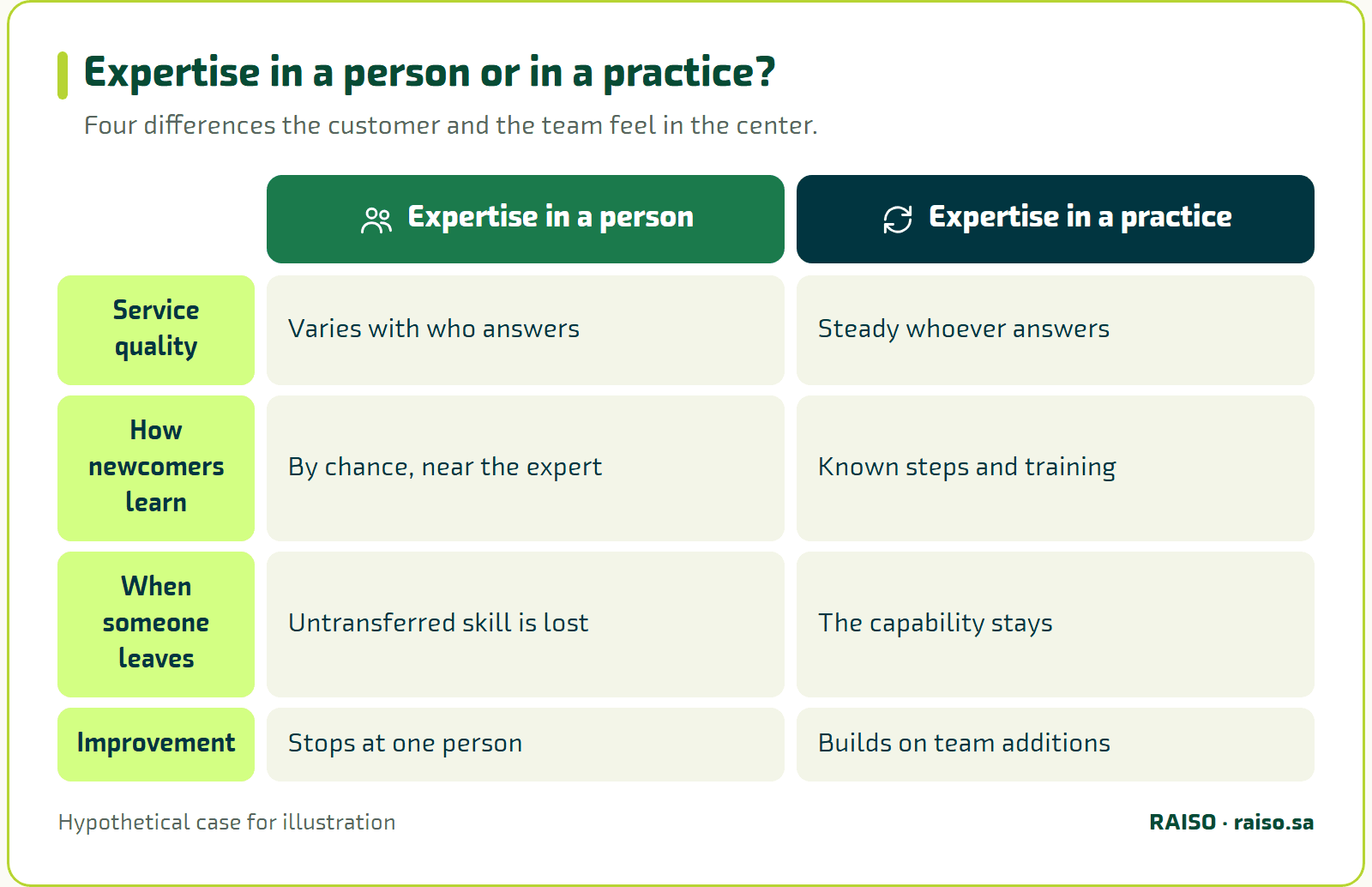
- Quality depends on who answers the phone: the customer gets an excellent reply if they reach Souad and an ordinary one if they do not.
- Newcomers learn by chance: whoever sits near Souad learns, whoever sits far away does not.
- Departure is total loss: when Souad leaves, whatever was not transferred leaves with her, and nobody knows how much that is.
- The center does not improve: no one's experience is added to Souad's, so it stops at the limits of a single person.
“Think of the most outstanding expert on your team. If they left tomorrow, what would the team lose that it could not even describe?”
“Five minutes, now: write the name of the person in your organization to whom the hardest cases are handed. Then ask them, or ask yourself if it is you, one question: what do you do in the first minute of a hard case? Note the answer exactly as spoken, without polishing it.”
Why does expertise not move on its own?
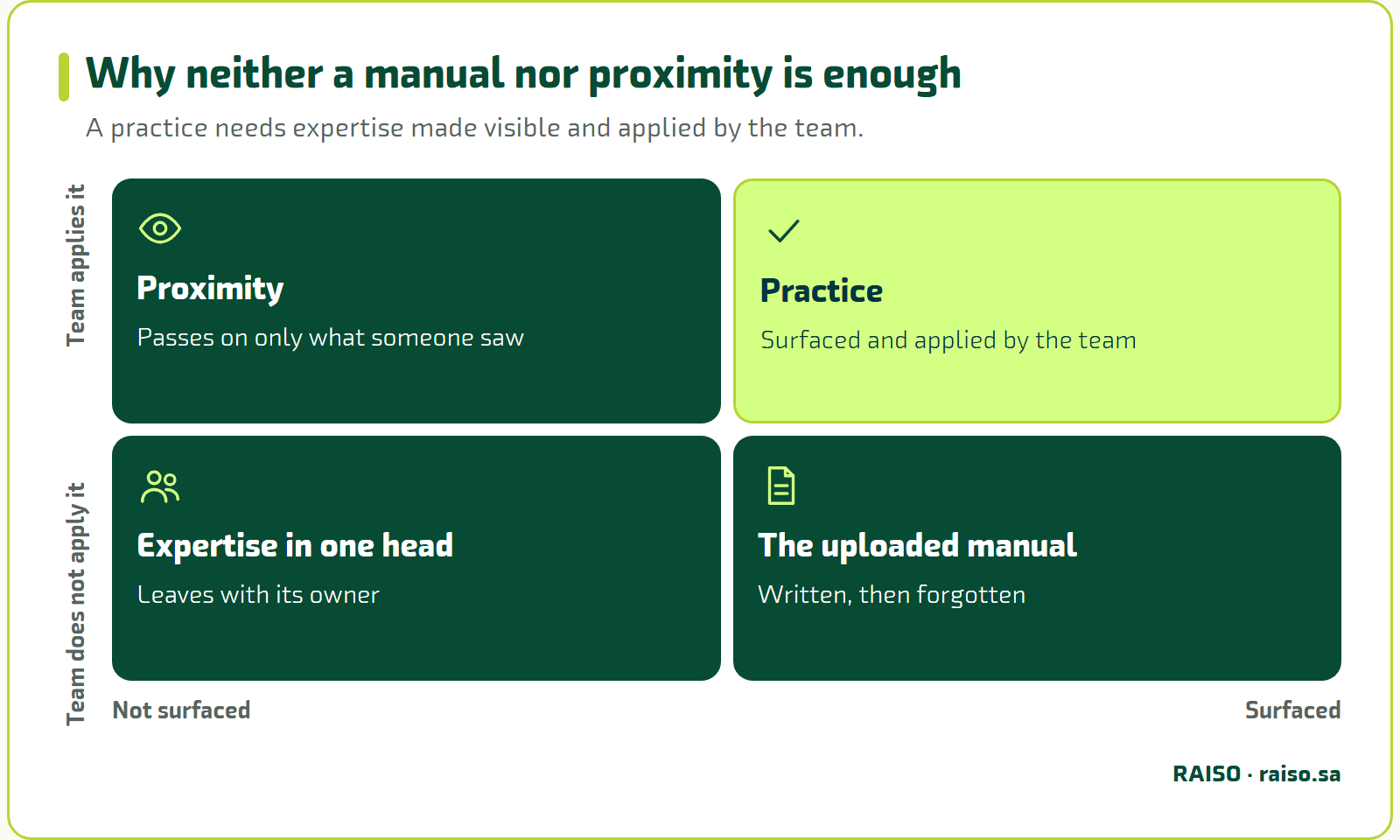
Many organizations assume expertise moves by proximity: seat the newcomer beside the veteran and they will learn. That happens partly, but it is slow, uneven and dependent on who happens to sit where. Whoever sits near Souad picks up some of what she does, yet does not know what they picked up and cannot pass it on to anyone else.
Other organizations assume the answer is documentation: ask the expert to write down what they know. Here a different error appears. Experts write what they can say, which is usually general principles: «Stay calm, listen, show empathy.» Those are true, but they do not distinguish Souad from anyone else. Her secret is not that she knows the principle. It is what she does in the moment the customer flares up, and that is precisely what she cannot say.
Three mistakes in transferring expertise
- Stopping at documentation
A manual is written, uploaded and forgotten. Everyone assumes the transfer happened, when in fact it never began.
- Relying on proximity
We let newcomers pick up expertise by sitting near the expert, and transfer only what someone happened to see.
- Forgetting who updates it
Even if expertise moves today, unless someone looks after it, it will age into what the expert once did.
The answer is none of these alone but a loop that combines them in the right order, which is what we set out in the next section.
The loop: from expertise to practice in four stages
By practice we mean a way of working that a team shares, with known steps, that any member can perform at an acceptable level without being the expert. Practice differs from talent: talent lives in an individual, practice lives in a team.
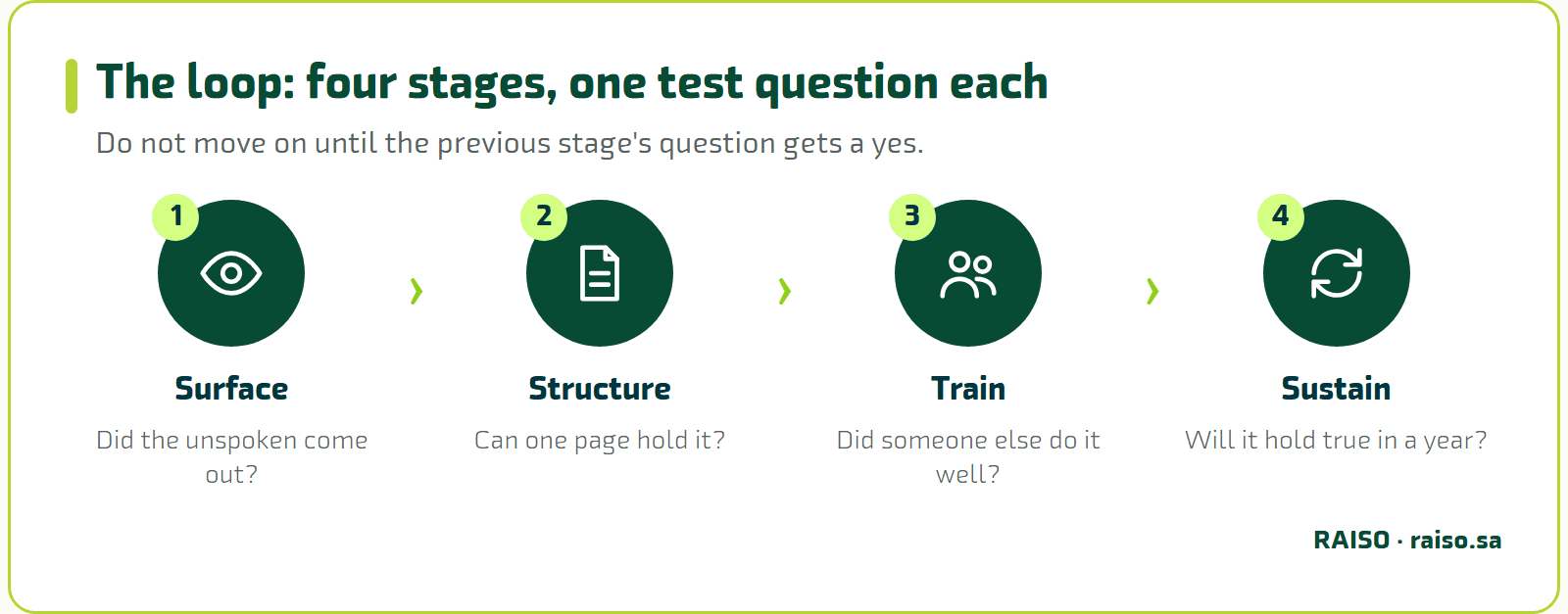
Moving from one to the other takes four consecutive stages. Surfacing: we bring the expertise out of the head and into the light, without aiming for perfection. Structuring: we turn what surfaced into an asset others can refer to, such as a checklist or a decision tree. Training: the team applies the asset to real cases, with guidance, until they master it. And sustaining: we name a keeper and set an update rhythm, so the asset changes when the work changes.
The order is not a detail. Whoever structures before surfacing builds an asset out of general principles that distinguish nothing. Whoever stops after structuring has a manual nobody uses. Whoever neglects sustaining has a good practice that dies within a year. Most organizations stumble at the third or fourth stage, because the first two look like enough of an achievement.
“Documentation is not the goal. The goal is that the team can do what Souad used to do.”
Stage one: surfacing
The problem this stage solves is that the expert does not know what they do. So asking «How do you do it?» will not help; they will answer with principles. What you need is to watch them at work and ask specific questions about specific moments.
Sit with the expert as they handle a real case, or listen to a recording of a past call with their consent. Pause at each turning point and ask: why did you say that just now? What did you notice before saying it? What would you have done had the customer responded differently? These questions draw out what the expert knows without knowing that they know it.
Do not demand perfection at this stage. The aim is visibility. Record the notes as they were said, in the expert's own words. When a moment recurs across several cases, you have found a pattern worth turning into an asset.
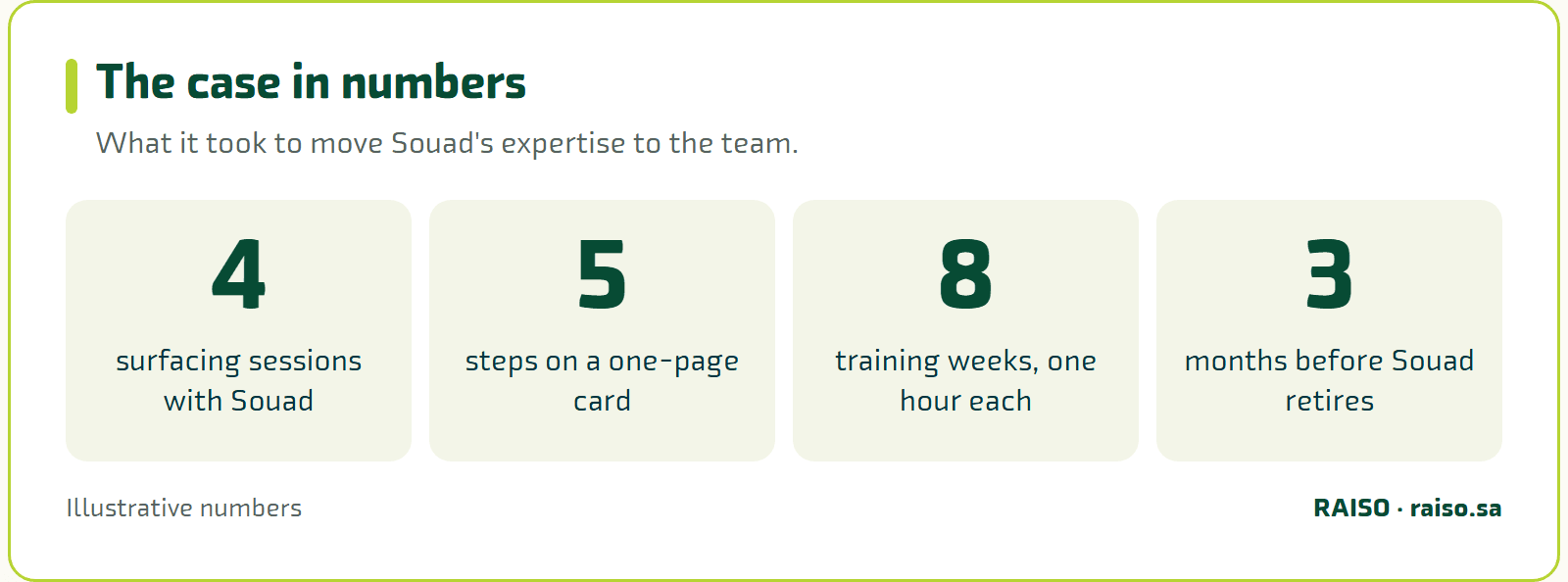
In the case now: Lama sat with Souad for four sessions, each following the recording of two angry-customer calls. In the second session Lama noticed that Souad never opens a call with an apology. She says to the customer: «Let me make sure I have understood. You mean this.» Asked why, she said: «Because he wants to feel that someone heard him, before he wants the solution.» Souad had not known she did this until she was asked.
“Apply it now: choose an expert in your organization and one case they handle. Watch them, or listen to a recording of it, and stop them three times at turning points to ask: why did you do that just now? Write down the answers in their words.”
Stage two: structuring
Raw notes are of use only to their author. The problem this stage solves is that what surfaced is still personal: Souad's words in their context, of no use to someone who did not attend the session. You need to turn the notes into something others can work with without rediscovering it.
Choose the simplest form that suits the expertise. If it is sequential, a checklist. If it branches by situation, a short decision tree. If it consists of phrasings people lean on, a set of sample sentences. If it spans a path across departments, a simple map. In every case keep it short: one page, not sixty, because a short asset gets used and a long one gets filed.
Add two things to every step in the asset: what we do, and why. A step without a reason turns into ritual, and a step with its reason turns into understanding an employee can adapt when the situation shifts. Review the asset with the expert herself, so she confirms that it represents what she actually does.
In the case now: Lama turned the notes from the four sessions into a one-page card titled «The first two minutes with an angry customer». It has five steps: let him finish without interrupting; restate his problem in one sentence and confirm you understood; name what is bothering him without blaming anyone; say what you will do now and how soon; then do it. Beside each step sits its reason in a sentence. Souad read it and said: «That is what I do, but I never knew it was five steps.»
“Apply it now: turn your notes from the previous exercise into a one-page card of three to five steps, with the reason beside each. Show it to the expert for correction.”
Stage three: training
This is where most organizations stop, and the problem this stage solves is that a card alone does not create skill. Someone who has read how to drive a car cannot drive one. Skill comes from applying the card to real cases, with someone guiding, then repeating until it becomes habit.
Begin with a short demonstration: gather the team for about thirty minutes, listen to a real call with the customer's consent or with their details removed, and follow the card step by step. Then let each employee apply it in a role-play with a colleague, afterwards on a live case with a guide present, who may be the expert herself or a supervisor trained on it.
Focus on an employee's first applications. The first time they try the card is when it is decided whether they master it or drop it. Guidance here is brief: what worked, and what to watch for next time. Without this step the asset stays shelved and the team keeps handing the hard cases to Souad.
In the case now: Lama set aside one hour a week for eight weeks. In the first week they listened to a real call and followed the card. In the second they role-played in pairs. Then each employee began handling a hard case with Souad or a supervisor who had trained with her beside them, noting just two remarks. It was not smooth: some of the team grumbled about «exercises that do nothing», but that changed in week four, when a new employee calmed a customer who would otherwise have been passed to Souad.
“Apply it now: pick three people on your team to try the card. Have them apply it once in a role-play and once on a live case with you present. After each try, write what worked and what needs adjusting.”
Stage four: sustaining
The first three stages may succeed and the practice may still disappear within a year. The problem this stage solves is that work changes: systems change, customers change, staff change. What was right today may not fit tomorrow. If nobody looks after the practice, it becomes something old, well written.
Sustaining rests on three things. First, a named keeper who owns the asset and answers the question: is it still right? Second, a fixed review rhythm, such as a short quarterly meeting where the team brings what it has learned from new cases. Third, a link between the practice and the work it supports, so it can be measured: has the resolution rate on hard cases improved? Have referrals to supervisors fallen?
More important still is letting the practice grow. When an employee learns something useful, it is added to the asset under their name. The team then sees that the asset is not the old expert's document but a shared possession that widens each time they use it.
In the case now: Lama named a supervisor, Mona, as keeper of the card and set a half-hour quarterly meeting. At the first one, a new employee offered a note: when customers ask for compensation, it helps to tell them what can be done at once and what needs approval. It was added as a sixth step in his name. Lama also began measuring the share of hard cases resolved without referral, which rose from about a third to nearly half in three months. These are hypothetical figures, showing the kind of effect to look for.
“Apply it now: at the top of your card, write the keeper's name, the date of the next review, and one measure you will follow, such as the share of hard cases resolved without referral. Then decide who adds what the team learns.”
| # | Item | How to test it | If not met | Met | Partly met | Not met |
|---|---|---|---|---|---|---|
| Signs the expertise has moved | ||||||
| 1 | A newcomer handles a hard case without the expert | Give them the card alone and see if they call for help | Return to training | |||
| 2 | The team explains the reason, not just the step | Ask: why restate the problem before the solution? | Return to structuring and add the reason | |||
| 3 | The card changes in the team's hands | Look for additions from staff within six months | Return to sustaining | |||
| Safeguards for sustaining | ||||||
| 4 | The card has a named keeper | Does the team know who owns the card? | Name a keeper and give them time | |||
| 5 | A fixed review date | Is the next meeting date written down? | Set a quarterly meeting | |||
| 6 | A measure linking practice to results | E.g. share of hard cases solved without referral | Pick one measure and track it | |||
Rate your team on each item. A gap points to the stage to return to.
Lama, after Souad
Souad retired on schedule. The center held a modest party for her, and in her speech she said: «I used to think what I know cannot be taught.» Then she smiled and added: «It turns out it just needed someone to ask me the right questions.»
In the first week after she left, an angry customer called about an invoice error that had happened three times. The employee who took the call was Yasser, new, who had not worked with Souad for a single day. He followed the card: he restated the problem and made sure he understood it, named what was bothering the customer, and said what he would do and how soon. The call ended after seven minutes with thanks. Nobody transferred it and nobody said: «If only Souad were here.»
What Lama did was not to copy Souad, for Souad cannot be copied. She did something harder and more useful: she moved the expertise from a person to a team, so the center now owns what one individual used to own. And Souad kept her mark, because the five steps came from her own work and from questions asked of her with attention. The expertise was no longer hers alone; it became a capability for everyone who comes after her.
What do you take with you?
Talent lives in individuals, and practice lives in teams. The move between them does not happen through proximity or documentation alone, but through a loop that is designed: surface the expertise with specific questions, structure it in a short asset, train the team on it with real cases, then sustain it with a keeper and a review rhythm. When this loop works, every expert can leave without taking anything away.
The four stages in brief:
- Surface
Watch the expert at work and ask about specific moments, not about principles.
- Structure
Turn what surfaced into a short asset, a checklist, decision tree or template, with a reason beside each step.
- Train
Apply it to real cases with guidance, and focus on the first applications.
- Sustain
A named keeper, periodic review, and a measure linking the practice to results.
Start this week with one expert and one piece of expertise: sit with them for four short sessions, ask about their hard moments, and turn what you hear into a one-page card. And if you want to build the full loop in your own organization, RAISO's knowledge management practice courses lead you through the four stages on real expertise from your team, with ready exercises and tools. Get in touch and we will help you choose the expertise to start with, before its owner leaves.