



From the Gemba to the Boardroom: How Does the Truth Travel?
On Monday morning Mona sits at her desk in a customer service centre, with six people lined up in front of her. She opens the first transaction and the system freezes for two full minutes. She waits. She apologises with a tired smile. Then she types the data by hand onto a side sheet so she can enter it later. The same thing happens with the second transaction, the third, the tenth. This is the truth as it is lived, before anyone has retold it.
Then the truth begins its climb. Mona tells her supervisor Saad: «The system is slow.» Saad tells the department head Hind: «There is a technical challenge we are following up.» Hind writes in her monthly report: «Operational performance is within target.» And in the boardroom the chief executive, Fahad, reads that all is well. Four levels, four versions. Each version is honest from where it stands, and none of them resembles what happened at Mona's desk on Monday.
This article follows that same journey step by step. We first see where the truth lives and why it weakens as it rises. Then we look at what a decision loses when it is built on a polished copy of reality. After that we try four practices that keep the truth intact: leaders walking to the place where work happens, channels that bypass the chain of command, safety in speaking up, and leaders looking at raw data themselves. At every step we return to Mona, Saad, Hind and Fahad to see what changed in their situation, and we leave you a short exercise to try in your own organisation. We follow Kolb's learning cycle here: start from an experience, reflect on it, name the concept, and apply it.
“The people and numbers in this article are imaginary, written for illustration only, and do not refer to any particular organisation.”
Monday morning: four versions of one event
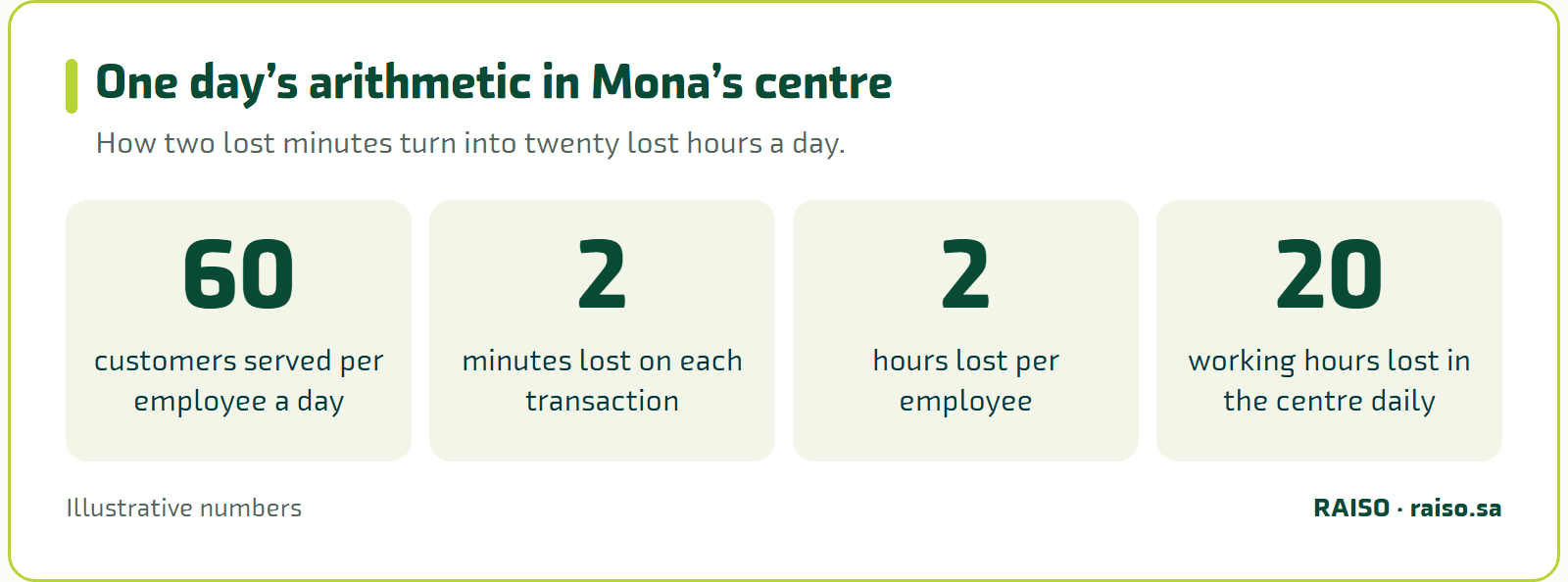
Let us go back to the same event and do the arithmetic. Mona serves around sixty customers a day and loses two minutes on each transaction. That is two full hours lost every day from her time alone. The centre has ten employees like her. So twenty working hours evaporate daily, a queue grows, and a customer leaves angry. That is the truth in its detail.
Now read what reached each level. Saad heard the word «slow» from Mona. He did not hear about the two hours or the side sheet. Hind heard the word «challenge» from Saad, a soft word that does not say anyone is being hurt. And Fahad read a single line on page three of a long report. None of them lied. Each passed on what he or she understood, in the way each works. But the result is that leadership knows nothing about the side sheet and nothing about the twenty hours.
We will call this «truth erosion»: nobody necessarily lies, yet the accumulated result is a polished copy that no longer resembles the original. What makes it dangerous is not that the copy is bad, but that it is reassuring. Leaders do not decide on the basis of reality. They decide on the basis of the version that passed through all these filters until it became safe to present.
Where the case stands now: Mona knows the full truth and Fahad knows almost none of it. Three people stand between them, and each believes he or she passed the news on faithfully.
“Apply it now: Pick a problem your frontline team already knows about and ask someone there to describe it. Then ask their direct manager. Then ask the person above. Write the three descriptions side by side and notice how much of the original survives each time.”
The gemba: where the truth lives
In operational excellence, «gemba» is a Japanese word for «the real place». It is the place where work is actually done: where the product is made, the service delivered, and the employee meets the customer. In our case the gemba is Mona's desk and the queue behind it. The boardroom is another place, where pictures of the gemba are shown. They are not the gemba itself.
The idea is simple and strict at once: the most accurate and complete knowledge about any process sits with the people who perform it, not with the people who manage it. Mona knows which transactions are slowest, which hour brings the most pressure, and how she invented the side sheet to keep work moving. No report carries that knowledge. It stays trapped in the field unless a faithful channel carries it out.
The distance between the gemba and the boardroom is not just physical. It is a distance of knowledge. The higher we climb, the more abstract things become and the less detail remains. A number replaces a scene, and a summary replaces an incident. Some of this is necessary, because leaders cannot run an organisation on raw detail. It turns dangerous when we forget that behind every figure in a report there is a human moment, lived by an employee or a customer.
“A representation of a thing is not the thing. The report describes the gemba and cannot replace it.”
Where the case stands now: We know where the truth of our story lives: with Mona. And we carry one question into the rest of the article: how does that truth reach Fahad without changing on the way?
“Apply it now: Identify the gemba of your own team: where does the work meet the customer or the product? Write down the place, and the name of one person who spends the day there. That person is your nearest source of the truth you need.”
Three filters on every floor
Why does the truth weaken as it rises? Not because people are bad, but because the hierarchy itself behaves like a filter. Between any two levels three forces work together. Let us watch them one by one as they appeared in Mona's story.
The first force is summarising. Saad receives dozens of remarks a day from ten employees, and he cannot pass all of them to Hind. So he picks what seems important and drops the rest. Summarising is, at heart, deletion. And what looks small to Saad today may be the seed of next quarter's crisis. That is how the side sheet disappears from the message: it looks like a detail.
The second force is softening. Nobody likes to be the bearer of bad news. So we soften the edge of the problem, add a reassuring phrase, and set it in a context that makes it look smaller. A «problem» becomes a «challenge», and a «repeated complaint» becomes «feedback from some customers». That is why Saad did not tell Hind: «Our staff lose two hours a day.» He said: «a technical challenge we are following up.» Softening piles up layer on layer until the problem reaches the top with its worrying features gone.
The third force is reframing. Each level restates the news in its own language and priorities. Mona speaks of an incident, Saad turns it into an operational issue, Hind turns it into an indicator, and Fahad reads it as a number in a general trend. Every restatement moves the meaning one more step away from the original incident, until the reader can hardly recover the scene it came from.
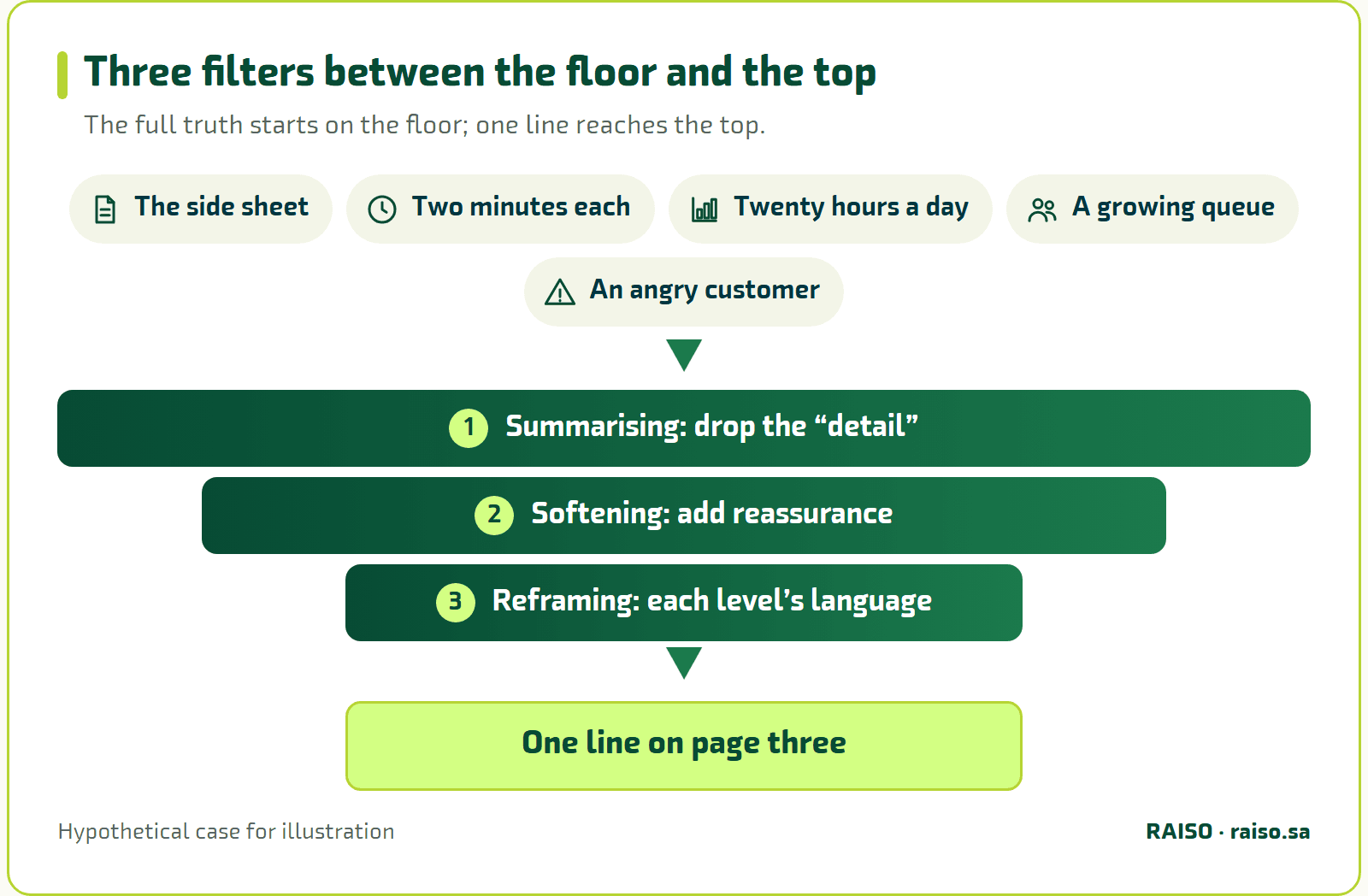
The real danger is not in any single step. Each looks innocent alone. The danger is in multiplying them by the number of floors. Four levels mean three rounds of summarising, softening and reframing. So the truth reaches the top changed in substance, and nobody carries responsibility for the change.
Where the case stands now: We can now point to what Mona's story lost at each hand-over. Between Mona and Saad the numbers were lost. Between Saad and Hind the sharpness was lost. Between Hind and Fahad the whole scene was lost.
“Apply it now: Take a report you sent or received recently and look for three phrases: one from which a number was dropped, one whose edge was softened, and one whose language was changed to suit the reader. For each, write the original version as the frontline would tell it.”
Why the messenger stays silent
You may ask: why does Mona not tell the whole truth from the start? Suppose she tried. Last week a colleague raised a similar complaint and was told: «You always find problems. What about solutions?» Mona saw that, and she learned the lesson. An employee who raises a problem may be labelled «negative» or «unable to solve things». Someone who submits rosy reports is thanked and promoted. That is how an organisation teaches its people, even without meaning to, to silence the truth before it is spoken.
This is not so much a question of personal ethics as of incentives. People respond rationally to what the organisation rewards and punishes. If raising a problem is personally costly and hiding it is comfortable, plain logic pushes toward hiding. Over time an organisational silence forms: everyone knows there is a problem and nobody dares to say so clearly.
Fear does not need to be explicit to work. It is enough for an employee to remember one occasion when a colleague was punished for frankness. The whole lesson is learned in a single go and passed on to the next person. So silence becomes a habit, and leadership is deprived of the most valuable thing it can have: early news of a mistake before it grows.
“The most dangerous thing in an organisation is not the problem leaders do not know about, but the problem everyone below knows about and nobody dares to raise.”
Where the case stands now: We understand why Mona settled for the word «slow». She is not hiding anything out of bad faith. She is protecting herself from an experience she watched happen.
“Apply it now: Recall the last time someone on your team raised bad news. What was your first reaction? Write down the exact sentence you said, then ask yourself: if I were in their place, would I raise something again next time?”
When the person judged reports on themselves
Beside fear sits a quieter force that matters just as much: incentives. Hind does not submit her monthly report because she loves polishing. Her department is assessed on the numbers she reports herself. When we ask a manager to report on her own performance and tie her evaluation to that performance, we place her between her interest in looking good and her duty to tell the truth. Most of the time, interest wins.
This conflict does not need bad intent to corrupt data. A manager who highlights achievements and plays down failures in good faith is simply responding to the system the organisation built. The fault is not in her, but in a design that makes the carrier of information the very beneficiary of polishing it. When the one who reports a number is also the one held accountable for it, we are asking her to be the judge in her own case.
The problem appears in forms well known in management literature, and Hind's report may contain some of them:
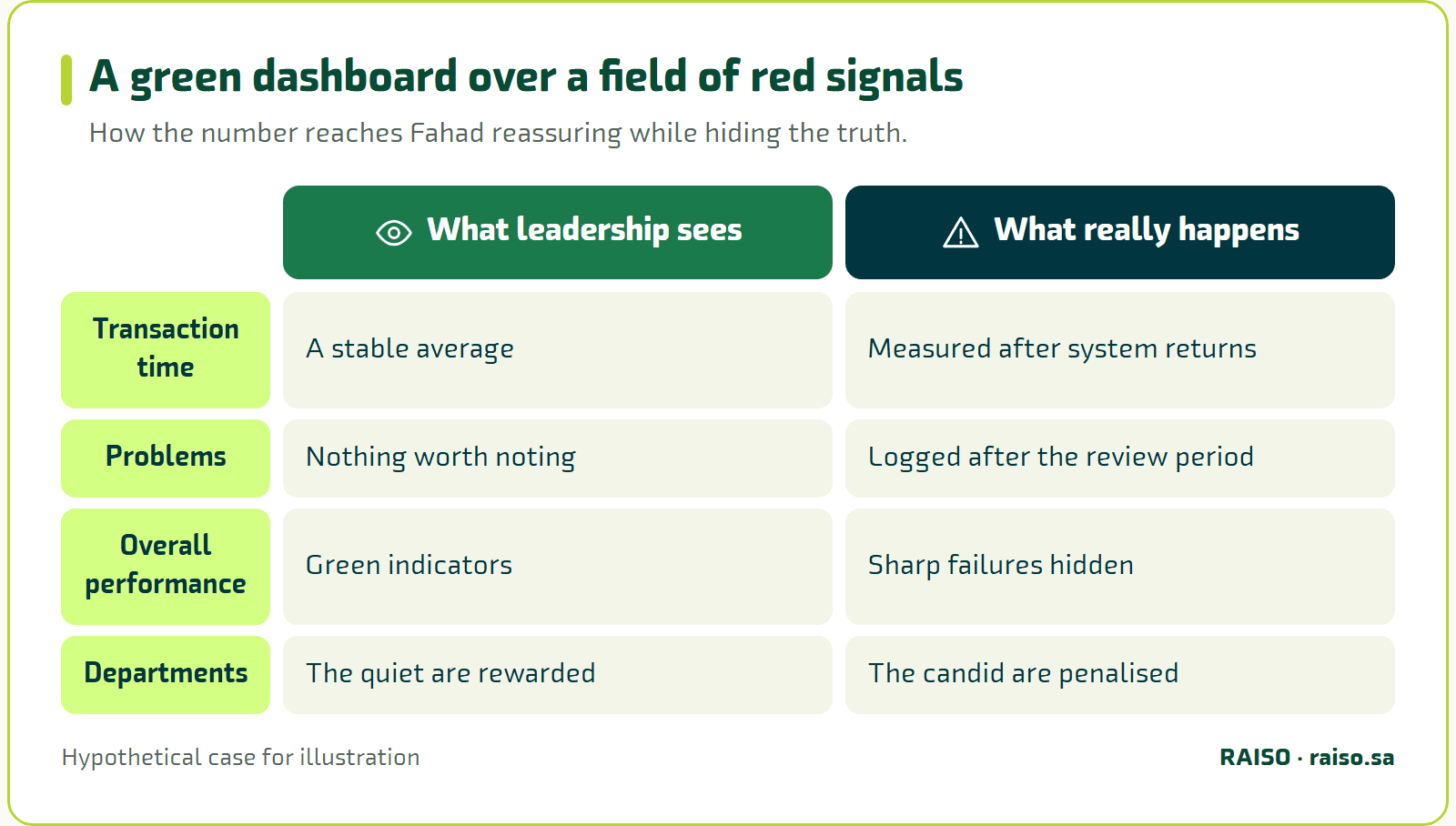
- Choosing the method or timing of measurement so that the number improves while performance does not, for instance measuring transaction time after the system comes back rather than from the moment the customer arrives.
- Improving the indicator at the expense of the goal: pouring effort into the measured number and neglecting the value it was meant to represent.
- Delaying the recording of problems until after the assessment period, or bringing achievements forward so they fall inside it.
- Showing averages that hide sharp failures behind seemingly stable performance.
When these combine, leadership ends up with a dashboard that is entirely green while reality is full of red signals nobody recorded. Worse, the greenness itself switches off alertness. Why look for a problem when the numbers say there is none?
Where the case stands now: Fahad's dashboard is green. The overall average transaction time looks acceptable because most transactions are quick, and Mona's slow ones vanish among them. The dashboard does not lie, but it does not show the problem.
“Apply it now: Choose one indicator on your dashboard and write: who measures it, and who is evaluated on it? If it is the same person, write down how a second party could check the number, even once a quarter.”
What does a polished reality cost?
Now we reach what Fahad actually cares about: what does he lose when he decides on a green dashboard? A decision is never more accurate than the information it rests on. And the greatest loss is not that leaders do not know, but that they think they know. Someone who knows he is ignorant moves carefully. Someone with false certainty makes bold decisions on a weak foundation.
Imagine what Fahad might do at his next meeting. He sees stable performance, so he decides to expand the centre with two new branches on the same system. The freezes multiply with the expansion, so do the side sheets, and so do the lost hours. Meanwhile Hind's department is rewarded for its green results, while another department that revealed its real figures, and with them real difficulties, is penalised. The gap widens between what leadership believes and what is really happening.
The most serious form of cost is surprise. An organisation living on reassuring reports loses its ability to see a crisis as it forms. Then it erupts all at once as what looks like a «sudden event», when in truth it is the outcome of many signals suppressed on their way up. Picture the system failing completely one day. Everyone will say it was unexpected. But Mona had known for months.
In the context of Saudi Vision 2030, where the pace of transformation is quickening and the stakes of decisions are growing in both public and private sectors, the cost of a polished reality is higher than ever. The speed of change multiplies the cost of a wrong decision as much as it multiplies the return on a right one. An organisation aiming for world-class performance cannot afford decisions built on comforting illusions.
“When information arrives polished, even the best decision becomes a well-executed mistake.”
Where the case stands now: The expansion decision is on the table, and if taken today it would be a well-executed mistake. So the question changes. It is no longer why the truth was late, but how to reach it before the decision is signed.
“Apply it now: Write down an important decision taken in your organisation last year, and name the information it was built on. Where did it come from? How many levels did it pass through? And did anyone see it at the place of work before it was approved?”
Step one: go to the gemba
If information distorts as it climbs, the simplest and deepest fix is for leaders to go down to where the truth is. This is the practice of «going to the gemba»: leaders do not settle for reading reports about work, but go and watch the work in its own place, with its real tools and its real pressures. It is not a ceremonial tour where the floor is tidied before the official arrives. It is a quiet visit whose aim is understanding, not inspection.
Imagine Fahad decides to spend next Monday morning in Mona's centre. He will see with his own eyes what no report brings him: the queue that grows, the screen that freezes, and the side sheet invented by the staff to keep work going. No clever dashboard replaces that direct viewing, because it carries reality as it is, not as it was told through intermediaries who each added a touch of their own.
But the visit has one condition that cannot be bargained over: the leader must come to learn, not to judge. If employees feel the visit is a disguised inspection, they fall back into defensive behaviour and show the polished version of their work, and the leader leaves with a false impression he takes for the truth. A visit succeeds or fails according to the leader's intention, language and questions.
| # | Behaviour during the visit | Compliant | Partly compliant | Non-compliant |
|---|---|---|---|---|
| Before I speak | ||||
| 1 | I asked “How does your work really go?”, not “Is everything fine?” | |||
| 2 | I asked about obstacles, not achievements | |||
| While listening | ||||
| 3 | I listened more than I spoke and did not defend the system | |||
| 4 | I did not blame anyone for what I heard | |||
| After the visit | ||||
| 5 | I thanked whoever revealed a real problem | |||
Rate your last or next visit to the real place of work.
Four rules that keep the visit from turning into an inspection:
- Ask «How does your work really go?» rather than «Is everything fine?». The first opens the conversation and the second closes it.
- Ask about obstacles, not achievements, because obstacles are what leadership needs to know.
- Listen more than you speak, and resist the urge to defend or justify the system.
- Thank whoever reveals a real problem, so the organisation learns that honesty is safe.
Where the case stands now: Fahad sits next to Mona for a full hour. He asks: «What slows you down most?» She shows him the side sheet. He counts with her the transactions that ran late. In that first hour he learns about the case what three monthly reports never told him.
“Apply it now: Put one hour in your diary this week at the actual place of work, with no escort and no file. Prepare three open questions beginning with «how» and «what», and record what you learned, not what pleased you.”
Step two: channels that bypass the hierarchy
Leaders cannot be in the field all the time. So the organisation needs channels that carry a signal upward without passing through every filter of the hierarchy. The idea is not to abolish the chain of command but to complete it with direct routes that let raw truth sometimes arrive without mediation. When the only road for information is the ladder, every problem will inevitably be softened before it arrives.
There are many practical forms. Leaders can look straight at raw operational data, such as actual transaction times and customer calls, instead of settling for summaries. A channel can be opened through which an employee sends a signal that reaches a higher level without passing every layer. And listening sessions can be held regularly with frontline staff, away from their direct managers. What they share is that they shorten the distance between the source of the truth and the decision maker.
| Channel | What it brings | Condition for credibility |
|---|---|---|
| Raw operational data | Actual transaction times and customer calls, unsummarised | It is read and used for decisions |
| Direct signal channel | An employee’s signal reaches a higher level skipping layers | Every signal is answered and has an effect |
| Listening sessions | Regular talks with frontline staff, away from their managers | No one is punished for what they said |
A channel succeeds through credibility, not through existing.
But a channel succeeds through credibility, not through existing. Imagine Mona uses a direct channel, raises her signal, and nothing happens. Or worse, it comes back to hurt her. The channel then dies quietly, and everyone learns it was decoration. A channel lives or dies by what happens after the first signal travels through it. So it is not enough for leaders to announce a channel. They must prove it at the first real test, and answer the sender with what was done.
Mature organisations do not rely on a single channel. They build a network of routes: the hierarchy for orderly summary, direct channels for critical signals, gemba visits for deep understanding, and raw data for independent checking. When routes multiply, no single filter can hide the whole truth, because what is softened on one route may arrive raw on another.
Where the case stands now: Fahad sets up a direct channel through which any employee can send a short signal to his office. Mona sends her first: «Two hours a day are lost to manual data entry.» Fahad answers her the same day, saying her signal arrived and that he has opened a follow-up file. That reply is what will keep the channel alive.
“Apply it now: Write in two lines how a frontline employee can get a signal to you with no intermediaries. If you cannot find a way, that is your first piece of news. If you can, write down when it was last used and what happened afterwards.”
Step three: safety first, sight second
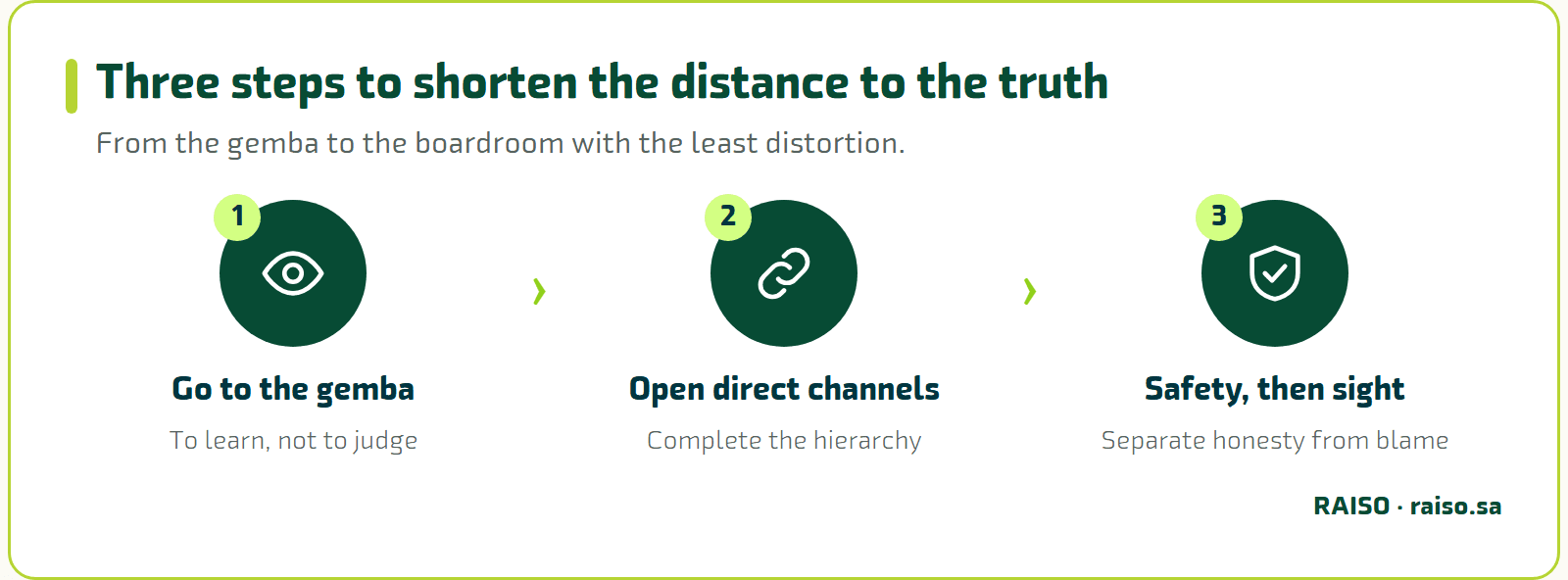
An organisation can build the best channels and send its leaders to the field every week, and still the truth stays hidden. The reason is that all these tools stand on one foundation: «psychological safety», a shared belief that raising a problem, a mistake or a hard question will not expose the person to punishment or humiliation. Without that foundation, all the tools become a stage on which a polished version of reality is performed.
Psychological safety does not mean the absence of accountability. It means separating the telling of truth from punishment for telling it. A mature organisation holds people firmly accountable for performance, yet rewards honesty in revealing it. Whoever hides a problem is held to account for the hiding. Whoever reveals one early is thanked for it, even when the problem lies in their own area. With this distinction, the organisation's culture moves from blame to learning.
Building safety is first of all a leadership duty, because a leader draws, by daily behaviour, the line between safe and risky. It shows up in concrete practices:
- The leader admits mistakes openly, proving that admission is respectable behaviour, not a danger.
- The one who carries bad news is not punished merely for carrying it. The message is not the messenger.
- Raising risks early is rewarded even if the risks never materialise, to encourage alertness.
- Everyone can see that raised signals are taken seriously and have an effect.
Beside safety comes direct operational sight: leaders seeing for themselves instead of being told. The closer they are to raw data, the fewer filters stand between them and the truth. The aim is to design systems so that reality shows up in time: indicators that reflect what is happening now rather than last month, data that shows the sharp cases and not only soft averages, and the ability to drop from an «average time» figure to one particular transaction that sat waiting for four minutes.
But direct sight is a double-edged sword. If it becomes a live surveillance tool used for instant blame, we are back at the start: employees learn to polish what the systems see, just as they used to polish what the reports said. Sight gives leaders the eye, and safety is what makes sure that what the eye sees is real. So use it to learn and to verify, not to hunt and to punish.
Where the case stands now: When Fahad saw the side sheet, he did not say to Mona: «Why didn't you report this before?» He thanked her for the sheet and asked what she needed. And he asked Hind to add a new indicator to her dashboard showing the slowest ten per cent of transactions, not the average alone. In this case the truth now rises because rising is comfortable.
“Apply it now: At your next meeting, when someone presents a problem, do not comment on the mistakes in the first minute. Instead say thank you, then ask one question about what they need to solve it. Then notice how many new problems are brought to you in the following weeks.”
What you carry with you
We followed a single piece of news from Mona's desk to Fahad's boardroom. We saw that the truth lives at the gemba and weakens as it climbs through three forces: summarising, softening and reframing. We saw that fear and incentives multiply the effect, and that a decision built on a polished reality is a well-executed mistake. Then we tried what brings the truth back on course: leaders going to the field to learn, channels that bypass the hierarchy and are honoured with a reply, safety in speaking up that is protected, and leaders seeing raw data themselves.
An organisation that sees itself as it is does not appear by accident. It is built by a leadership decision that prefers the uncomfortable truth to false reassurance, and that rewards the person who says «we have a problem» more than the one who says «all is well». The distance between the gemba and the boardroom will never vanish. But what crosses it is a reflection of what leadership rewards and what it punishes.
So ask yourself this before closing the article: when I am told that all is well, is it because all is well, or because I have built an organisation that does not dare tell me otherwise?
Start this week with one visit to the real place of work, and one channel to which you can answer every signal. And if you want to build this practice in your organisation with an orderly method, explore RAISO's quality management practice, and the courses that train your teams to go to the gemba and handle the signals raised.