



Do We Really Understand How Our Organization Works?
Majed was about to sign a contract for a new customer complaint management system. The presentation was convincing, the vendor confident, and senior management enthusiastic. Before he put his signature down, he asked himself a plain question that seemed ordinary to him: do I know how a complaint is handled here today, step by step? He tried writing the steps on a sheet of paper, and stopped after the third one.
This article is about that unfinished sheet. We follow Majed, an operations director in a hypothetical service organization, as he asks three managers about the same process and gets three different answers. Then we look at why this gap between what we think happens and what actually happens forms, what it costs the organization, and how a leader can start closing it with a practical method. At the end of each section is a short exercise to try in your own organization.
Majed asks three managers
Majed decided to postpone signing by a day. He invited three managers who know the complaints process well, one at a time, and asked each the same question: how exactly is a complaint handled here? Who receives it, what are the steps, who approves what, and where does it end up?
Fahd, the customer service manager, answered confidently: the complaint reaches the employee through the electronic form, who logs and classifies it, refers it to the relevant department, and closes it after a week. He said this has been written in the manual for five years.
Sarah, the quality manager, gave a more attractive answer: a complaint is logged within an hour, its root causes are analyzed, the customer is contacted within two days, and the causes of recurrence are addressed. She described the process as it ought to be, and she was convinced it was what happens.
Tariq, the operations manager, said: I receive the complaint from customer service as soon as it is transferred, and I handle it within two days. What comes before and after is not something I know. He described his own scope accurately, and assumed the rest of the chain runs as it should.
Majed sat in front of three answers that disagreed on the number of steps, on the closing time and on who holds the decision. Nobody lied and nobody was careless. All of them were honest, and all were describing different processes that carry the same name.
“Three honest answers about one process mean the organization does not understand itself as well as it thinks.”
“Majed, Fahd, Sarah, Tariq and the numbers in this article are hypothetical, made up for illustration, and refer to no real organization.”
| Manager | What they said about complaints | What are they really describing? |
|---|---|---|
| Fahd Customer service | Form, logging, referral, then closure after a week | What the manual said five years ago |
| Sarah Quality | Logged in an hour, contact in two days, root causes fixed | The process as it ought to be |
| Tariq Operations | I receive it after transfer and handle it in two days | Only the part his team touches |
All are honest, and all describe a different process with the same name.
Majed reflected. If he signed the contract the next day, which process would be automated? Fahd's old one? Sarah's ideal one? Or the part Tariq knows? He would have been buying a system for a process whose shape he did not know.
“The case now: Majed has not signed. And he now holds an uncomfortable but valuable question: if three managers cannot agree on the process, who knows how it really works?”
“Try it now: Pick one process you think you understand completely. Ask three people involved in it, one at a time, how it works. Write down their answers without correcting anyone, and compare them.”
The map is not the territory
Why did the answers differ? A well-known phrase in the study of knowledge says: “the map is not the territory.” A map is a useful representation of reality, but it is not reality. It leaves things out, simplifies, and freezes what moves. The territory, the land itself, changes every day.
And an organization is full of maps. The organizational chart is a map of authority: who reports to whom. The process map represents flow: which step follows which. The procedures manual is a written description of steps. The problem is not that these maps exist, since they are necessary. The problem is that we confuse them with the land, and judge the organization by its representation rather than by its reality.
The organizational chart, for instance, tells you who reports to whom, but not how work gets done. A customer complaint does not respect the boxes of the chart. It passes through customer service, then operations, then finance if compensation is involved, then quality. It moves horizontally across departments, while the chart draws vertical lines. A leader who understands the organization through its chart alone knows who is responsible, but not how value flows to the customer.
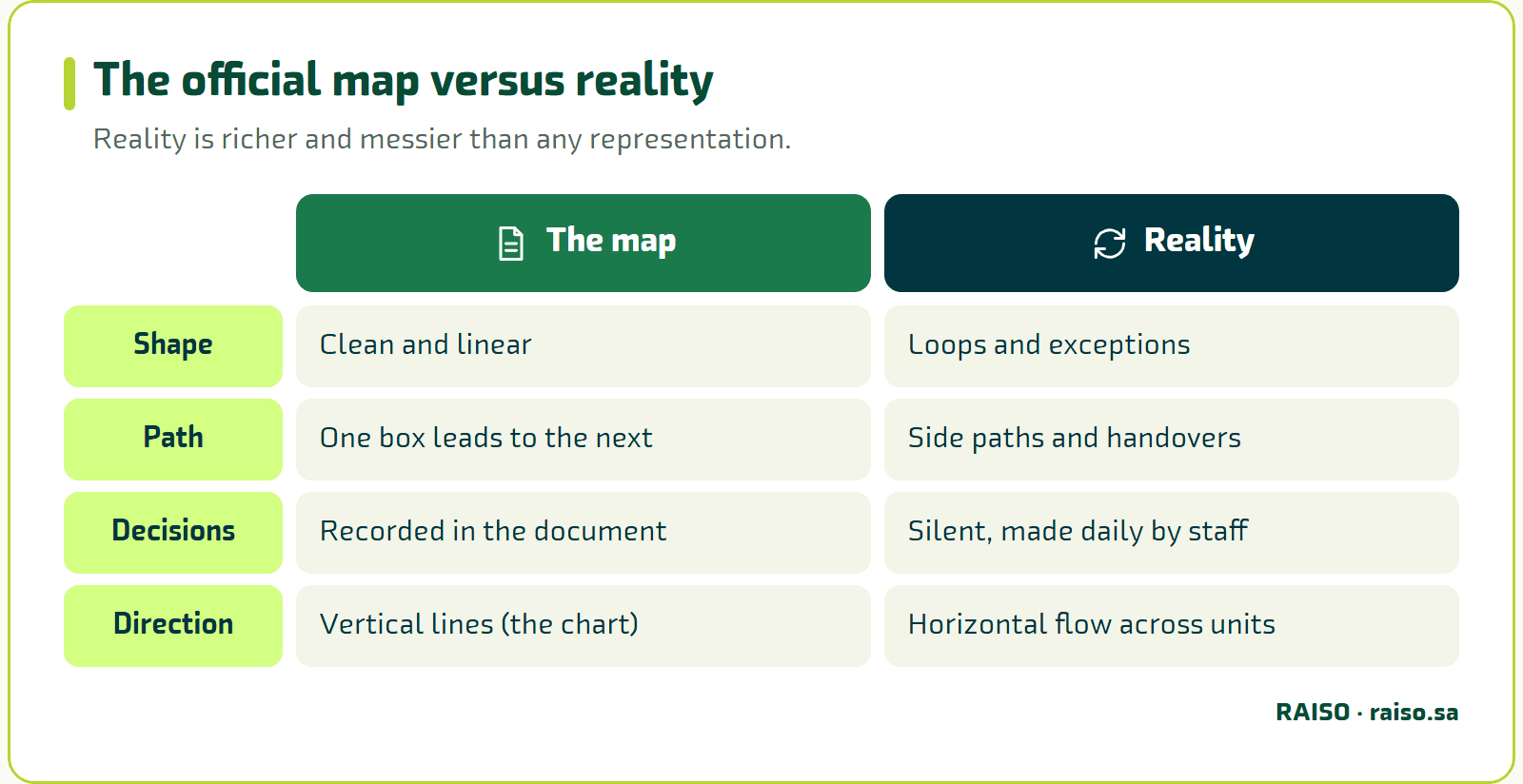
Putting the official map beside reality makes the gap clearer. The map is clean and linear: one box leads to the next. Reality is full of loops, exceptions and side paths, and of silent decisions that employees make every day without recording them anywhere. This is not a drawing error. It is a property of every human system: reality is always richer and messier than any representation of it.
The real danger begins when we forget that a map is a map. Then we take big decisions, such as automation, restructuring and cost cutting, on the basis of a simplified picture of an organization we no longer see as it is. And we are surprised when the decisions produce opposite results, because we improved the map and left the land as it was.
“The case now: Majed realized that the manual hanging in Fahd's department is a map, and that the vendor's presentation is another map. What remained was to see the land.”
“Try it now: List the maps your organization uses to describe one process: the chart, the procedures manual, the diagram. When did you last compare any of them with what actually happens?”
Four kinds of answers
Let us return to Majed's three managers, because their answers are not an administrative anecdote but a diagnostic window. Each answer shows a different pattern of misunderstanding, and understanding these patterns is the first step to closing the gap.
Here are the four patterns, three of which appeared in Majed's case:
- The design answer: what Fahd said. He describes the process as written in the original document, unaware that it has evolved or eroded since. He is honest, but he is describing the past.
- The aspiration answer: what Sarah said. She describes the process as it should be, and in good faith blends reality with the ideal. She describes an organization better than the one that exists.
- The part answer: what Tariq said. He accurately describes the part his team touches, and assumes the rest of the chain works as it should. Precise within his scope, blind beyond it.
- The reality answer: and it is rare. A manager who recently went to the field and saw how things really happen, with all the exceptions. This is the most valuable answer and the rarest.
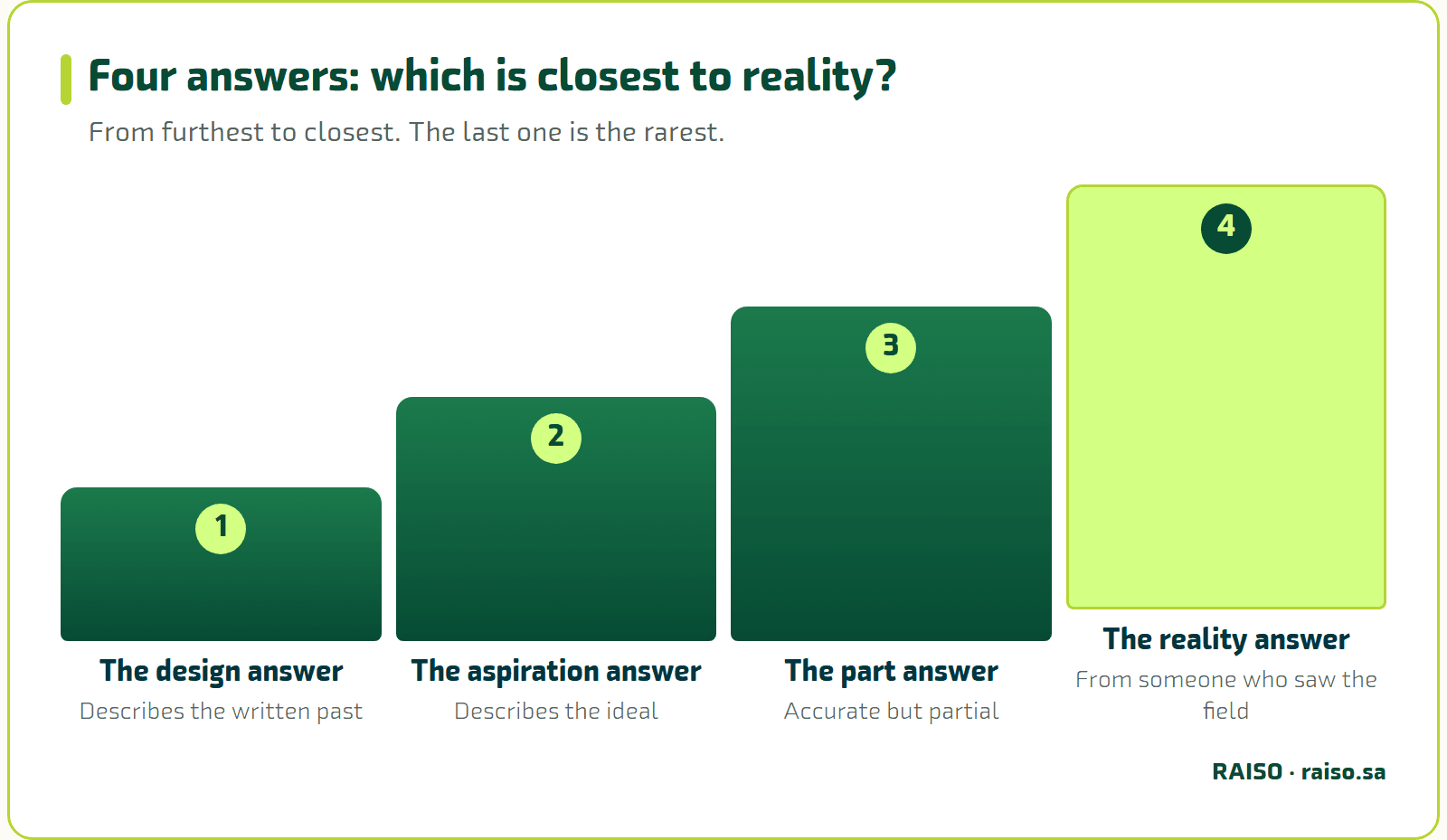
What stands out is that each of them is convinced he or she knows. That is the heart of the problem. They are like people touching different parts of a large elephant, then describing the whole elephant from the part they touched. And when they gather around a table to decide something about the process, they do not only disagree on solutions. Without realizing it, they speak of different processes in their minds.
So the deep danger is not that someone is ignorant. The danger is that everyone knows partially and contradictorily, and takes it for complete and consistent knowledge. This variation is not limited to chaotic organizations. You will find it in mature, disciplined ones, because it is not a failure of discipline. It is a property of how operational knowledge is stored and distributed.
“The case now: Majed now sees why a discussion among the three managers at one table would not help, and why each of them would sincerely defend his or her own description.”
“Try it now: Classify the answers you gathered in the previous exercise: which is a design answer, which an aspiration, which a part, and did you find a reality answer?”
Why does the gap form? Five structural causes
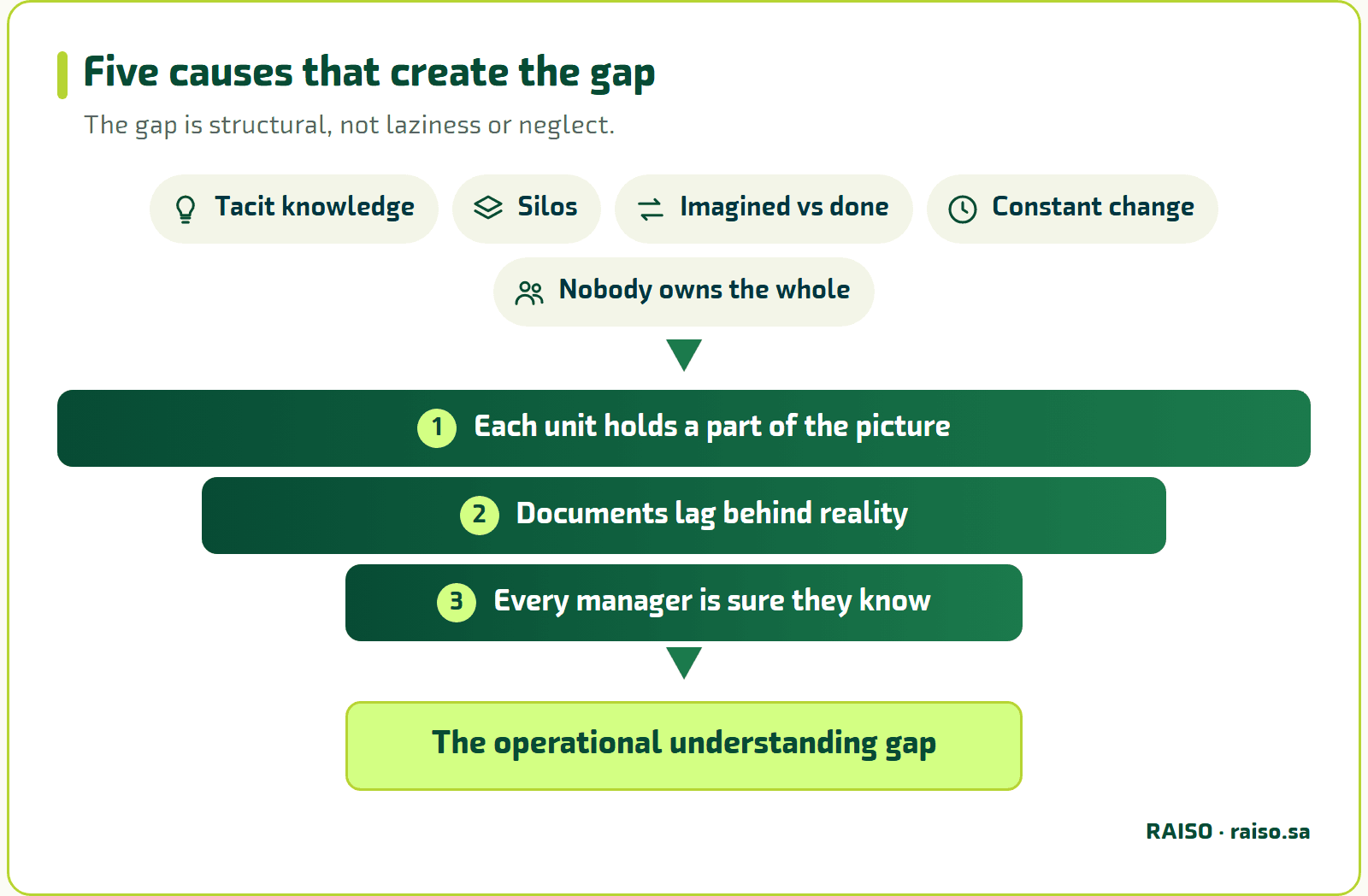
If the gap were laziness or carelessness, it could be closed with more discipline. But it is deeper than that. It is the product of five structural forces operating in every organization, regardless of its size or maturity. Majed found the mark of each of them in the complaints process.
- Tacit knowledge outweighs documented knowledge
Tacit knowledge is what the experienced employee knows and cannot find in any document. They know this customer needs special follow-up, that system goes down at month end, and approval is faster if you call someone directly. It is the oil that keeps the organization's gears turning, but it is invisible, does not transfer easily, and leaves with its owner. The more a process relies on it, the wider the gap between what is written and what is done.
- Silos fragment the picture
Organizations arrange themselves in units: customer service, operations, finance, quality. This helps specialization and accountability. But it creates silos, closed units each seeing part of the process and not the whole. Horizontal processes, the most important ones since they create value for the customer, become orphans: each part has an owner, and nobody owns the whole.
- Work as imagined differs from work as done
Work as imagined is what designers and leaders think happens. Work as done is what people actually do under the pressure of reality. The gap between them is not a deviation to be eradicated. It is a natural phenomenon: procedures are designed for ideal conditions, and work is done in imperfect ones. The employee who bypasses a step to finish on time is often the one keeping the process alive despite its design flaws.
- Constant change keeps documents behind
Systems change, people come and go, and new requirements arrive. With every change the real process evolves immediately because people adapt, while the document lags, if it is ever updated. Reality changes at the speed of human adaptation, and documents change at the speed of administrative procedure. As long as the two speeds differ, the gap stays open.
- Nobody is charged with seeing the whole
In most organizations everyone is responsible for a part and nobody for the whole. Auditors check compliance, managers run their units, and top leadership looks at results. Overall operational understanding is nobody's explicit job, so it stays orphaned. This is the cause that unites all the others.
Notice how the causes show up in Majed's case. Fahd knows one part because of silos. Sarah describes the ideal because documents lag behind reality. All three rely on tacit knowledge that was never written down. And most important, none of them was charged with knowing the whole process, neither from the moment a complaint arrives to its end, nor beyond.
“An organization does not ignore its processes because someone failed. It ignores them because nobody was explicitly charged with knowing them whole.”
“The case now: Majed stopped blaming the three managers. He saw that the gap is a product of structure, and that a structure like this will not be fixed by a reprimand or by a new system.”
“Try it now: Ask: who in your organization is explicitly charged with knowing one main process from start to finish, across all departments? If you cannot find a name, that is your first discovery.”
The price of not knowing yourself
The operational understanding gap may look like a theoretical problem. But it translates into concrete costs the organization pays every day, even if they do not appear as a separate line in the expense list. In Majed's case the price was about to appear in the contract for the new system.
When an organization does not know how it really works, it pays on several fronts at once:
- Decisions built on illusion: we automate a flawed process and speed up the fault, and we redesign a step that works while leaving the struggling one as it is.
- Duplication and hidden work: when nobody sees the whole picture, work repeats across units, and shadow work appears that employees build to patch the gaps.
- Silent risks: the gap is where operational risks hide. What we do not see, we do not know where it can break, until it breaks suddenly.
- Fragility when people leave: when knowledge lives in heads and not in systems, one resignation can paralyze a whole process.
- Slow adaptation: an organization that does not understand itself cannot change itself quickly, because every change becomes a leap into the unknown.
There is a price more serious than these five: the lost opportunity. An organization that spends its energy putting out fires in processes it does not understand has no energy left for innovation or growth. It stays busy fixing what it cannot see, and blames its slowness on the market or competition, while the cause is inside.
You cannot improve what you do not understand, speed up what you cannot see, or trust numbers that describe an organization that no longer exists. And those same numbers feed budgets and targets, so a small illusion turns into big decisions.
“The case now: Majed counted what he was about to lose: a costly contract for a system that automates a process he does not know, and training employees on a path that may not exist in reality. So he decided to postpone the contract until he sees reality for himself.”
“Try it now: Pick a major decision your organization recently took on automation or change. Did it rest on a documented understanding of the process, or on the usual map?”
Process discovery: seeing what really happens
Closing the gap begins with an indispensable step: seeing the process as it is, not as we imagine it. This sight does not come from sitting in a meeting room drawing boxes on a whiteboard. It comes from going down to where the work is done. This practice is called process discovery. It is the opposite of process design: design starts from what should be, and discovery starts from what is.
Process discovery is not an audit or an inspection. The aim is not to catch violations but to understand the logic. When employees feel you came to understand them rather than to hold them to account, they open the doors of tacit knowledge that appears in no document. So the first rule of discovery is: do not come as an accuser, come as a learner.
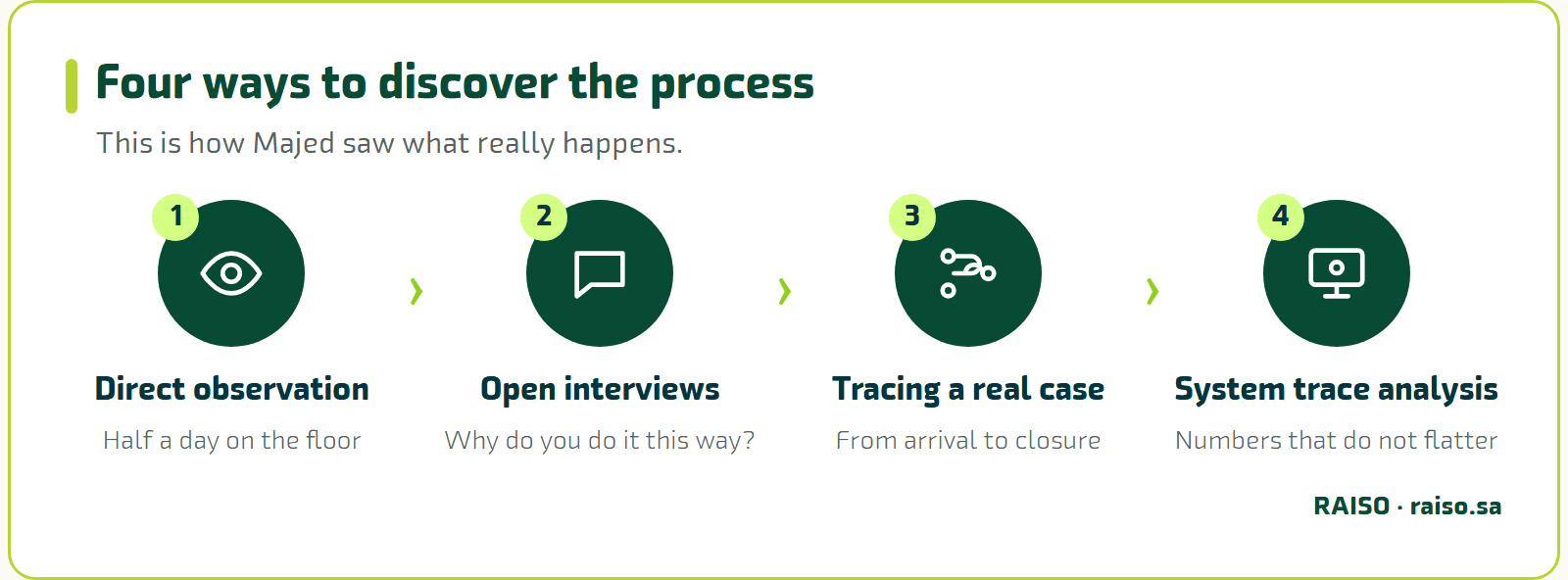
Majed went to the field and combined four methods:
- Direct observation
He sat beside Hessa, a customer service employee, for half a day and watched her work without directing her. He caught the real sequence, the exceptions, and the silent decisions nobody mentions when you ask because they have become obvious to them.
- Exploratory interviews
He asked open questions aimed at logic, not compliance: why do you do it this way? What happens if you follow the official step to the letter? When do you resort to a workaround?
- Tracing a real case
He took one real complaint and traced it from arrival to closure across all units. This horizontal tracing shows what no unit sees alone: delays between steps, lost handovers and loops back.
- System trace analysis
Digital systems record what actually happens: when the complaint was created, when it was referred, and how long it took between two steps. This data tells the story of the process in numbers that do not flatter, and reveals the gap between perceived time and actual time.
Majed discovered things that were in no document. A complaint often does not enter the electronic form, but arrives through an internal message group followed by Ahmed, a long-serving employee. Ahmed keeps a personal sheet recording repeated complaints, and refers urgent ones to Tariq by phone. Neither Fahd nor Sarah knew about this sheet, and it is what makes the process work in practice.
Here is an important irony. Had Majed learned this after signing the contract, the new system would have removed the sheet and the group together, and the process would have collapsed in the first week. Ahmed, without knowing it, was the real map of the process.
It is also important to resist the temptation to beautify what we find. The aim is to produce a more honest picture, not a prettier map. The mess that appears in the discovery picture is not a flaw in the drawing but information in itself. Every workaround reveals a gap in design, every wait reveals an obstacle, and every exception reveals a reality nobody had accounted for.
“The case now: Majed has a picture completely different from the hanging manual: steps never written, exceptions that became the rule, and a personal sheet carrying half the process. It is an unsettling picture, but a true one.”
“Try it now: Spend two hours beside someone carrying out the process you chose. Do not direct or correct them. Write down what they do, then ask: why did you do that here?”
From individual knowledge to a shared picture
Discovery reveals reality, but revealing alone is not enough. Knowledge that an individual discovers and then keeps in their head, or in an archived report, does not close the gap. It only moves it from one place to another. The further aim is building a shared operational picture: one visible, current understanding of how the organization works, shared by everyone who needs it.
A shared picture is not a dead document written once and forgotten. It is a living asset maintained continuously. It is wider than a process map: who owns each process, where processes intersect, what rules govern decisions, and where the known weak points are. When it exists, the three managers finally speak about the same process.
Building this picture needs more than a tool. It needs a change in culture and structure:
- Explicit ownership: each core process has a known owner responsible for understanding it whole across silos, not only a part.
- Living documentation, not archival: the document changes when reality changes, and does not freeze at the moment of writing.
- Transparency without blame: people will not reveal reality unless they feel safe from punishment. A culture that punishes workarounds pushes them into hiding, and one that understands them brings them out and treats their cause.
- Periodic maintenance: the picture ages like any asset, and needs regular review to bring it back in line with reality.
Majed took a simple and bold decision. He appointed an owner for the whole complaints process, and made Sarah play that role because she has a view of the final purpose. And he asked Ahmed, not to blame him but to thank him, to explain his sheet to everyone, so it became a visible part of the process instead of a secret in one man's hands.
When operational knowledge moves from individual heads to an institutional picture, the organization changes at its root. It becomes less fragile when people leave, quicker to adapt, and better able to take decisions built on reality, not illusion. And it moves from “the employees know” to “the organization knows.”
“The case now: The complaints process now has a shared picture and a clear owner. And when Majed went back to the vendor, he did not ask: what does your system do? He said: this is our real process, so show me how you serve it.”
| # | Step | What to do | Done | Partly | Not started |
|---|---|---|---|---|---|
| 1 | Choose one process | One that touches the customer or uses many resources | |||
| 2 | Run the three-answers test | Ask three people involved, one at a time | |||
| 3 | Go to the field | A full day watching the real execution | |||
| 4 | Trace one whole case | Record every wait, handover and workaround | |||
| 5 | Draw reality, not the ideal | Document what you saw, mess included | |||
| 6 | Turn understanding into a decision | Redesign, empower, document or assign ownership |
Tick what you have done on one high-impact process.
“Try it now: Write the name of the person you think best placed to own your chosen process from start to finish, and in one line: what authority is missing that they need in order to play the role?”
How can a leader start this week?
Closing the operational understanding gap is a long project, but it starts with small steps that any leader can begin this week, without a large budget. The idea is to begin with one important process and learn from it, not to understand the whole organization at once. These are the steps Majed followed.
- Choose one high-impact process
Begin with a process that touches the customer directly or consumes many resources. Customer complaints were Majed's choice.
- Run the three-answers experiment
Ask three people involved, one at a time. The size of the variation between their answers is a direct measure of how wide your operational gap is.
- Go to the field
Spend a day watching the process being carried out. What you see with your own eyes will differ from what you are told, and that difference is the gap itself.
- Trace one whole case
Take a real request and trace it through every unit. Record every wait, every handover and every workaround.
- Draw reality, not the ideal
Document what you really saw with all its mess, not what should be.
- Turn understanding into a decision
Every gap you find should lead to action: redesign, empowerment, documentation or assigning ownership. Understanding that does not turn into action remains an intellectual luxury.
More important than the steps is the shift in mindset. When a leader starts by assuming that he or she does not know how the organization really works, not out of false modesty but out of realism, a door to real learning opens. A leader who assumes he or she knows closes that door before opening it.
And patience is needed. A gap that built up over years of tacit knowledge, silos and constant change will not close in one workshop. But every process understood as it really is narrows the gap a little, and builds a new organizational muscle: the habit of looking at reality instead of settling for the map.
“The case now: Two months later, Majed has two processes understood and a list of four more waiting their turn. And he no longer signs a contract before he has seen the land himself.”
“Try it now: Block a full day in your calendar within the next two weeks to go to the field. Write down the process you will observe and the name of the person you will sit beside.”
What you take with you
Go back to the sheet on which Majed stopped writing after the third step. That pause was the most valuable thing that happened to him that week. Because an organization that knows itself operationally holds an advantage that is hard to copy: it improves precisely because it knows where the fault is, adapts quickly because it knows what it will move, and trusts its decisions because they rest on reality, not illusion.
Take five ideas with you from this article:
- The map is not the territory: the chart, the manual and the diagram are representations, not reality.
- Three honest answers about one process are a symptom of a structural gap, and not individual failure.
- Five forces create the gap: tacit knowledge, silos, work as imagined versus done, lagging documents, and the absence of anyone seeing the whole.
- Process discovery starts by going to the field as a learner, not an accuser.
- A shared picture with explicit ownership and living documentation turns individual knowledge into the organization's knowledge.
Now put the question to yourself: if I were asked how my organization works, would I describe my real organization or my picture of it? An honest answer is the first step on the road. And if you want to learn how to discover processes, build a shared operational picture and turn what you see into improvement decisions, explore RAISO's process management practice and the courses that take your team to the field and teach discovery on its own real processes.